 >
>

China Perspective Issues
BOOK REVIEWS
Projecting Images of China: Star House as a Shopping Centre between Red China and Self-Orientalism, 1960s–1970s
Henry Sze Hang Choi is Lecturer in China General Education China Programme, Office of University General Education, at the Chinese University of Hong Kong, Room 802A, Heung Yeung Shing Building, CUHK, Shatin, Hong Kong SAR (henrychoi@cuhk.edu.hk).
Introduction
New scholarship on the Cold War in Hong Kong has emerged in the past two decades, offering a fresh perspective for understanding the Cold War within the East Asian context. Starting with Chi-kwan Mark (2004), the Cold War in Hong Kong is analysed through the lens of great power rivalry, focusing on military defence, covert intelligence, diplomacy, and economics. Christopher Sutton (2017) highlights Hong Kong’s proactive role in addressing the Communist threat through stringent public order measures. Pricilla Roberts and John M. Carroll’s (2016) edited volume makes a major contribution to studies on Cold War Hong Kong. Why do stories about Hong Kong matter in Cold War studies? The rules of the global Cold War established by the US and USSR were sometimes disregarded in Hong Kong. The Cold War in East Asia developed its own internal dynamics and trajectories, independent of the major powers’ influence. Describing Hong Kong as the “Berlin of the East” can therefore be misleading, as Hong Kong was never a physically divided city as Berlin was. Instead, Hong Kong accommodated “fractured and conflicting loyalties and identities” of different Chinese political and cultural factions in the same city (Szonyi and Liu 2010: 7; Roberts and Carroll 2016: 26-8). Recent studies on Cold War Hong Kong within the framework of “Cold War cities” in East Asia speak about the polarised ideologies of capitalism and communism – Hong Kong was a liminal space that invited confrontation and negotiation between both ideologies (Hon 2022: 2-3). New landmarks in Hong Kong, such as Sung Wong Toi Garden in Kowloon Bay and the Benjamin Franklin Centre at the Chinese University of Hong Kong (CUHK) in the New Territories, were conscious attempts by the British colonial government to make Hong Kong an ideological part of the Western Bloc. In these landmarks, the icons of cultural China[1] represented a cultural battle against communism (Hon and Chan 2023).
The Tsim Sha Tsui (TST) waterfront, a four-kilometre promenade situated between Ocean Terminal[2] and Hung Hom, on the tip of the Kowloon Peninsula, became the focal point of Hong Kong’s post-World War II transformation from the hub of transit trade with Mainland China into a site for attracting “free-world” tourists. Current research works on the region by scholars such as Henry Sze Hang Choi (2019) and Elton Chan (2020) focus on the demolition of the old TST Railway Station in 1978, the commercialisation of the former marine police headquarters which has been restored and transformed into a tourism site and luxurious shopping mall (renamed “1881 Heritage” after its revitalisation), and the waterfront promenade as public spaces from the 1970s to 2010s; however, they do not set their analysis within the Cold War context.
The role of TST changed drastically after 1950, when Hong Kong’s seamless connection with Mainland China was severed during the Korean War,[3] and Hong Kong’s connections with Western countries (especially the US) grew exponentially. Postwar American travel writings noted Asia’s accessibility to American tourists. These writings saw Hong Kong as “a capsule of China” within the round-the-world tourism network of the “free world” (Klein 2003: 104-5). The year 1967 was significant for tourism in the world and Hong Kong specifically. The United Nations designated 1967 as International Tourist Year, with the slogan of “Tourism – Passport to Peace” for the world, and especially developing countries to follow (HKTA 1967a). Taking both this context and the one of the Cold War into account, this paper will illustrate how the images of Orientalised China and Red China coexisted at Star House, a unique liminal space where tourism activities and consumption facilitated peace between different ideological camps.
During the Cold War era, Hong Kong was not an isolated island in the world trend of tourism development. Since 1961, the rise of cheaper and convenient transportation options, such as commercial air jet travel, had driven the global expansion of international tourism for the masses (UNESCO 1966). Mirroring the United Nations’ call for removing red tape to facilitate international tourism in the early 1960s, the Hong Kong government relaxed its visa policy towards free world tourists.[4] Even during the 1967 riots, Hong Kong successfully attracted visitors from Europe, North America, and South America (Government of Hong Kong 1968). In the 1960s, a large number of foreign visitors came to Hong Kong by air or ship, and Ocean Terminal and the Peninsula Hotel[5] transformed TST from a “Gateway to China”[6] before World War II to a “Gateway to the world” during the Cold War.
Starting in the late 1950s, Hong Kong tried to become a highly attractive tourist centre in Asia by consciously “combining the exotic, flavorful atmosphere of the East with the well-policed comfort and orderliness of the West” (Time 1960). To foreign visitors (especially from the US), Hong Kong was a “tourism space” to be “imaged, constructed, and used differently by foreign visitors and foreign governments” (Mark 2016: 168). For example, British visitors found Hong Kong’s British colonial characteristics and exotic Eastern cultural elements particularly appealing (Sum and So 2004: 119-21), while American military personnel (sailors) came to find their imagined “Suzie Wong” (Mark 2016: 168). A winner in an essay competition organised by the Victoria Junior Chambre of Commerce and Hong Kong Tourist Association (HKTA) in 1967 offered the following words on Hong Kong’s Orientalisation: “[Hong Kong] should be its own Oriental, exotic self, not try to be another London – or Peking” (South China Morning Post, hereafter SCMP 1967a: 2). Therefore, in the 1960s, the unique cultural combination of East and West were crucial for the success of Hong Kong’s tourism and shopping industry.
Kowloon Wharf and Godown Company Limited and pro-PRC tycoon Henry Fok built Ocean Terminal and Star House, respectively, on the ruins of piers and warehouses. Inaugurated in TST during the social unrest of 1966–1967, these venues exemplified Hong Kong as a shopping and business paradise, with business being done despite the riots. Ocean Terminal, both a pier and a shopping centre, aimed to give foreign visitors an exquisite experience (especially those who came to Hong Kong on ocean cruisers) in dining, shopping, and entertainment. Star House concentrated on selling Chinese cultural products that satisfied visitors’ desire for Oriental exoticism. Ocean Terminal and Star House established Hong Kong as the “Pearl of the Orient” and an accessible cosmopolitan global destination identifying as both an Eastern and a Western city. For the West, Hong Kong was on par with international cities such as London, Paris, and New York. People in Hong Kong had multilingual skills and offered multifarious services to an international transcultural sensitivity. For the East, Hong Kong was a replacement for China, which was inaccessible to Westerners due to the Cold War and was just starting its Cultural Revolution.
Apart from privately-run tourism facilities, the official government presentation of Hong Kong during the Cold War period also deserves examination. According to Lok-yin Law’s research on the marketing strategies of the HKTA, a government-subsided organisation created in 1957, the period from the 1950s to the 1970s was crucial for Hong Kong in establishing itself as a tourist attraction with Chinese folk culture. This occurred within an Orientalist framework that remained detached from the ideological Cold War in Asia, and was particularly aimed at American tourists. Not until the 1980s and the 1990s did genuine historical sites and monuments like walled villages in the New Territories become tourism and public education resources. However, cultural tourism rather than heritage tourism remained the promotional focus of the HKTA. These strategies were epitomised at artificial theme parks such as Sung Dynasty Village (1979–1997) at the privately-run Lai Chi Kok Amusement Park (also known as Lai Yuen), and Middle Kingdom Village at the government-subsided Ocean Park developed in the 1990s (Law 2024). As shown in the second half of this paper, the HKTA-sponsored Harbour Village at Star House was the precursor of these theme parks, representing an effort by Hong Kong business figures to create an “Orient” that was disconnected from Hong Kong society and the realities of China.
This paper examines the different images of “authenticated” and “imagined” China presented at Star House. I focus on Star House for two reasons. First, it was the political and cultural icon of China. Star House subtly represented the presence of Communist China in the British colony of Hong Kong. Built by pro-PRC tycoon Henry Fok and later sold to Hongkong Land, Star House was geographically, ideologically, and culturally a mini “Chinatown” within the “Westerner’s stronghold.” Second, Star House was more than a commercial hub selling merchandise; it served as a gigantic showroom of various emblems of China for foreign tourists’ consumption. Star House had two cultural representations. First, authentic Chinese food and Chinese cultural products like handmade artifacts; visitors felt they were in China – a forbidden land during the Cold War. Second, the presence of an orchestrated exotic place and culturally different people that catered to the visitor’s desire and satisfied their search for a Westernised vision of Orientalised China.
In the second half of this paper, I will examine how Star House was a commercial property with various roles for different countries. There were bazaars, restaurants, museums, and exhibition halls that highlighted Chinese culture and products. For countries outside of China, it served as a centre for cultural organisations from Britain and Germany and other commercial entities. Star House appeared like a gigantic showroom, where Hong Kong businesses thematised each floor with multifarious representations of China (which included Hong Kong as the Pearl of the Orient). The representations were multilayered: a PRC capital-run exhibition hall highlighted a modern China, a British capital-run bazaar presented an Orientalised view of China, and a local artist-run wax museum showcasing Chinese historical figures as exotic interpretations aimed at satisfying an Orientalised gaze and nostalgia. This approach rendered Star House particularly attractive to foreign visitors. Unsurprisingly, Hong Kong’s business community made clear attempts to Orientalise China, and thereby reflected their own self-Orientalism.
“The Orient is Hong Kong”: Hong Kong’s move toward Orientalisation
In 1965, the Information Director for North America of the HKTA observed that overseas travel writers and welfare organisations were keen to construct negative public images of Hong Kong, focusing on tales of prostitution, slums, homeless refugees, triad gang activities, and drug addiction in the Kowloon Walled City. The HKTA had therefore been fighting a publicity battle for Hong Kong since the late 1950s. Its campaign promoted excellent shopping deals, top-notch hotels, beautiful beaches, and wonderful restaurants as Hong Kong’s new attractions to Western tourists (Lo 1965).
Western standards of comfort and recreation were not appealing enough for tourists. Portuguese architect Alfredo Alvares noted that Hong Kong would be more attractive to tourists if it was “an Oriental city,” and not “a smaller version of New York” (SCMP 1964: 4). An anonymous female English visitor to Hong Kong, quoted in a South China Morning Post article, also asked: “Is Hong Kong going too Western? Do you think I could see something more Chinese now?” She further argued that modern arcades, Americanised hotels, and bathing beauties dressed in Western styles made Hong Kong just “another town in the Western world.” Therefore, according to the visitor, what tourists wanted to see was a Hong Kong with the “old-style charm of Eastern young women,” men dressed in “silken long gowns,” Chinese food served on rare porcelain, and hotels fitting into an Eastern setting (SCMP 1962: 10).
In an article for its members titled “Orientalising Hong Kong,” and published in 1965, the HKTA argued that the Chinese media’s claims of tourists’ desire to see “an Oriental city” was exaggerated. The HKTA then argued that Hong Kong “has never been a Chinese city,” but instead was “an artificial place” created by the British out of a “barren rock” – a description applied to Hong Kong by Lord Palmerston in 1840 – with the assistance of the Chinese. The true allure of Hong Kong therefore lay in being “not completely British, yet not totally Chinese; partly Occidental, and also partly Oriental” (HKTA 1965). In doing so, the HKTA took part in the Orientalisation of Hong Kong as a marketing process to bring American tourists to the city in the 1960s. In 1966, the HKTA joined with three airline companies to launch a promotional programme named “The Orient Salutes America” in 14 American cities. The programme featured talks on the Orient, accompanied by photographic slides, as well as Chinese dance and opera performances by two Cathay Pacific Airline hostesses (HKTA 1966).
Historians and sociologists have examined the construction of different Oriental images of post-World War II Hong Kong by American TV drama series like American Broadcasting Company’s Hong Kong (1960–1961), and films like Soldier of Fortune (1955), and the HKTA’s marketing strategies. Traditional mandarin gown (cheongsam 長衫) and Manchu queue hairstyles that modernised local Hong Kong residents rarely adopted actually, were combined with Chinese fishing junks, sampans, rickshaws, Chinese religious mythology figures, and local Chinese arts and crafts, as well as the traditional Chinese practice of divination, playing mahjong, and incense burning, to become typical signifiers of the Orient ready for commodification, marketing, and consumption. These signifiers presented Hong Kong as an exotic, mystical, and Oriental city that satisfied the Western gaze at Eastern “otherness” while maintaining a safe cultural distance from Mainland China (Sum and So 2004: 120-1; Mark 2016; Choi 2018: 50-64; Yuen 2021: 208-12; Law 2023). In the 1960s and 1970s, Chinese junks, cheongsam ladies, rickshaws, Tiger Balm Garden,[7] sampans, and Chinese dragons were Oriental elements that frequently appeared in HKTA and airline promotional posters.[8]
This paper draws on Edward Said’s theory of Orientalism to analyse this Orientalisation process in 1960s and 1970s Hong Kong. Said defined Orientalism as “a style of thought based upon an ontological and epistemological distinction made between ‘the Orient’ and (…) ‘the Occident.’” As Said put it, Orientalism was originally based on a long European tradition of colonisation of the Orient (composed of Middle East and East Asia), making the Orient here not imaginative but as part of the Occident. America viewed the Orient in a different way. Due to its military campaigns in Japan, Korea, and Indochina from the 1940s to the 1970s, the American view of the Orient was more realistic and also more relevant to East Asia (Said 1979: 1-2).
Grace Yan and Carla Almeida Santos note the importance of examining the dynamic relationship between Orientalism and modernity in tourist discourse. They quoted Dirlik’s analysis of self-Orientalism as an “extension of Orientalism” (1996) where “the Orient itself participates in its construction, reinforcement and circulation” (Yan and Santos 2009: 297). They state that there are two facets of self-Orientalism. The first one is the internalisation of Orientalist discourse. For example, the Great Wall, originally military fortifications against nomadic invasions in history, was regarded by Jesuit missionaries as the symbol of “Oriental glory.” Hence, such Western perceptions made contemporary China to adopt the Great Wall as a national identity symbol. The second, a result of the Orient’s pursuit of modernity, is an assumption of its inability to meet the Western standards of modernity (Duara 1995; Dirlik 1996; Yan and Santos 2009: 298). The Orientalist perceptions held by tourists are fuelled by exotic images of the past and overlooking the recent developments of the host society (Ooi 2005: 288).
The HKTA had two approaches in its early 1970s marketing strategy. Since becoming a British colony in the 1840s, Hong Kong was depicted by Britain as a “fishing village.” Even after a century of Hong Kong’s evolution into a hub for entrepot trade with modern steamships and container ships, the image of a Chinese junk remained the logo of the HKTA, promoting Hong Kong’s public image internationally. This icon continues to represent the Hong Kong Tourism Board, the HKTA’s successor, even today. This is the first trope of self-Orientalism, driven by touristic interest. HKTA-authorised travel guides in 1958 stated that “Hong Kong is remarkably clean, peaceful and healthy – especially by Eastern standards”; “Hong Kong is the English-speaking gateway to the Orient” (HKTA 1958). These statements implied that the Orient could not match Western public hygiene and security standards, while Hong Kong could because of its history as a British colony. This aligns with the second facet of self-Orientalism. In essence, merely achieving Western modernity is insufficient to attract Western tourists to Hong Kong; instead, the primary facet of self-Orientalism, which involves making Hong Kong “Orientalised,” is more crucial for drawing in visitors.
While American sanctions on Star House in the mid-1960s were eye-catching, this paper rather focuses on the everyday cultural Cold War at Star House instead of the great power rivalry involving the US, Britain, and the PRC behind the scenes. Through textual and visual analysis of travel guides, tourism reports, newspaper accounts, and postcard images, I examine how the self-Orientalism of Hong Kong business figures played an active role in the Orientalisation of Hong Kong. By analysing the representation of China at the height of the Cold War, I highlight the interconnectedness between Orientalism as an act of objectifying the other, and self-Orientalism as an act of subjecting oneself to the gaze of the other. Although there is a polarised relationship between the observer and the observed, Orientalism and self-Orientalism are interlinked because the observer’s need to see creates a demand for the observed to show. In the tourism industry, where profit is generated by catering to the observer’s gaze, the observed must align with the observer’s imagination. The observed must subjectively objectify itself in order to satisfy the observer.
Star House: Red China within the Westerner’s stronghold
During the Cold War, Hong Kong served as a unique window for Red China’s connection to the West, and a watchtower for the US to contain the expansion of Chinese Communism (Fu 2018: 2). The history of Star House highlights this aspect of Hong Kong. Formerly named Kowloon Commercial Centre (KCC) before Hongkong Land’s purchase, Star House was constructed and managed by a syndicate that included Henry Fok and Macau tycoon Stanley Ho (SCMP 1968a: 12). Hong Kong’s role as a watchtower for the US was made clear in 1967–1968 when the American consulate in Hong Kong blacklisted KCC and announced that shops in the KCC were forbidden to sell American-manufactured products. Meanwhile, Hong Kong government put pressure on government-franchised telecommunication company from providing telecommunication connections to the building due to Henry Fok’s alleged aid to the PRC during the Korean War. This forced Henry Fok to relinquish his ownership of the building. After the British property development company Hongkong Land purchased the building from Henry Fok at a nominal price in May 1968, KCC was renamed Star House (xingguang hang 星光行) – a name which relates to the building’s proximity to the Kowloon Star Ferry Pier (SCMP 1968b: 15). Star House, then owned and managed by Western capital, continued to serve as a window to Red China as Hongkong Land allowed the PRC’s products and exhibitions in the building.
Star House was surrounded by Western-style shopping malls and pubs. Similarly, the PRC-owned Bank of China (BOC) building was located in Central, a place with a heavy concentration of Western-capital banks and firms in the 1960s. During the 1967 riots, the BOC building was a site for pro-Maoist propaganda and public rallies against British colonial rule. However, Star House took a less confrontational approach by embracing modern consumption and portraying more diverse images of Red and Orientalised China, which served the tourists’ Oriental gaze and the nostalgia for Chinese folk culture among local residents.
Considering Hong Kong’s commercial value and its proximity to Mainland China, Britain was the first Western country to diplomatically recognise the PRC. It adopted a policy of accommodating PRC commercial activities in Hong Kong if they abided by Hong Kong law. Yet, Britain still needed to maintain a special friendship with the US (Mark 2004: 19-25). Britain allowed American agencies to covertly gather intelligence on Communist China through Hong Kong (Lombardo 2000: 64-7). The Hong Kong government did not stop US actions against the KCC and also did not publicly intervene in the lawful business operations of PRC enterprises at Star House. Nonetheless, before Hongkong Land took over the building, Fok still managed to lease one-third of KCC’s shop space (from the basement to the fifth floor) to local and international tenants such as Ding How Department Store, Star Bowl, La Bamba Restaurant, the Swiss-run Mido Far East Centre, and Seiko Service Centre (SCMP 1968c: 19, 1968d: 9). These shops and entertainment venues for bowling served both locals and tourists. Chinese merchants such as Henry Fok made good use of the signifiers of modern consumption brands and Oriental attractions to soften the building’s tone of Maoist ideology. For example, Seiko displayed its advertisement vertically on KCC’s exterior wall facing Canton Road. The banner was visible to pedestrians walking on Salisbury Road (Figure 1). Meanwhile, a batch of rickshaw pullers waiting on the street alongside Star House was an Oriental attraction for tourists.
Figure 1. Postcard showing Seiko’s advertisement banner on the exterior wall of Star House
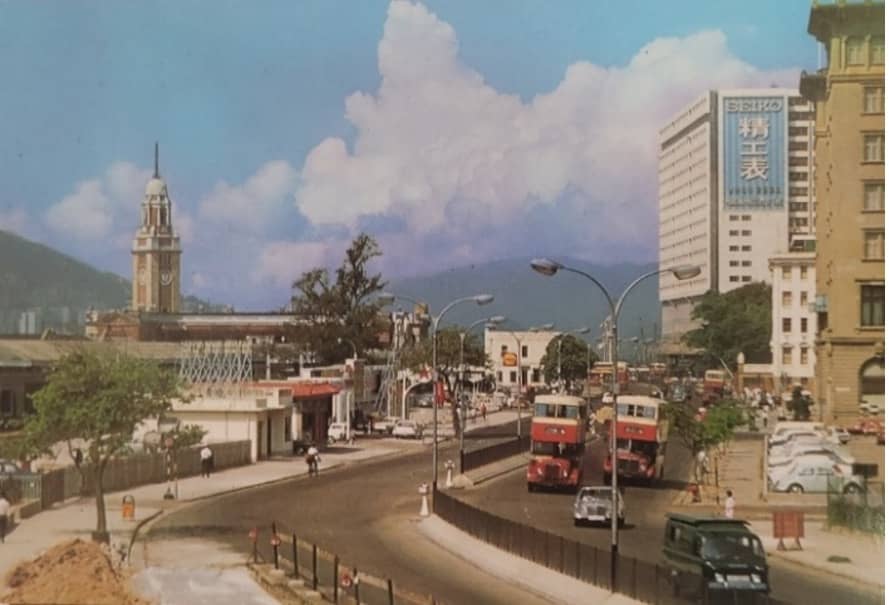 Credit: the author’s own collection.
During Fok’s ownership of KCC (from 1966 to May 1968), which coincided with the peak period of China’s Cultural Revolution, KCC displayed images of Chairman Mao surrounded by a cheering crowd and banners that celebrated the anniversary of the founding of the People’s Republic of China. These included the slogan “Hold high the great red banner of Mao Zedong thought” (Gaoju Mao Zedong sixiang weida hongqi fenyong qianjin 高舉毛澤東思想偉大紅旗奮勇前進), prominently facing the TST Star Ferry Bus Terminus. These politically charged billboards contrasted sharply with the apolitical local and international billboards at Ocean Terminal, such as those for the brands Philips, Yashica, Caltex, and Carlsberg (Figure 2).
The simultaneous existence of Ocean Terminal and Star House at the Western end of Victoria Harbour, close to the TST Star Ferry Pier and TST Railway Station, testified to a coexistence of capitalist consumption and Communist propaganda. This was a very specific spatial phenomenon in Cold War Asia.
Figure 2. Postcard showing Ocean Terminal and Star House on the left and right, respectively, around the late 1960s
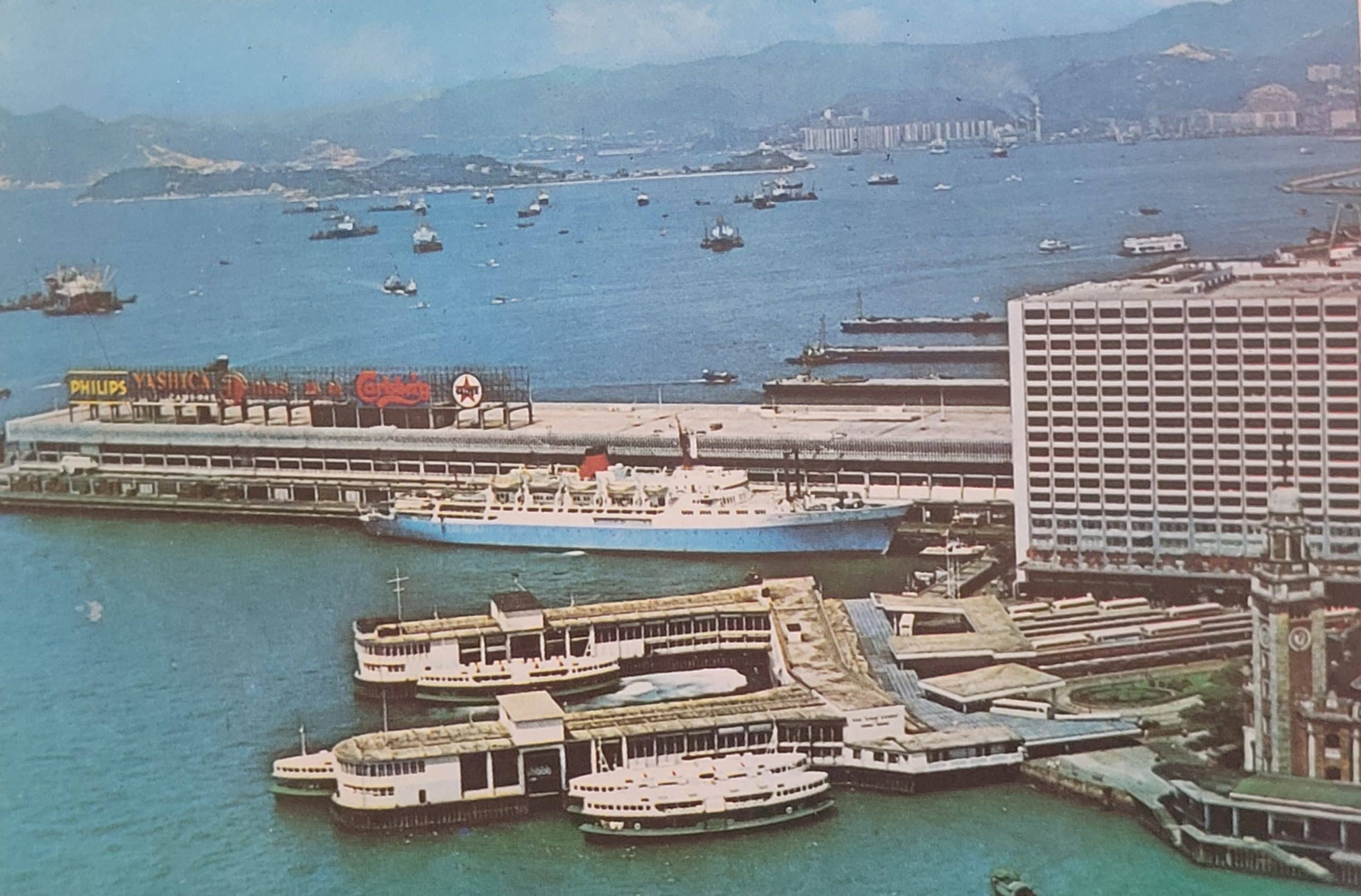 Credit: the author’s own collection.
Apart from the Maoist banners, two months before the outbreak of the 1967 riots, the Chinese Export Commodities Exhibition Hall, hereafter CECEH (Zhongguo chukou shangpin chenlie guan 中國出口商品陳列館), was inaugurated on the second floor of KCC. CECEH became an important venue for the public to learn about Maoism and the PRC’s recent economic and industrial development from 1967 until the late 1970s. CECEH was modelled on Guangzhou’s China Import and Export Fair (also called Canton Fair). China Advertising Company managed it under the authorisation of four state-owned enterprises: China Resources Company (Huarun gongsi 華潤公司), Teck Soon Hong (Dexinhang 德信行), Ng Fung Hong (Wufeng hang 五豐行), and China Hua Yuan Company Limited (Huayuan gongsi 華遠公司). CECEH used its main hall for thematic exhibitions. It had six other exhibition rooms that regularly showcased PRC-manufactured oils and foodstuffs, tea and native products like dehydrated vegetables, industrial products and minerals, animal by-products, textiles, and light industrial products. Since visa restrictions prohibited Western visitors from attending the Canton Fair, CECEH allowed foreign visitors to gain insights into socialist China (SCMP 1967b: 16; Ta Kung Pao 1967a: 4, 1967b: 5).
At the peak of the Cultural Revolution, CECEH became the venue for the display of Mao’s personality cult in Hong Kong. The entrance of the main hall featured a statue of Chairman Mao, alongside a painting of Mao standing with the Red Guards. In 1967, thousands of students from leftist schools visited the CECEH every day, each holding the little red book – Quotations from Chairman Mao – to take group photos with Mao’s statue. Some visitors bowed before Mao’s statue while others wrote on the guestbook: “Every exhibited item reflects the shine of the thought of Chairman Mao!” Hundreds of copies of Quotations from Chairman Mao and 500 Mao badges were sold daily. In April 1967, long queues of 2,000 students, workers, teachers, businessmen, and even farmers from the New Territories came to KCC every day. They waited three hours to get into the CECEH and bought Mao badges and Quotations from Chairman Mao with a special red-ink seal of the CECEH (Ta Kung Pao 1967c: 4, 1967d: 4).
Despite Americans forcing Henry Fok to surrender his ownership of KCC, Hongkong Land welcomed Chinese Arts and Crafts Co. (Zhongyi gongsi 中藝公司, CAC) to stay after acquiring the building. Located on the ground floor and first floor of KCC (SCMP 1968e: 1), CAC was Hong Kong’s sole distributor of PRC-manufactured arts and crafts before the 1970s. From 1967 onward, CAC had China Resources Company and Henry Fok as its primary shareholder and strategic investment shareholder, respectively. Despite CAC’s political and economic affiliation with the PRC and Fok, it still occupied the front side of the building facing the TST Star Ferry Pier. Because CAC sold traditional Chinese arts and crafts, it became a visible icon of Red China-made “Orientalised” China for pedestrians passing by the public concourse on buses or ferries every day.
To balance the political tone, Hongkong Land provided shop and office space to companies that sold Western or international products. Trading firms, stores, and organisations of different countries outside of China were located on the sixth to nineteenth floors of Star House. Apart from Chinese shops, there were three types of commercial organisations at Star House. First were de facto cultural or tourism institutions such as the Kowloon Library of the British Council, the Goethe-Institute German Cultural Centre, and Macau Tourist Information Bureau. Second were the offices or service centres of international firms such Chase Manhattan Bank, Coca-Cola Export Corporation, EMI (HK) Ltd., Manufacturers Life Insurance Co. of Canada, Schenker-ASG (HK) Ltd., Texas Instruments Asia Ltd., and Twentieth Century Fox (HK Inc.). Third were purveyors of Western dining and merchandise such as La Bamba Restaurant, Pacific Pearls Tokyo (Rudolf Voll) Ltd., and Star Watch & Jewellery Co.[9] Hongkong Land’s Star House achieved détente between the Eastern and Western Blocs by accommodating Red Chinese and foreign enterprises in the same building.
Throughout the 1970s, CECEH reduced promotion of the Maoist cult, and turned to promoting modern scientific achievements and recent industrial development of the PRC. It became the Hong Kong branch of the Canton Fair, serving as a platform to promote the PRC’s economic and industrial progress to foreigners and Hong Kong residents. When the Guangzhou–Kowloon train resumed operation in 1979, merchants from Hong Kong and abroad were able to attend the Canton Fair. That year marked the conclusion of CECEH’s historical mission.
Orientalism and self-Orientalism in Harbour Village
Hobsbawm defines “invented tradition” as a set of practices that seek to “inculcate certain values and norms of behaviour by repetition,” so it can establish continuity with “a suitable past” (2012: 1). Consequently, what practices of the past are deemed “suitable” and repetitive for the consumption of tourists visiting TST? These practices catered to the tourist’s need to gaze. Urry and Larsen (2011: 4-5) argue that the tourist gaze “is constructed through signs,” while tourism “involves the collection of signs.” In the case of France, tourists identify two people kissing in Paris as “timeless romantic Paris.” In other words, signs are cultural stereotypes recognised by tourists. Frenchness is not defined by French people themselves, but rather by tourist gaze. Current scholarship centres on the debates surrounding “Chineseness” as shown in Chinese diaspora and films in Cold War Asia and Hong Kong (Taylor and Xu 2022). This paper examines “Chineseness” in Hong Kong via tourism facilities. The specific case of Harbour Village (Xingguang cun 星光邨), which opened in November 1970 on the fourth floor of Star House, will examine the Western understanding of “suitable” signs regarding China’s past and “Chineseness” in 1970s Hong Kong.
As Said put it, “The Orient is the West’s flawed understanding of the East” (1979: 5-6). From this perspective, the images of traditional China in Harbour Village – a British capital-run bazaar in Star House – did not aim at representing the realities of China. Similarly, the West’s perception of the Orient would not succeed without proof: the self-Orientalism of the locals provided “authenticated” images of Oriental culture for the Westerner’s gaze. When tourism was Hong Kong’s major source of income during the Cold War,[10] Hong Kong’s entrepreneurs Orientalised the city to maximise their profits. According to a mid-1960s tourist survey, many foreign tourists disagreed that “Hong Kong looks ‘Oriental enough.’” Indeed, many Western tourists wished that all of East Asia become “more exotic,” meaning to look more mysterious and romantic (Neilan 1966: 4). The concept of “authenticity” stems from Western cultural views of the Orient, contrasting premodernity (considered authentic) and modernity (viewed as inauthentic). Therefore, modernisation would lead the exotic Orient to lose what Westerners wished to observe (Cole 2007: 944-5). Tourists are keen on seeking “authenticity” that reflects the images shown in travel brochures. These images therefore serve as the indicators of what is deemed authentic despite being pseudo-stereotypes (Adams 1984: 472). After two decades of postwar urban development, Hong Kong became a modernised, if not “Westernised” city. Hong Kong therefore needed to “Orientalise” itself in the 1960s and 1970s.
As a meeting place of East and West in the 1960s, Hong Kong had abundant cultural resources for Orientalisation. For instance, “The Orient is Hong Kong” and “The Orient is mystic” were signature slogans in HKTA posters and print advertisements promoting Hong Kong’s exotic image to the US, and by extension to the world (SCMP 1963: 6). During that time, American and British filmmakers also regarded Hong Kong as the “Mecca for Oriental locations.” Since they could not travel to China, they used Hong Kong’s geographical, cultural, and social milieu to portray stories related to China in their films (Bourke 1967).
An urgent call for Orientalising Hong Kong was made at an Urban Council meeting in June 1965. During the meeting, councillor Hilton Cheong-Leen 張有興 proposed that the Urban Council should cooperate with HKTA to form a committee to help find ways of “Orientalising Hong Kong” in response to tourists’ disappointment with Hong Kong’s lack of “real Oriental flavour” (SCMP 1965a: 6). Cheong-Leen later gave a talk called “Making Hong Kong more Oriental” at the Lions Club of Hong Kong, suggesting three ways to Orientalise Hong Kong: first, opening a wax museum featuring Chinese historical figures such as Confucius, Yang Guifei 楊貴妃 (the famous consort of the Tang dynasty), and famous Chinese film actress such as Linda Lin Dai 林黛 (who was active in the Hong Kong film industry in the 1950s and the 1960s); second, building an outdoor model of a Chinese village with willow bridges, pavilions, and summer-houses to give visitors a taste of traditional China; third, establishing a training centre for “Oriental craftsmen” in ivory, brassware, and silverware to upgrade folk-art design to attract tourists (SCMP 1965b: 6). These suggestions later inspired the development of Harbour Village in Star House and Sung Dynasty Village (a replica of a typical village in China during the Song dynasty) at Lai Yuen in the 1970s.
While not all of these ideas were put into action, they demonstrated an effort by Chinese political and commercial leaders in Hong Kong to Orientalise Hong Kong. A month after Cheong-Leen’s speech, a columnist for the Los Angeles Times wrote: “The Orientals are dissatisfied with Hong Kong. They want to ‘Orientalise’ the place to attract more tourists. (…) Just because it lies there spread across the tip of the Chinese Mainland doesn’t mean it’s Oriental enough.” The columnist criticised Cheong-Leen’s ideas of investing several million dollars in “dressing up” Hong Kong with Oriental attractions for tourists and the establishment of the wax museum as a “touristy flap” (Hulse 1965). The criticisms failed to alter the trend of Orientalising Hong Kong in publicity campaigns. The first nationwide promotion campaign of Hong Kong products in the US, held in autumn 1966, particularly emphasised Oriental flavour, as in the case of the Macy’s department store in Kansas City, where the promotion team set up a store “decorated with Chinese lanterns, and [whose] ledges (…) [were] trimmed with rickshaws, delicate Oriental umbrella, and Oriental garden effects” (SCMP 1965c: 1). This was because contemporary mass-tourism Americans “find pleasure in inauthentic contrived attractions, gullibly enjoying ‘pseudo-events’ and disregarding the ‘real’ world outside” (Urry 2011: 7-8). The indoor Orientalised Harbour Village was more appealing to tourists than the authentic Chinese traditional stalls on the streets of Hong Kong.
In the 1960s, Chinese wood carvings, traditional dragon boat races, and dim sum cuisine were “exotic attractions” in HKTA’s promotion film of Hong Kong (Law 2023: 228-9). Therefore, the images of China portrayed in these films were already ingrained in tourists’ minds before their arrival in Hong Kong. Western tourists from the 1960s to the 1970s were more drawn to the “authenticated” and timeless Chineseness in indoor shopping malls and tourist attractions, rather than the authentic Hong Kong visible on the streets. On the one hand, tourists wanted to see what they paid for. They were not keen to understand the then-Mainland China behind the Bamboo Curtain in the Communist Bloc, but rather what they imagined China to be. On the other hand, Hong Kong businesspeople discovered ways to shape tourists’ perceptions of China to generate income.
The colonial government of Hong Kong also found it safe to show an “authenticated” Chineseness that was cultural and apolitical. Affiliated with neither the PRC nor the Republic of China, it avoided inciting Chinese nationalism or ideological tensions between the Communist Bloc (PRC) and the Capitalist Bloc (ROC). When Hong Kong passed the peak of the 1967 riots in November, the Hong Kong government’s “Hong Kong Week” publicity campaign held two events at Ocean Terminal (the only privately-run venue among the otherwise government venues). The two events, “Craftsmen of HK” and “200 Years of Chinese Beauties,” featured live demonstrations of traditional Chinese folk culture and female models dressed as Qing dynasty empresses and Chinese brides from the Republican period (HKTA 1967b: 6; Wah Kiu Yat Po 1967: 2.3). Ocean Terminal was then temporarily transformed from a “Westerner’s stronghold” into a haven of Chineseness that attracted three-fourths of the audience of the “Hong Kong Week” events. Businessmen were more effective than the colonial government in expressing “Chineseness” to mitigate Maoism on the streets of Hong Kong.
Drawing on insights from past Orientalisation efforts, Harbour Village opened to the public in November 1970, occupying the entire fourth floor of Star House. This strategy played a crucial role in Hong Kong’s survival and growth under the threat of war in the global Cold War. Hongkong Land planned the venture, which was sponsored by the HKTA. Operated by Star Promotions Limited, a subsidiary of Hongkong Land, with Annie Wu Suk-ching 伍淑清 as its general manager, Harbour Village had a single purpose – to satisfy the Western desire to find its “China.” The media coverage highlighted that Harbour Village was constructed in an “authentic Chinese architectural style,” showcasing Chinese handmade folk art and customs that offered foreign tourists a taste of “Chineseness” in just one to two hours (SCMP 1970a: 7; Wah Kiu Yat Po 1973: 3.1) (Figure 3).
Figure 3. Advertisement for Harbour Village and Yee Tung Village in A-O-A Hong Kong Guidebook published in 1978
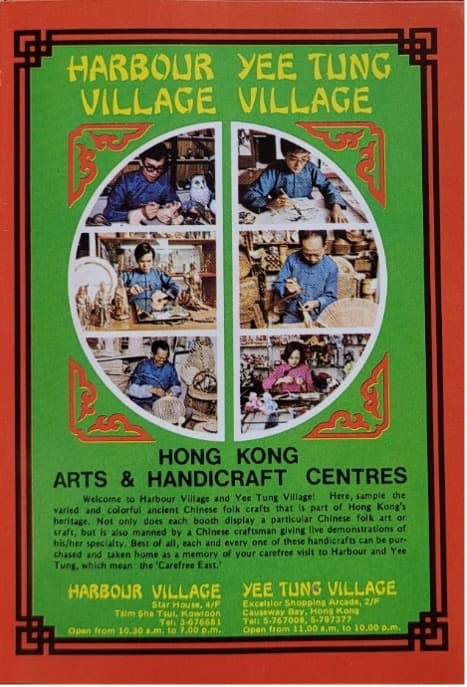 Credit: the author’s own collection.
Chineseness became a big part of Harbour Village to satiate the Westerner’s gaze. Harbour Village functioned as an indoor amusement Chinese village. A travel guide advertisement stated that “gwei-lo” (鬼佬, literally “foreign devil,” the Cantonese slang term for Westerners) would experience joy and amazement after visiting Harbour Village, where they could consume rare ginseng and learn their future from fortune-telling birds that answered queries by picking a card from a pile of envelopes under the direction of a fortune-teller. Both helped to immerse foreign visitors into China’s past (Sebastian and Leung 1978: 126-7). Other advertisements also referred to Harbour Village as “Chinese village life under one roof” and “Hong Kong’s only cultural centre that recreates the everyday skills and crafts that are distinctly Chinese.” Chineseness was presented in a variety of ways. There was a special exhibition on “authentic” Chinese Emperor dragon robes and ancient Chinese curios in the village’s showroom. Dragon-beard candy was sold at a stall as “an old imperial treat” (SCMP 1972: 4; Hayes 1975: 14). A live demonstration by chefs from the Jade Garden restaurant[11] cutting out a snake’s gallbladder to make nourishing Cantonese cuisine was another Oriental attraction (Wah Kiu Yat Po 1972: 4.1). These exhibited items or live demonstrations were rarely seen on the modernised streets of Hong Kong.
Harbour Village and its counterpart Yee Tung Village (怡東邨) in Causeway Bay were both modelled after the modern indoor Chinese bazaar (modeng da da di 摩登大笪地), but they differed from both the traditional bazaar (da da di)[12] and the modern shopping mall. Air-conditioned Harbour Village reflected a modernism that traditional open-air Chinese bazaars did not have. Conversely, Chinese folk products (tuchan 土產) were the symbols of folk style (tufeng 土風) that were not available in Hong Kong’s modern shopping malls such as Ocean Terminal.
What did folk style represent in Harbour Village? The owners of various stalls wore traditional Chinese suits known as cheongsam, and sold traditional Chinese handmade artifacts. The stalls also provided traditional Chinese medical consultation and fortune telling. An advertorial on Harbour Village mentioned that “Chinese nationals feel a sense of close acquaintance and foreign nationals feel interested” when consuming traditional Chinese folk products and watching traditional Chinese folk practices at Harbour Village (Wah Kiu Yat Po Colour Weekly 1977: 26). The general manager of Hongkong Land, Vernon Roberts, spoke of the uniqueness of Harbour Village with its entire architectural layout providing “an attractive Oriental flavour.” Shopkeepers and elderly craftsmen wore “authentic” Chinese costumes “to re-capture some of the romance of a time too soon to be swallowed up by modernisation, mechanisation and conformity” (HKTA 1970: 1).
In August 1970, Madame Vivian’s Wax Museum (MVWM) opened in Harbour Village. Inspired by Madame Tussaud, MVWM’s founder, Vivian Sun 孫惠文, introduced new art elements in making her wax figures (Hopper 1969: 9). These figures attracted the gaze of both foreign tourists and local Chinese residents. Wax figures of Chinese boat people, hawkers, rickshaw pullers, and opium smokers testified to the “exotic” Orient. The scenes of ancient corporal punishment and concubines’ bound feet brought up memories among local Chinese residents (SCMP 1970b: 7, 1971a: 10). Given Sun’s focus on nudes in her work, her international cultural outlook, and good understanding of the need for Orientalisation and nostalgia,[13] she was able to create a nude female wax figure of “Mrs Tang who breast-fed her sick mother-in-law,” a story from the classic text of Confucian filial piety The Twenty-four Filial Exemplars (ershisi xiao tu 二十四孝圖). This has to be considered in a context where feminised Chineseness was particularly appealing to Western tourists although such gesture of filial piety was no longer in practice in the societies of China and colonial Hong Kong.
Conclusion
Kowloon Wharf Piers No. 1 to No. 5, located at the Western end of the TST waterfront, witnessed the transformation of Hong Kong’s economy from the 1950s to the 1980s. From the 1960s to the 1980s, Kowloon Wharf Piers No. 1 to No. 4 were gradually rebuilt as Ocean Terminal and then Harbour City. They became Hong Kong and Asia’s most modern shopping malls for both Western tourists and local residents. The opening of China Hong Kong City at the old No. 5 Kowloon Wharf Pier in 1988 reclaimed TST’s pre-1949 connection with the Pearl River Delta. Establishing and redeveloping these piers helped the Kowloon Peninsula attract transshipment trade, international tourism, and Mainland Chinese tourism.[14] The outbreak of the Cultural Revolution in 1966, Ping-pong diplomacy in 1971, and the launch of the reform and opening policy in 1978 were the three significant political, diplomatic, and economic turning points of contemporary China. Star House attracted Western tourists to Asia (not including Mainland China) in the 1960s and 1970s, and adapted to these points in three phases. First, it accommodated the Maoist personality cult at the Chinese Export Commodities Exhibition Hall during the peak of the Cultural Revolution. Second, Harbour Village served the American gaze of China after the détente reached through Ping-pong diplomacy in the early 1970s. Third, the fading of Star House and TST as a Westerners’ tourist zone in the late 1970s coincided with Westerners’ ability to visit China starting in 1978. During this period, with the rise of Japanese economy and the fall of Western economy due to the oil crises, the Japanese became the largest source of foreign tourists in Hong Kong, and the formula of Orientalisation was therefore no longer effective for promoting Hong Kong tourism.
The signs of Red China and exotic China were visible to tourists when they visited Lok Ma Chau Lookout[15] and Tiger Balm Garden, respectively. However, these places were too far from Ocean Terminal and Kai Tak Airport. For short-haul tourists, Star House in the 1970s was the most accessible and convenient place, housing the finest aspects of traditional China, Red China, and Orientalised China. Star House was an ideal commercial and apolitical space for constructing an “Orientalised China” that was alien to local Chinese residents but highly appealing to the Orientalist gaze of Western tourists. In this sense, the coexistence of Red China capital and British capital behind the Chinese Art and Crafts Co., the Chinese Export Commodities Exhibition Hall, and Harbour Village at Star House became a liminal space engaging in self-Orientalism, cultural consumption, and tourism while also serving as a détente between the PRC and the West in the cultural Cold War.
Acknowledgements
This study is a continuation of the author’s project named “History of Tsim Sha Tsui Waterfront, Urban Development and Collective Memory of Common People,” funded by the Lord Wilson Heritage Trust in 2017–2019. The preliminary version of this paper was presented at the academic conference “Hong Kong Convergence: (Re)connection: Communication, and Contact,” held on 8 June 2024. I would like to thank the panel chair, Pr Tze-ki Hon, and the panelists, Dr Yu Chang and Dr Heidi Huang, for their stimulating ideas and warm encouragement during my whole process of writing this paper. I also thank the editorial team of China Perspectives and the three anonymous reviewers for their insightful comments and detailed suggestions on this manuscript.
Manuscript received on 27 September 2024. Accepted on 6 March 2025.
Primary sources
BOURKE, Terry. 1967 “Hongkong Mecca for Foreign Film-makers.” South China Morning Post. 11 September: p. 28.
HAYES, Holly. 1975. “Chinese Village Life Under One Roof.” South China Morning Post. 25 April: p. 14.
HONG KONG TOURIST ASSOCIATION (HKTA). 1958. Travellers Guide to Hong Kong. Hong Kong: Hong Kong Tourist Association.
———. 1965. “Orientalising Hong Kong.” News Views V(7). July: p. 1-2.
———. 1966. “‘The Orient Salutes America’ Promotion is Underway.” News Views VI(3). March: p. 2-4.
———. 1967a. Hong Kong Tourist Association Annual Report 1966/7. Hong Kong: Hong Kong Tourist Association.
———. 1967b. “November: Hong Kong a-go-go.” Hong Kong Travel Bulletin IX(10). October: p. 6.
———. 1970. “A Busy ‘Village’ on the Harbour.” Hong Kong Travel Bulletin XII(12). p. 1.
GOVERNMENT OF HONG KONG. 1968. Hong Kong Report for the Year 1967. Government Printer. 161-2.
HOFFMAN, Walter K. 1978. A-O-A Hong Kong Guidebook. Hong Kong: A-O-A Ltd.
HOPPER, Keith. 1969. “Vivian Sun Recreates the Past – in Wax.” South China Morning Post. 26 April: p. 9.
HULSE, Jerry. 1965. “Bringing Chopsticks to China.” The Los Angeles Times. 15 August: p. 116.
LO, Lorenzo. 1965. “Hongkong’s Changing Image Abroad.” South China Morning Post. 17 September: p. 34.
NEILAN, Edward. 1966. “Most Bonds Have Little Bounce.” Daily News-Post. 9 February: p. 4.
SEBASTIAN, Evelyn, and Betty Kit Man LEUNG. 1978. Hong Kong from A to Z: A Compact Guide to Enjoying Hong Kong (with a Bit of Cantonese to Save Your Life). San Diego: Gulliver Books.
SOUTH CHINA MORNING POST (SCMP). 1962. “Where West Meets West.” 17 September: p. 10.
———. 1963. “Number of Colony Visitors from the US Can Be Doubled.” 6 December: p. 6.
———. 1964. “Tourists Want to See an Oriental City, Not Another New York.” 29 March: p. 4.
———. 1965a. “Plans to Make HK More Colourful for Tourists.” 2 June: p. 6.
———. 1965b. “Museum Suggested to Make Colony More Oriental.” 3 July: p. 6.
———. 1965c. “Hongkong Display Captivates US Mid-West: Kansas City.” 15 November: p. 1.
———. 1967a. “Promotion Contest Draws Spot on Ideas.” 5 November: p. 2.
———. 1967b. “Chinese Export Commodities Exhibition Hall.” 4 February: p. 16.
———. 1968a. “HK Land Takes Over Kowloon Commercial Centre Today.” 20 May: p. 12.
———. 1968b. “Commercial Centre to Be Renamed.” 18 July: p. 15.
———. 1968c. “Inauguration of Mido Far East Centre Ltd Hong Kong.” 11 February: p. 19.
———. 1968d. “Thong Sia Co. Proudly Announces the Inauguration of Their New Premises and Seiko Service Centre.” 10 May: p. 9.
———. 1968e. “HK Land Buys Big Property in Tsimshatsui.” 4 May: p. 1.
———. 1969. “Attitudes to Nudes Changing.” 22 June: p. 26.
———. 1970a. “Harbour Village Opening Soon.” 26 October: p. 7.
———. 1970b. “Waxworks Draw for Tourists.” 29 August: p. 7.
———. 1971a. “Hongkong’s Madam Vivian Sun Waxes Very Eloquently.” 13 March: p. 10.
———. 1971b. “Wax Museum Firm Gets New Orders.” 4 April: p. 8.
———. 1972. “Special Exhibition at Harbour Village Showroom.” 6 March: p. 4.
TA KUNG PAO 大公報. 1967a. “中國出口商品陳列館昨天開幕” (Zhongguo chukou shangpin chenlie guan zuotian kaimu, Chinese Export Commodities Exhibition Hall opened yesterday). 5 February: p. 4.
———. 1967b. “中國出口商品陳列館受中外觀眾熱烈讚美” (Zhongguo chukou shangpin chenlie guan shou Zhong wai guanzhong relie zanmei, Chinese Export Commodities Exhibition Hall warmly praised by local and foreign visitors). 27 February: p. 5.
———. 1967c. “中國出口商品陳列館擴大供應毛主席著作” (Zhongguo chukou shangpin chenlie guan kuoda gongying Mao zhuxi zhuzuo, Chinese Export Commodities Exhibition Hall increases the supply of the works of Chairman Mao). 23 April: p. 4.
———. 1967d. “佩上新款毛主席像章語錄章兩千同胞喜洋洋” (Pei shang xinkuan Mao zhuxi xiang zhang yulu zhang liang qian tongbao xi yang yang, Two thousand compatriots happily wore badges of Chairman Mao and the Quotations from Chairman Mao). 24 April: p. 4.
UNESCO. 1966. “1967: International Tourist Year.” The UNESCO Courier. December 1966: p. 5-9.
TIME. 1960. “Hong Kong: The Fragrant Harbor.” 21 November: p. 28, 33-6.
WAH KIU YAT PO 華僑日報. 1967. “香港週各項展覽表演, 琳瑯滿目港督擊節稱賞” (Xianggang zhou ge xiang zhanlan biaoyan, lin lang man mu Gangdu ji jie cheng shang, Different exhibitions and performances at Hong Kong Week, Hong Kong Governor appreciates its wide variety of activities). 31 October: piece 2, p. 3.
———. 1972. “星光邨即景: 老畫師即席揮毫, 小蛇王當場攞胆” (Xingguang cun jijing: Lao huashi jixi huihao, xiao shewang dangchang luo dan, A sketch of Harbour Village: Old painter does live demonstration, little snake dealer cut snake’s gallbladder on the spot). 20 November: piece 4, p. 1.
———. 1973. “星光邨內遊客多, 大笪地五花八門” (Xingguang cun nei youke duo, da da di wu hua ba men, Harbour Village has many tourists, modern bazaar full of varieties). 16 April: piece 3, p. 1.
WAH KIU YAT PO COLOUR WEEKLY 彩色華僑. 1977. “怡東邨星光邨兩個摩登‘大笪地’” (Yidong cun Xingguang cun liang ge modeng “da da di,” Two modern bazaars: Yee Tung Village and Harbour Village). 10 July: p. 26.
References
ADAMS, Kathleen M. 1984. “Come to Tana Toraja, ‘Land of the Heavenly Kings’: Travel Agents as Brokers in Ethnicity.” Annals of Tourism Research 11: 469-85.
CHAN, Elton. 2020. “Public Space as Commodity: Social Production of the Hong Kong Waterfront.” Proceedings of the Institution of Civil Engineers–Urban Design and Planning 173(4): 146-55.
CHOI, Henry Sze Hang 蔡思行. 2018. 玩讀香港: 西方視野中的香港 (Wan du Xianggang: Xifang shiye zhong de Xianggang, Playing with Hong Kong history: Hong Kong under the lens of Westerners). Hong Kong: Cosmos Books.
———. 2019. 尖沙咀海濱: 歷史, 城市發展及大眾集體記憶 (Jianshazui haibin: Lishi, chengshi fazhan ji dazhong jiti jiyi, The history, development of city and collective memory of Tsim Sha Tsui seafront). Hong Kong: City University of Hong Kong Press.
COLE, Stroma. 2007. “Beyond Authenticity and Commodification.” Annals of Tourism Research 34(4): 943-60.
DIRLIK, Arif. 1996. “Chinese History and the Question of Orientalism.” History and Theory 35(4): 96-118.
DUARA, Prasenjit. 1995. Rescuing History from the Nation: Questioning Narratives of Modern China. Chicago: University of Chicago Press.
FU, Poshek. 2018. “More than Just Entertaining: Cinematic Containment and Asia’s Cold War in Hong Kong, 1949–1959.” Modern Chinese Literature and Culture 30(2): 1-55.
HOBSBAWN, Eric. 2012. “Introduction: Inventing Traditions.” In Eric HOBSBAWN, and Terence RANGER (eds.), The Invention of Tradition. Cambridge: Cambridge University Press. 1-15.
HON, Tze-ki (ed.). 2022. Cold War Cities: The Politics of Space in Europe and Asia during the 1950s. London: Routledge.
HON, Tze-ki, and Hok-yin CHAN. 2023. “A Historical Garden and a Student Centre: Two Memorial Landscapes to Reposition Hong Kong, 1959–1968.” Inter-Asia Cultural Studies 24(6): 1033-54.
KLEIN, Christina. 2003. Cold War Orientalism: Asia in the Middlebrow Imagination, 1945–1961. Berkeley: University of California Press.
LAW, Lok-yin. 2023. “The Orient is Hong Kong? Cultural Representations of Hong Kong in Tourism Materials and the Missing Voices of the Tourists.” In Catherine S. CHAN, and Tsang Wing MA (eds.), East Asia beyond the Archives: Missing Sources and Marginal Voices. Leiden: Leiden University Press. 221-42.
———. 2024. “From Exotic Orient to City with Heritage: Heritagisation in the Tourism History of Hong Kong.” Journal of Tourism History 16(3): 314-36.
LOMBARDO, Johannes R. 2000. “A Mission of Espionage, Intelligence and Psychological Operations: The American Consulate in Hong Kong, 1949–1964.” In Richard J. ALDRICH, Gary D. RAWNSLEY, and Ming-Yeh T. RAWNSLEY (eds.), The Clandestine Cold War in Asia, 1945–65: Western Intelligence, Propaganda and Special Operations. London: Frank Cass. 64-81.
MARK, Chi-kwan. 2004. The Cold War: Anglo-American Relations, 1949–1957. Oxford: Oxford University Press.
———. 2016. “Hong Kong as an International Tourism Space: The Politics of American Tourism in the 1960s.” In Priscilla ROBERTS, and John M. CARROLL (eds.), Hong Kong in the Cold War. Hong Kong: Hong Kong University Press. 160-82.
OOI, Can-seng. 2005. “The Orient Responds: Tourism, Orientalism and the National Museums of Singapore.” Tourism 53(4): 285-99.
ROBERTS, Priscilla, and John M. CARROLL (eds.). 2016. Hong Kong in the Cold War. Hong Kong: Hong Kong University Press.
SAID, Edward E. 1979. Orientalism. New York: Vintage Books.
SUM, Ngai-Ling, and Mei-Chi SO. 2004. “The Paradox of a Tourist Centre: Hong Kong as a Site of Play and a Place of Fear.” In Mimi SHELLER, and John URRY (eds.), Tourism Mobilities: Places to Play, Places in Play. London: Routledge. 119-30.
SUTTON, Christopher. 2017. Britain’s Cold War in Cyprus and Hong Kong: A Conflict of Empires. London: Palgrave Macmillan.
SZONYI, Michael, and Hong LIU. 2010. “Introduction: New Approaches to the Study of the Cold War in Asia.” In Yangwen ZHENG, Hong LIU, and Michael SZONYI (eds.), The Cold War in Asia: The Battle for Hearts and Minds. Leiden: Brill. 1-11.
TAYLOR, Jeremy E., and Lanjun XU (eds.). 2022. Chineseness and the Cold War: Contested Cultures and Diaspora in Southeast Asia and Hong Kong. London: Routledge.
URRY, John, and Jonas LARSEN. 2011. The Tourist Gaze 3.0. London: Sage Publications.
WANG, Gungwu. 2017. “Hong Kong’s Twentieth Century: The Global Setting.” In Priscilla ROBERTS, and John M. CARROLL (eds.), Hong Kong in the Cold War. Hong Kong: Hong Kong University Press. 1-14.
YAN, Grace, and Carla Almeida SANTOS. 2009. “‘CHINA, FOREVER’ Tourism Discourse and Self-Orientalism.” Annals of Tourism Research 36(2): 295-315.
YUEN, Chi 阮志. 2021. 從荒岩到東方之珠: 形塑香港的旅遊文化史 (Cong huangyan dao Dongfang zhi zhu: Xingsu Xianggang de lüyou wenhua shi, From a barren rock to the Pearl of Orient: A cultural history of Hong Kong tourism). Hong Kong: Sanlian chubanshe.
[1] The icons of cultural China refer to the construction and reconstruction of historical memory regarding the Song Emperor as in the memorial stone at the Sung Wong Toi Garden, and using Chinese as the medium of instruction at CUHK.
[2] Built in 1966 in Tsim Sha Tsui, Ocean Terminal was the world’s first ocean terminal with a shopping mall.
[3] Since October 1949, there had been travel restrictions between Guangdong Province and Hong Kong. Direct train service between Guangzhou and Kowloon was stopped. Passengers deboarded the train at Lo Wu or Shenzhen and walked across the Lo Wu Bridge for immigration inspection in the PRC or Hong Kong. Yet, during the first three decades of the Cold War, Hong Kong was “a convenient meeting place” for both the capitalist and socialist camps and a “conduit” that China used to engage with the outside world (Wang 2017: 1-14).
[4] By 1967, most nationals from Europe, North America, and South America were allowed to enter and stay in Hong Kong for up to one month without applying for visas, while many other nationals were permitted to transit through Hong Kong by sea or air without visas. They could also stay up to seven days.
[5] There was shuttle bus service between the Peninsula Hotel and Kai Tak Airport.
[6] The Tsim Sha Tsui Railway Station, opened in 1916, served as the terminus for the Kowloon-Canton Railway heading for Guangzhou and onward on a transnational railway route to Moscow.
[7] Tiger Balm Garden is a mansion built by British Burma-born Chinese merchant Aw Boon-Haw in 1935, with a garden featuring a Tiger Pagoda and artificial landscapes of the Buddhist after-life world. It was later opened to the public.
[8] See Hong Kong Travel Poster Collection held by Hong Kong Baptist University Library, https://bcc.lib.hkbu.edu.hk/artcollection/collection/travel-poster/ (accessed on 11 March 2025).
[9] Hong Kong Telephone Company, 1973, Telephone Directory: Kowloon & New Territories, October 1972, Hong Kong Telephone Company Limited.
[10] In 1966, the expenditure of foreign tourists and US military personnel in Hong Kong amounted to HKD one billion. The figures rose to 2.1 billion in 1971. See the Estimates of Gross Domestic Product, 1966-71, published in 1973, Hong Kong: Census and Statistics Department, p. 27.
[11] Jade Garden was the first Cantonese teahouse restaurant operated by Annie Wu’s family company, Maxim’s.
[12] The first 大笪地, which literally means “open area” in Cantonese, was established in front of the Macao Ferry Pier in Sheung Wan on Hong Kong Island after World War II. The area was a parking lot during the day and became an open-air night market from around 8 pm till midnight, earning the name Poor Man’s Night Club (Hoffman 1978: 63).
[13] Vivian Sun was born in Beijing and migrated to Hong Kong in 1958. She studied painting and sculpture at Académie Julian, a private art school in Paris. The wax museum in California’s Chinatown also displayed Sun’s wax figures depicting Chinese immigrants during the gold rush in California in 1849. Sun also produced Western oil paintings of nude women exhibited in the United States and Hong Kong (SCMP 1969: 26, 1971a: 10, 1971b: 8).
[14] Mainland Chinese tourism was facilitated by establishing Mainland travel agencies in Guangdong Province to organise “Hong Kong tours” in 1983.
[15] A tourist attraction site where visitors could watch the vast farmland of Red China on the north side of Shenzhen River.