 >
>

China Perspective Issues
BOOK REVIEWS
Neon Signs in Cold War Hong Kong: Between Language Politics and Visual Hybridisation
Ge Song is Assistant Professor in the Department of Linguistics and Modern Language Studies, The Education University of Hong Kong, B4-1/F-19, 10 Lo Ping Road, Tai Po, New Territories, Hong Kong (gsong@eduhk.hk; gsong1@ln.hk).
Introduction
During the second half of the twentieth century, Hong Kong’s neon signs held significant meaning, representing the city’s rich history and encounters with different languages and cultures (Kwok 2018a). The streets were filled with thousands of glowing signs for restaurants, nightclubs, pharmacies, and pawn shops. These signs extended horizontally into the streets, competing for space and creating a soft, luminous atmosphere at night. For decades, the appearance of Hong Kong was shaped by these handmade signs, which, to a large extent, signified the progress and energy of the city (Ribbat and Anthony 2013), leading to Hong Kong’s reputation as a “neon city” (Macgregor and Price 2002) and “the Pearl of the Orient” (Kwok 2018b: 73). Once unimaginable, the absence of neon signs in Hong Kong has become a stark reality today. Since the 2000s, the relentless redevelopment of old neighbourhoods, stricter government regulations, and the widespread adoption of LED advertisements have led to the rapid disappearance of most neon signs, which were once synonymous with Hong Kong’s visual landscape.
From the 1960s to 1970s, Hong Kong became a frontline city caught, in general, between the heavily fortified Soviet-led Eastern and US-led Western Blocs in the Cold War, and in particular, between two competing forces: China, the country it had been part of before 1841, and Britain, the imperial power that colonised it from 1841 onward (England 2023). In the meantime, hundreds of thousands of people flooded into British Hong Kong, driven out by socialist China’s land reforms (in the early 1950s), Anti-rightist Campaign (1957–1959), the Great Famine (1959–1961), and the Cultural Revolution (1966–1976). At the height of the Cold War in East Asia – marked by the founding of the People’s Republic of China (PRC) in 1949, the Korean War (1950–1953), and the US involvement in Vietnam (1965–1975) – Hong Kong constituted a “liminal space” for the contestation of power between the Eastern and Western Blocs (Hon and Chan 2022: 88). Cold War was “a distinct and critical period” during which Hong Kong was fundamentally transformed (Roberts 2016: 15).
The geopolitical neutrality brought about by balanced tensions allowed multiple powers to coexist, and turned Hong Kong into a Cold War “contact zone” (Pratt 1992), in which colonialism, communism, and anticommunism were “neutralised” at the point at which they met (Li 2021: 241). Hong Kong was both a window through which the West could monitor what was happening and a conduit that China could use to reach out and keep in touch with the outside world (Wang 2016: 5). Therefore, during these three decades, significant China–Western convergences took place in the city. Neon signs, as “socio-technical artefacts” (Broto 2015), became somewhat a reflection of this historical period, as they served as a platform where splendid colours, bilingual texts and various shapes negotiate cultural streams and foster local identity.
Recent scholarship highlights the multifaceted significance of Hong Kong’s neon signs. Kwok (2018a) emphasises their role as vernacular design, reflecting local identity and cultural heritage through a blend of Western and Chinese aesthetics. Kwok and Coppoolse (2017) delve into the visual language of these signs, demonstrating how they represent Hong Kong’s cosmopolitan character and commercial culture. Song (2021) examines the inter-semiotic interactions within neon signs, focusing on how the interplay between visual elements, text, and spatial arrangement contributes to their overall meaning and impact within the urban environment, thereby reinforcing the signs’ cultural and communicative function. However, none of them focused on the sociocultural historiography of neon signs, or on the Cold War period. Furthermore, the field of Hong Kong cultural history has not paid sufficient attention to neon, the city’s iconic visual culture. While Hong Kong’s role as a frontier in the global battle of ideologies has been investigated (Roberts 2016: 25-59), this current research delves into the battle of aesthetics, languages, and sociocultural details informed by neon signs. I therefore raise two questions: What can the neon signs say about Hong Kong’s Cold War history, particularly from the 1960s to 1970s? How do they inform our understanding of Hong Kong culture during this period of time?
In this article, I examine the intricate relationship between neon signs and Hong Kong’s sociopolitical landscape during the Cold War, particularly between the 1960s and 1970s. By contextualising neon signs within the realities of this historical period, I demonstrate how these visual elements serve as a testament to the city’s evolving social and political dynamics. As neon signs constitute a visual testament to this societal timeline (Kwok 2018a: 43), I provide a chronological narrative of neon signs in Hong Kong, highlighting how they reflect the city’s unique position in the Cold War. I then delve into case studies of specific neon signs by analysing their visual and symbolic significance against the broader sociopolitical settings, and present my argument for Hong Kong as a Cold War city through the lens of neon signs. In the following sections, the connection between neon signs and Hong Kong’s sociopolitical situation will be established by contextualising neon signs in a Cold War reality. This will be followed by a justification of the theoretical foundation of this research and an introduction of the research methods. Case analyses of specific neon signs will then be presented.
The growth and blossoming of neon signs in Cold War Hong Kong
Neon, discovered as a rare gas in 1898, was first used by sign maker Georges Claude in Paris during the 1910s. Its bright colours then began to illuminate landmarks in New York and Las Vegas before reaching Asian cities such as Shanghai, Tokyo, and eventually Hong Kong in the 1920s. However, neon did not become a regular element in Hong Kong’s streetscape until the 1950s, when the city entered a phase of rapid economic growth after World War II (Chan S. 2018: 147). Between the late 1920s and 1930s, Hong Kong experienced the inception of neon signs, a period marked by the nascent stages of neon art and sophistication. The emergence of neon signs in Hong Kong was influenced by many factors. Initially considered a colonial backwater overshadowed by Shanghai and Singapore, Hong Kong’s fortunes changed with the founding of the People’s Republic of China in 1949, leading to an influx of people, capital, and technology into the territory (Steele 2016: 92). The southward migration of Shanghai’s entertainment industry to Hong Kong, coupled with the city’s burgeoning consumer culture, created a fertile ground for neon signs to flourish. This migration brought with it skilled professionals and entrepreneurs who were familiar with neon technology, which had already been well-developed in Shanghai. Neon signs became an attractive and affordable tool for promoting entertainment venues and businesses, offering vibrant visual advertising that could capture attention in densely populated urban areas. The technology and expertise from Shanghai helped establish Hong Kong as a hub for neon sign production, further enhancing their role in the city’s visual landscape. The trade embargoes against the Chinese Mainland and geopolitical challenges in the early 1950s spurred Hong Kong’s industrialisation, benefitting the neon industry. As traditional trading declined, manufacturing and services grew, creating a demand for advertising and signage, including neon signs. The influx of refugees and capital from the PRC brought skilled workers and entrepreneurs, contributing to the neon industry’s boom. By the 1960s, several major neon factories emerged, and by 1975, there were over 80,000 neon signs in Hong Kong, reflecting the industry’s thriving state (Tsang 2024).
The 1950s marked a period of fluidity in the bipolar world order, blurring the line between the Eastern and Western Blocs (Komska 2011: 155-63). This allowed for the free movement of people, products, and propaganda materials, creating a lively but somewhat confusing atmosphere (Hon 2022: 3). Based on historical archives, it is easy to see that it was during this period that neon signs flourished. In addition, the Korean War led to frequent docking of American warships in Hong Kong, boosting the bar industry in Wan Chai and Tsim Sha Tsui and contributing to the emergence of neon-lit streetscapes. During this period of time, Hong Kong primarily exhibited a bilingual and bicultural character. The boundaries between Chinese and English languages, and between Chinese and Western visual cultures were mostly distinct.
In response to the isolation of the PRC from the rest of the world, many people in Hong Kong gravitated towards the British global presence or aligned themselves with the American side of the Cold War (Wang 2016: 7). American influence, driven by the Vietnam War and the presence of US servicemen in Hong Kong, made a substantial contribution to the economic enrichment of Hong Kong (Roberts 2016: 51). The 1960 Hollywood film The World of Suzie Wong, which depicted a love story between a woman from Wan Chai and a Western man, attracted numerous Western tourists to Hong Kong with its neon-lit streets and tenement buildings (Song Z. 2015). This period witnessed the neon landscape infused with elements of mystery, colonial influence, and global presence. It also saw a continuous increase in cultural exchange between the Chinese and Western communities. In Hong Kong, during the period discussed, neon signs featuring both Chinese and English languages, as well as various visual images, reflected a cultural interplay, and contributed to the city’s visual feature. The display of neon signs across streets symbolised Hong Kong’s unique Cold War position, embracing or being forced to embrace Western influences while geographically situated near communist China, marking the development of a hybridised culture.
Starting from the 1960s, a hybridity emerged in language and image. This period marked the beginning of an intermingling of Chinese and Western languages and cultures, fostering innovation and giving rise to the nascent large-scale neon light landscape that characterised Hong Kong. Despite grappling with low living conditions in the 1960s (Man 2016: 176) and the repressive aftermath of the 1967 riots, Hong Kong experienced rapid economic growth. This era also witnessed the formation of a distinct local identity through a series of social movements (Chan J. 1992: 111). As this local identity took root, neon signs became a visual expression of Hong Kong’s distinct cultural and commercial character, symbolising the city’s vibrant nightlife, entrepreneurial spirit, and fusion of Eastern and Western influences. Their widespread presence in urban areas not only reinforced a unique aesthetic identity but also fostered a shared sense of belonging among residents, as these glowing signs shaped the collective experience of city life and became landmarks that defined neighbourhoods. This further propelled Hong Kong as a “hybrid place” in terms of a “mixture in people’s everyday lives” (Lee 2008: 240). In other words, the fusion of East and West, embodied in neon signs, and the daily practice of cultural code-switching became a normalised aspect of Hong Kong life.
Hong Kong served as “a forcing ground for ideas” – many of them originally taken from international sources – that could be developed and adapted to Asian needs (Roberts 2016: 19). Bielsa (2016: 8) points out that “intercultural relations have been predominantly perceived either in terms of hybridization and mixture… or in terms of clashes.” As discussed in the previous section, Hong Kong’s neon signs embody a form of intercultural relations, inherently infused with the encounter and clash of differences, particularly against the backdrop of the Cold War period. Cultural hybridity, as argued by Bhabha (1994: 311), represents a means for newness to enter the world and emphasises the dynamic nature of cultural formation. This concept is employed in this article to describe the blended nature of colonial Hong Kong’s culture and its dynamics. This cultural hybridity is characterised by the fusion of traditional Chinese calligraphy with Western neon techniques, as well as a blending of languages and aesthetics, against a backdrop of political and ideological tensions.
The 1970s witnessed a significant increase in urban density in Hong Kong which reached 750 people per acre by 1971, alongside an increase in the division of labour (Seng 2017: 82). Simultaneously, the urban landscape underwent rapid transformations, as numerous British-style buildings gradually gave way to high-rise tenement buildings (Lui 2012: 39). These buildings, with residential units above and ground floor shops, became the dominant architectural type and provided compact housing solutions for the growing population (Seng 2017: 82). This resulted in a diverse and dynamic signboard landscape, characterised by a mix of heights and positions, as shop owners used neon signs to compete for attention.
This surge of neon signs in the 1970s coincided with a period of increased cultural exchange between China and the West. While this era was characterised by significant socioeconomic changes amid political uncertainties (Man 2016: 176; Mark 2017: 257), Hong Kong’s increased connection with the PRC's economy during this decade resulted in mutual benefit for both sides, fostering an enhanced level of cultural hybridity (Hampton 2015: 19). The impact of Western modernisation on Hong Kong was evident as the city embraced modern fashions, imported foreign goods, and embraced new ideas in industrial design and fashion (Man 2016: 176). Trade visits between China and Britain’s high-ranking officials and industrial exhibitions further solidified Hong Kong’s position as a convergence point between China and the West (Lee 2008; Mark 2017: 261). During this period, neon designs displayed diverse aesthetic influences, combining Chinese calligraphy with geometric patterns and pictorial elements drawn from both Eastern and Western visual traditions that could be traced to Chinese commercial art traditions and Western advertising practices. In contrast to the PRC, where the neon industry was suppressed during the Cultural Revolution,[1] Hong Kong emerged as a neon enclave for China and a frontline for Britain in Asia, heightening the significance of neon signs in the visual landscape of the city.[2] This neon-dotted Hong Kong mirrored the dynamic economic and cultural life of the 1970s.[3] Hong Kong gradually transformed into a translational society in the 1970s, laying the groundwork for a cosmopolitan Hong Kong of the 1980s and 1990s. As Priscilla Roberts (2016: 15) states, “economically, intellectually, socially, and culturally, the Cold War years were crucial in ensuring that Hong Kong became a unique and cosmopolitan metropolis.”
The flourishing of Hong Kong’s neon landscape was also led by the flexibility of colonial government’s policies regarding advertisement regulation. While the colonial government did enact regulations such as the Advertisement Regulation Ordinance in 1912 and Advertising By-laws in 1920, these measures were not always strictly enforced, leading to a somewhat relaxed approach to urban governance regarding signage. This relaxed environment allowed businesses to experiment with diverse signage styles, including neon, without overly stringent restrictions on design or placement.[4]
In studying Cold War Hong Kong, Hon (2022) shows that space could be used as a signifier in demarcating the two rival camps and in registering local differences and nuances. Neon signs were lodged in precisely this kind of cultural, historical space. Hon’s argument that Hong Kong is a liminal space where different forces or groups negotiate and compete (2022: 3) adds further layers to the city’s cultural hybridity. However, as increasing elements from China and the West converge in this liminal space, it transforms into translational spaces, a concept defined by Sun (2021: 11) as “the spatialization of linguistic resources and cultural knowledge that can shed light on understanding the nature of translation.” This broad sense of translation is evident in multilingual and multicultural cities (Song G. 2024). Translational spaces involve the integration of linguistic, semiotic, and sociocultural resources into a three-dimensional network, where changes in one aspect can have knock-on effects on others. Spaces can be related to a “societal level or process,” as “a semiotic approach would search for signification in the articulation of spatial forms, and for the discovery of spatial grammars” (Boudon 1986: 99). These spaces have taken various forms throughout Hong Kong and continue to shape its evolutionary trajectory across time and space (Moreno 2022: 158). In light of this, a spatial conceptualisation of Chinese–Western convergences captures the complexities of sociocultural and urban environments, and merges them together. Neon sign-formed liminal and translational spaces potentially unveil the intricacies of Hong Kong society. This spatial conceptualisation will continue as a theoretical thread in this current research.
Landry and Bourhis (1997) have introduced the concept of linguistic landscapes, focusing on the examination of language usage in public signage, advertising billboards, etc. Despite not directly relating to linguistic landscape research, Miles-Watson (2015: 2) regards landscape as an “object of human perception and practice,” while Duncan (1990: 3-7, 11-24) considers landscape as a “signifying system” that communicates ideas, conveys meanings, and expresses the emotions of the local inhabitants. These perspectives hold particular relevance to the present study when viewed in the context of Hong Kong’s linguistic landscapes.
In addition to language itself, visual symbols play a crucial role in the process of meaning-making. Symbols are fundamental in establishing and creating meaning and relationships within urban spaces (Venturi, Scott Brown, and Izenour 1972). In a city, objects such as signboards not only serve as visual stimuli but also evoke clear and intense emotional responses in individuals (Lynch 1960). Regarding Hong Kong’s neon signs, their pictorial designs narrate a story about the city as a place characterised by eclectic coherence amidst apparent disorder (Kwok and Coppoolse 2017). Furthermore, neon signs assist people who are illiterate in English and/or Chinese in identifying the nature of businesses. For example, neon signs featuring a chicken or a crab signifies the restaurant’s signature dish (Kwok 2018b), while a palm tree and hotpot in other neon signs indicate a restaurant’s theme (Song G. 2021: 206-8). This points to the concept of multimodality, which refers to the simultaneous engagement of various modes, such as written language and imagery, within a given context (Gibbons 2012: 8). The sociological and functional aspects of the multimodal approach (Kaindl 2020: 52), along with the cultural richness it promises (Song G. 2021), make inter-semiotic interaction highly relevant to this study.
In short, the period from the 1960s to 1970s was a pivotal era for Hong Kong’s neon industry, shaping its techniques and artistic expressions. Neon technology improved to allow for more complex tube shapes and brighter, more colourful signs. Skilled craftsmen brought traditional aesthetics that blended with Western influences, elevating neon signs to artistic works. This era cemented Hong Kong’s reputation for neon displays, contributing to its urban landscape. It also paved the way for the city’s widely regarded golden age from the 1980s to the 1990s, when its neon art and streetscapes were also fully mature and highly identifiable. I draw upon scholarship on linguistic and semiotic landscapes under the conceptual umbrella of liminal space-turned translational spaces, concentrating on the merging of Chinese and Western influences and the resulting cultural hybridisation.
Research methods
To answer the research questions and make my argument, I consulted digital archives containing Hong Kong’s streetscapes from the 1960s to 1970s. To be specific, I searched neon-related photos and videos in online archives dedicated to old Hong Kong, such as the Facebook accounts “oldhkphoto” and “Oldhkincolour,” old street videos such as Kinolibrary (https://www.kinolibrary.com/collections/35mm-locations/35mm-hong-kong), and Hong Kong culture websites such as Zolima CityMag (https://zolimacitymag.com/). Kwok’s (2018a) book Fading Neon Lights: An Archive of Hong Kong’s Visual Culture also proved to be a valuable resource for searching historical photos of neon landscapes. After gathering relevant photos and videos from the aforementioned sources, I organised them chronologically and observed their evolving characteristics over time.
The photos used in this article feature neon signs established between 1949 and 1978. Due to copyright issues, I did not use any photos collected online. Instead, I used photos taken by myself. While the photos were taken recently, they were cross-referenced with historical records to ensure that the depicted neon signs were indeed from the specified period. While exploring digital archives online, I frequently encountered neon images that I had previously captured. Consequently, I curated photos from my personal collection featuring these same neon signs, focusing on elements that highlight language, semiotics, and cross-cultural interactions central to this research. Following a thorough cross-referencing process to confirm that the neon signs depicted in my photos were installed between 1949 and 1978, I displayed and analysed them in this article. It should also be acknowledged that neon signs with decades-long histories were not numerous at the time I took the photos, which limited the number of qualified images I could include in this article. However, this is not a major issue, as I could still discuss the general tendency of change in the neon landscape over time in my subsequent analysis by using verbal descriptions of necessary online images.
Language politics and Cold War dynamics
Hong Kong’s linguistic landscapes reflect its complex cultural geography, with English-only signage prevalent in areas such as Tsim Sha Tsui and Wan Chai, which historically catered to Western military personnel and expatriates. In contrast, Chinese-only signs dominated neighbourhoods serving local populations, such as Sham Shui Po and Tsuen Wan. On Hong Kong Island, as well as in Jordan Road and the southern part of Nathan Road in Kowloon, a blend of Chinese and English signage was prevalent, often accompanied by a rich variety of non-verbal symbols. In more remote areas of Kowloon, such as Kwun Tong, vertical Chinese signage remained dominant until the 1970s. These neon signs not only facilitated communication across linguistic divides but also represented the city’s strategic position in navigating geopolitical dynamics. This study primarily focuses on neon signs, which are mainly used for commercial purposes and are the result of grassroots, bottom-up initiatives.
My chronological observations on digital archives suggest that before the early 1960s, Hong Kong’s neon signs exhibited clear linguistic segregation that mirrored the broader cultural and economic dynamics of the time, reflecting the city’s specific position as a capitalist hub with strong ties to the West, while also being a place for people who fled socialist China. In the late 1960s, bilingual Chinese-English signs emerged against the backdrop of intensifying Cold War ideological tensions. In Wan Chai’s red-light district, the proliferation of English-language bar signs symbolised Western cultural influence and American soft power, while Chinese-only signs for traditional industries such as fabric and paper shops represented persistent local commercial traditions.
The prominence of English-language bar signs named after American cities – America Bar, Chicago Bar, Washington Bar, Boston Bar – projected American capitalist leisure culture and marked Hong Kong’s alignment with Western Bloc influences. Meanwhile, Chinese-only signs for traditional industries, including traditional Chinese medicine shops and tea houses, persisted, reflecting local commercial traditions. Even signs advertising “Turkish & Japanese Massage” somewhat suggested Hong Kong’s position within the US-led network of Cold War allies in Asia. The visual hierarchy between the more prominent, brightly lit English signs and the more modest Chinese signage revealed not just commercial preferences but also the complex power dynamics between competing ideological spheres in Cold War Hong Kong, where Western-oriented modernisation existed alongside traditional Chinese commercial practices. This coexistence, while appearing as cultural hybridity, actually embodied the competing political and cultural forces that characterised Hong Kong’s unique position as a capitalist enclave on the edge of socialist China.
In the 1970s, with the emergence of densely packed tenement buildings, an increase in population, and a higher concentration of signage, the relationship between Chinese and English became increasingly complex and intertwined, embodying Hong Kong’s evolving status as a place “caught in between.” For example, in the sign “鹿鳴春京菜” (lu ming chun Jingcai) (Figure 1, upper) the Chinese characters at the top are much larger than the English ones. There is a notable difference in meaning between the Chinese text 鹿鳴春 (literally “deer bleating for the spring”), which evokes traditional Chinese poetry, and its English counterpart “Spring Deer,” which loses the poetic element of “bleating.” In addition, the green-coloured Chinese text 京菜 (meaning Peking food) is not directly translated but instead replaced with the blue-coloured word “restaurant.” This linguistic negotiation represents more than mere translation; it embodies the careful balancing act Hong Kong performed between maintaining Chinese cultural identity and embracing Western modernity during the Cold War.
In the case of an “Indonesian Restaurant” (Yinni canting 印尼餐廳) (Figure 1, middle), established in 1970, the eight small Chinese characters at the bottom of the sign, “正宗印尼星馬食品” (zhengzong Yinni Xing Ma shipin, literally meaning “authentic food from Indonesia, Singapore,[5] and Malaysia”), are not translated into English. The Chinese characters are also generally larger than the English, likely due to a larger number of potential Chinese customers compared to British and international customers (Song G. 2021: 206).
Figure 1. Neon signs of “Spring Deer,” “Indonesia Restaurant,” and “American Restaurant”
Credit: the author.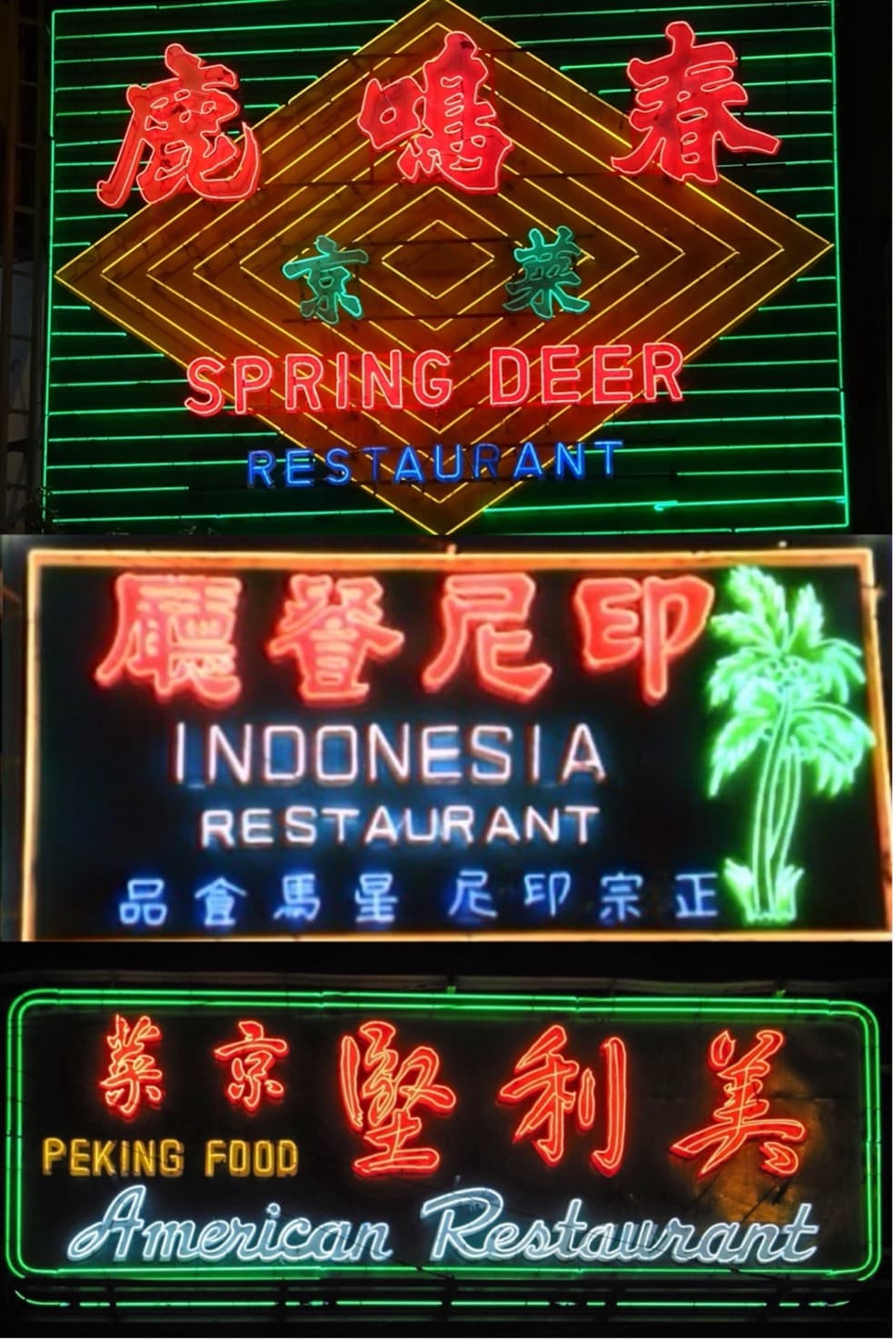
In certain cases, the direction of translation became ambiguous. Traditionally, translation involves a clear distinction between a source text and a target text, with a defined direction from one language or culture to another. However, in colonial cities, the conventional concept of translation often proves inadequate. For instance, the sign erected in 1978 that reads “American Restaurant Peking Food” (Meilijian Jingcai 美利堅京菜) (Figure 1, lower) shows Chinese text above its English counterpart. While this establishment primarily serves Peking food as a Chinese restaurant, the prominence of the text “American Restaurant” over “Peking food” in its name somehow suggests a complex identity that might not solely be about projecting an American identity. Instead, it could also indicate a desire to appear modern or cosmopolitan, appealing to both local and international clientele. This creates a deliberate contrast between the name and the cuisine it offers. This naming strategy embodies cultural hybridity, reflecting a distinctive aspect of Hong Kong’s cultural landscape. In such cases, it becomes futile to distinguish which language represents the original and which is the derivative. I discussed elsewhere (Song G. 2022b) that this phenomenon is common in culturally hybrid cities or enclaves such as American and Canadian Chinatowns.
This kind of deep integration of Chinese and English reflects Hong Kong’s evolution from a bilingual society into a translational one during the Cold War (Simon 2021). While bilingual societies merely acknowledge differences, allowing parallel cultural existences, a translational society actively negotiates between different worldviews, creating hybrid forms that resist pure Chinese or Western categorisation. This aligns with Simon’s (2012: 2) distinction between a multilingual city, where parallel conversations coexist, and a translational city, where linguistic streams converge into a shared discourse. This cultural synthesis, evident in the interplay of Chinese and English languages alongside visual symbols, helped forge Hong Kong’s distinctive identity as neither fully Western nor Chinese. The city’s resulting local consciousness transcended its status as a refugee city, positioning it as a unique third space between competing global powers. This ideological liminality was materially expressed through neon signs, which became emblematic of Hong Kong’s local heritage and its role as a cultural mediator between East and West.
The Cold War era led to more engaged and intense language interactions in Hong Kong. The delicate balance between English and Chinese became further complicated by the increased American presence and the influx of Chinese immigrants. During the colonial era, English remained the sole official language in Hong Kong until 1974. It was only after that year that Chinese, alongside English, became an official language. However, when I examine neon signs, it is evident that the colonial Hong Kong government had little control over the language use of the local population. The use of languages on neon signs was driven primarily by commercial interests, indicating a relatively liberal language policy. This demonstrates that even during the Cold War era, amidst the competition and balance between the Chinese and Western influences, Hong Kong allowed for a relative cultural freedom among its grassroots.
Neon signs were established by shop owners and targeted the general public. The linguistic phenomena on neon signs reflect Hong Kong’s identity as a frontline city during the Cold War, and illustrate how ordinary citizens used language and perceived their local linguistic realities, which in turn influenced their self-construction of local identity. To some extent, the Cold War intensified the integration of Chinese and English in Hong Kong. During the Cold War, events such as the Korean War and the Vietnam War, along with the processes of globalisation, increased the visibility of American influence. The recognition of Chinese alongside English in 1974 deepened the integration of these languages on the streets. The arrival of Vietnamese refugees after 1975 further contributed to linguistic and cultural hybridity in Hong Kong.
When considering the ongoing language dynamics in cities, the concept of “translation zones” comes to mind (Cronin and Simon 2014: 120). Simon (2019) argues that all cities embody translational forces to some extent, encompassing specific translation sites that serve as zones of intense interaction among diverse sensibilities, subjectivities, identities, and, of course, languages. These spaces are characterised by reciprocity and interactive engagement, blurring the boundaries of translation as a linear process that moves from one language to another (Song and Chen 2024; Wu and Jiang 2024). In the context of Cold War Hong Kong, the translation of languages in neon signs serves as a means for negotiating and signifying differences. The neon signs operated beyond simple linguistic conversion between Chinese and English, becoming sites of ideological negotiation between competing Cold War systems. The southern part of Nathan Road, for instance, became a particularly intense translation zone where American military influence, British colonial authority, and Chinese commercial practices created complex networks of meaning against the special geopolitical background of Hong Kong.
Visual hybridisation and Cold War aesthetics
The visual evolution of neon signs similarly charts Hong Kong’s journey from bicultural division to hybrid identity. The interplay of text, image, and colour in neon signs increasingly reflected Hong Kong’s sophisticated navigation of Cold War cultural politics. The neon signs share a common feature across eras: the Chinese characters or English texts are large, filling nearly the entire sign. The strokes are thick, visible from afar, conveying strength and power. This not only gives the impression that this shop is doing reliable business,[6] but also demonstrates that Hong Kong’s urban environment is dense, and shop owners need to make their signage stand out among many others, in a context of competitive commercial atmosphere.
Before the 1960s, Chinese signage predominantly followed vertical formats, a style inherited from Qing dynasty signboards. In contrast, English signs adhered to horizontal European conventions. This spatial segregation underscored the maintenance of distinct cultural spheres within colonial Hong Kong, where Chinese and Western cultures coexisted with minimal exchanges. During the 1960s, Chinese signage continued to adopt the vertical format, while English signage primarily followed the European horizontal orientation, with the exceptions of theatre signs, which were displayed vertically.
By the 1970s, Hong Kong’s neon signs began blending horizontal and vertical formats. As the economy boomed and urbanisation intensified, businesses needed more complex and attention-grabbing signage to stand out. Combining horizontal and vertical elements allowed signs to capture attention from multiple angles, ensuring visibility in a crowded environment. This integration created a dynamic visual effect, reflecting Hong Kong’s vibrant and competitive urban culture. The blending of design elements in the 1970s was indeed facilitated by the proliferation of high-rise buildings on narrow streets, which provided additional space for signage. However, it is crucial to clarify that this integration did not directly connect with the socialist ideology of the PRC, which explicitly rejected the commercial leanings of the Qing dynasty and Republican era. Hong Kong’s unique cultural position and colonial reality facilitated the blending of traditional Chinese elements with Western influences. To be sure, Hong Kong was partially influenced by Mainland China’s socialist ideology. The 1967 riots, for example, sparked by labour disputes and influenced by the Cultural Revolution, marked a pivotal moment in Hong Kong’s history, with pro-Beijing activists promoting socialist ideologies (Leung 2020). The Bank of China building in Hong Kong even displayed slogans echoing the Chinese Mainland during this period, highlighting the visible presence of socialist ideologies in Hong Kong.[7] However, despite these influences, Hong Kong’s colonial status and capitalist economy enabled it to maintain a distinct cultural identity that diverged from the socialist ideology of the Mainland. The city’s cultural landscape was therefore rather shaped by a combination of factors: its predominantly Chinese population, its British colonial heritage, and its role as a hub for international trade and cultural exchanges. This unique blend of influences allowed Hong Kong to develop a cultural identity that was distinct from both its colonial past and the socialist system of the Mainland.
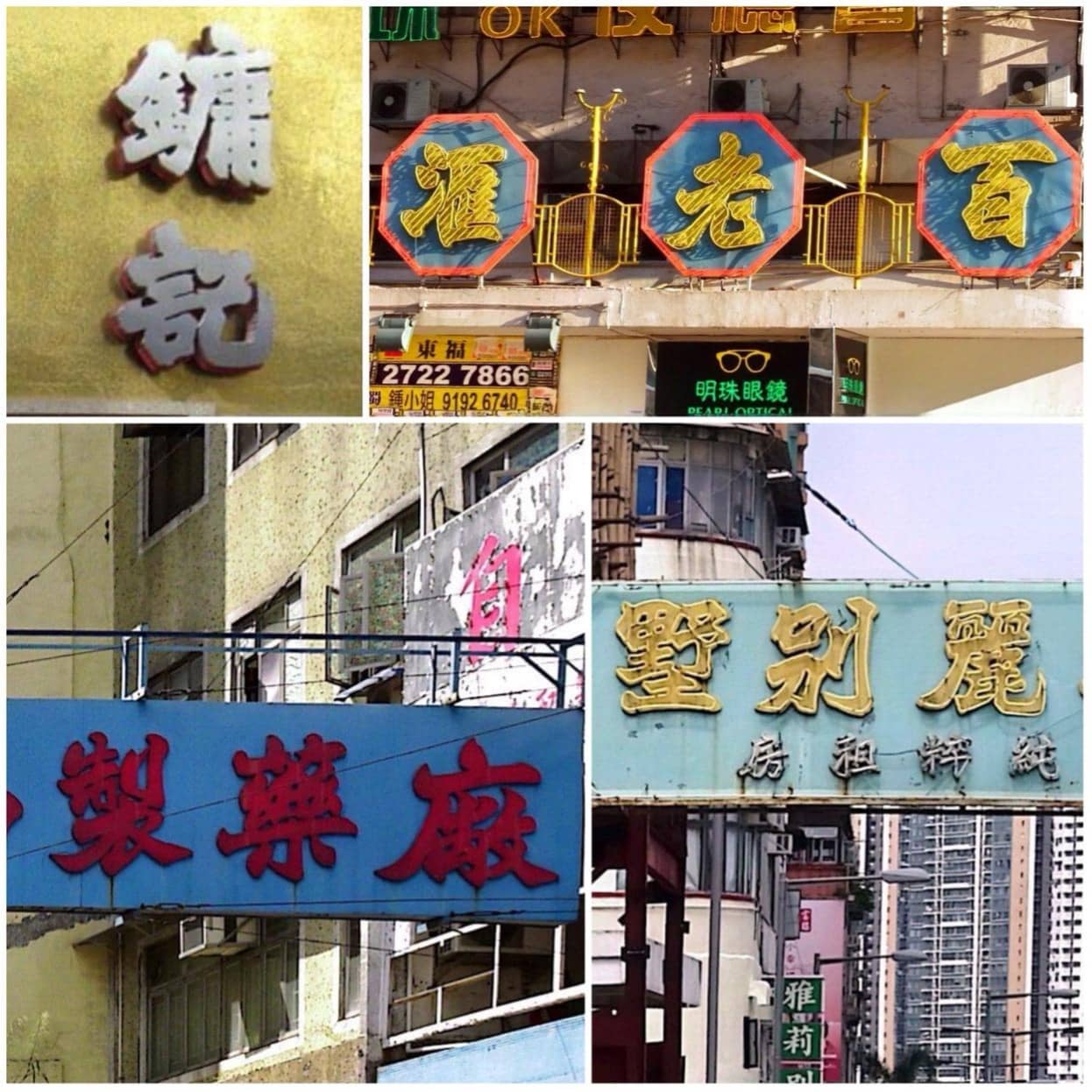
The following examples of neon signs illustrate this kind of cultural hybridity. After World War II, some renowned calligraphers in Hong Kong frequently used the Northern Wei script for signage, sparking a trend of imitation.[8] This choice of script was favoured by businesses of all kinds (Kwok 2019: 13). As a result, beginning in the 1940s and 1950s, the signage style in Northern Wei script became extremely popular on the streets, becoming a distinct feature of Hong Kong’s local culture[9] (Chan S. 2018), as shown in the examples on Figure 2. It can be observed that the neon sign has inherited and appropriated Chinese calligraphic tradition for contemporary Western visual language, which encapsulates the mixture of Chinese and Western elements that characterises Hong Kong modernity.[10]
Figure 2. Examples of Northern Wei script
 Credit: the author.
There is a multimodal translation among neon signs, which means that the interplay of text and images creates new and enhanced meanings (Chiaro 2008: 141). Among the collected neon signs, I identified three types of multimodal translation: the first reflects the type of food served, the second conveys brand identity, and the third showcases special visual art. Throughout all types, colour politics played out against the backdrop of competing Cold War ideologies, with Hong Kong’s neon landscape offering a third way between Soviet-style austerity and American consumer capitalism.
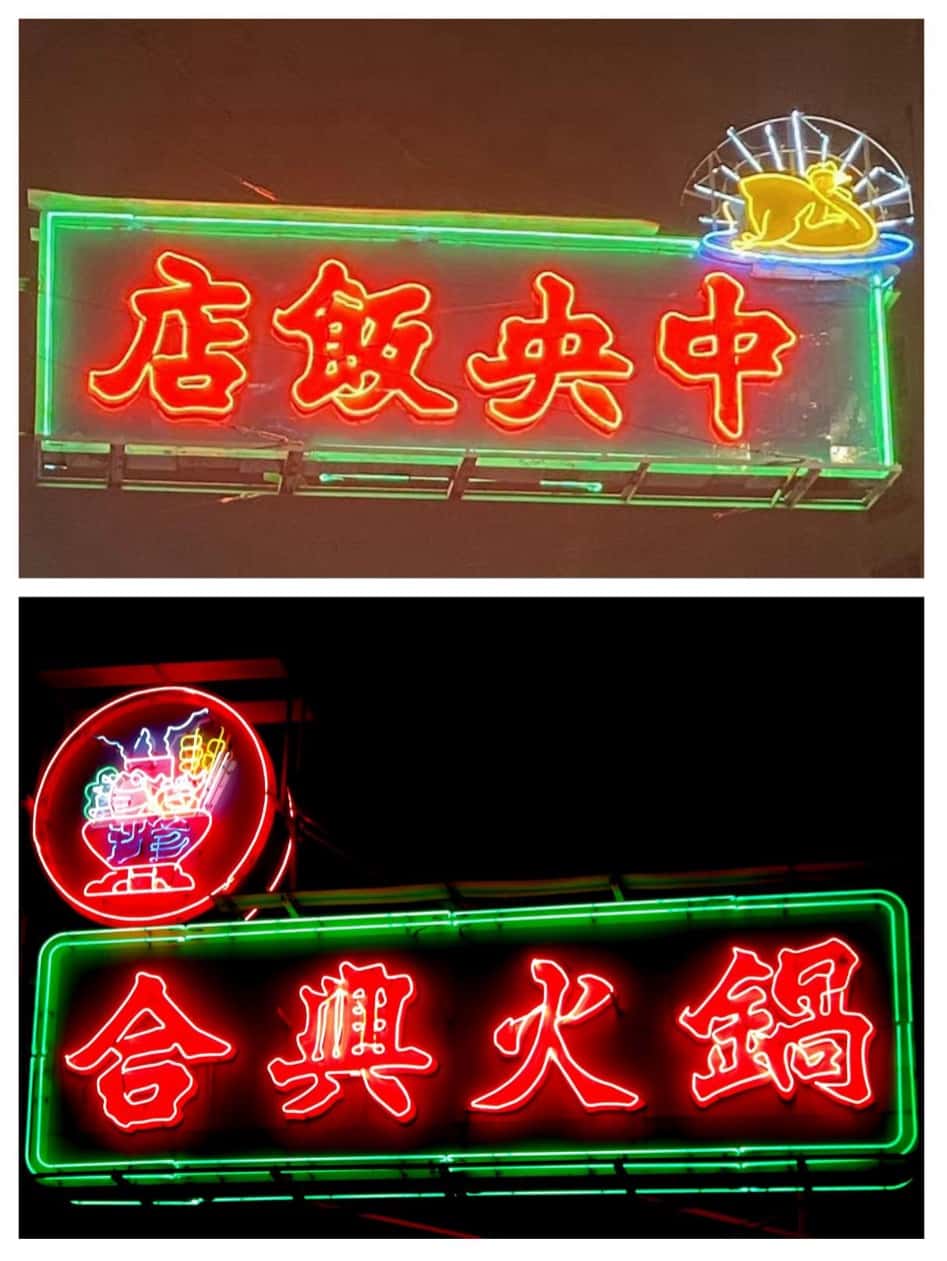
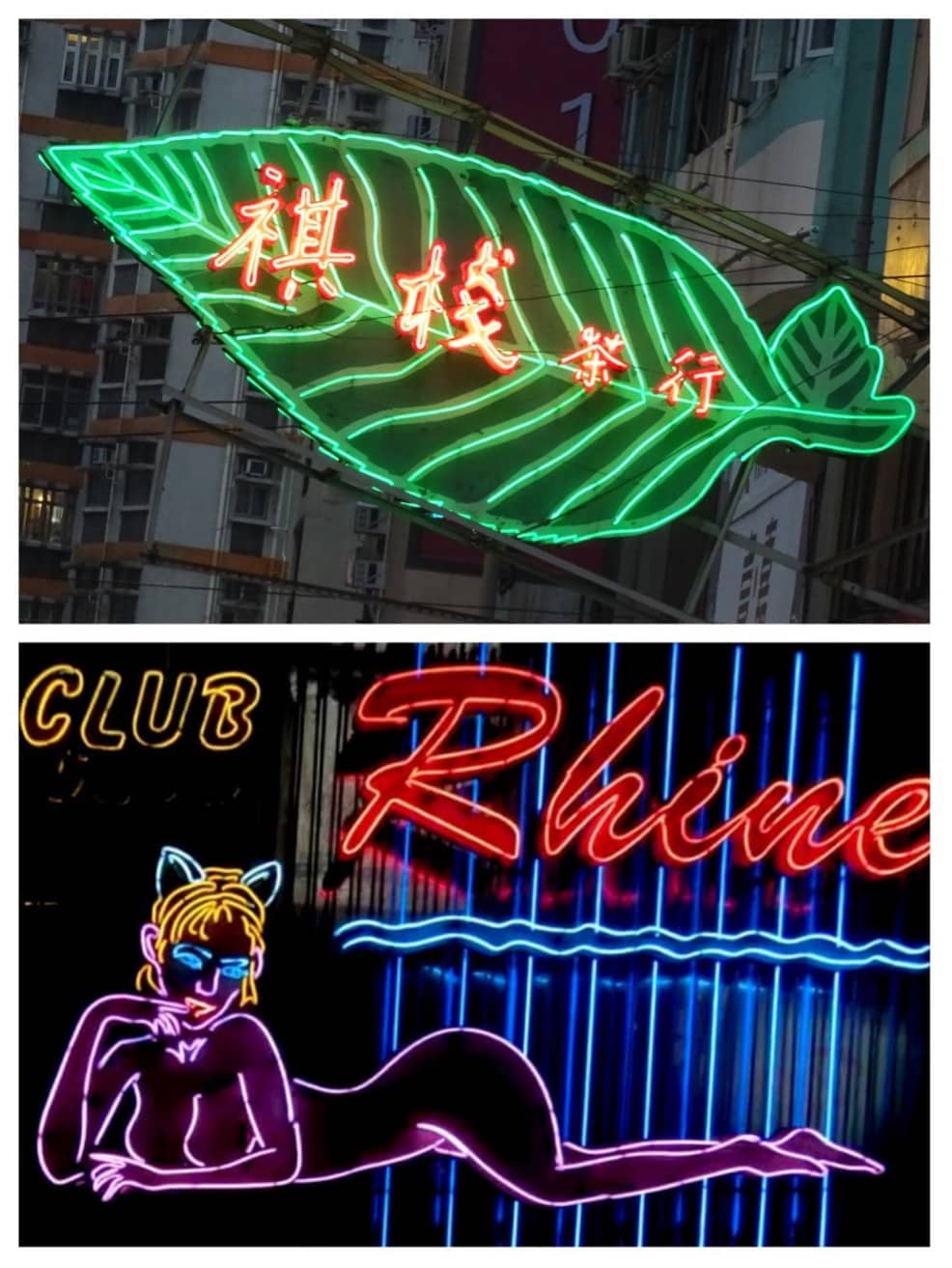
The first category encompasses neon signs that signify the type of cuisine offered. For example, Central Restaurant (Zhongyang fandian 中央飯店), established in 1961, prominently displays Northern Wei Chinese script alongside a glowing chicken motif (Figure 3, upper). While the Chinese characters alone may not reveal the restaurant’s menu, the accompanying visual imagery effectively does. This harmonious blend of image and text synergistically conveys intended meanings. In the case of Ho Hing Hotpot (Hexing huoguo 合興火鍋), a depiction of a hotpot above the text visually translates the Chinese characters, ensuring a clear message for international patrons regardless of the language they speak (Figure 3, lower). This exemplifies a form of intersemiotic translation, where verbal languages are transformed into visual representations. Similarly, Ki Chan Tea Co.’s (qi zhan cha hang 祺棧茶行) signage creatively incorporates the shape of green tea leaves, effectively communicating the Chinese store name to a diverse audience with varying linguistic and cultural backgrounds (Figure 4, upper). Another striking example is a sign featuring a captivating woman in a catsuit whose allure speaks volumes about the club’s ambiance, obviating the need for Chinese characters (Figure 4, lower). This visually engaging and bold signage captures the essence of Wan Chai’s nocturnal offerings.
Figure 3. Neon signs of Central Restaurant and Ho Hing Hotpot
 Credit: the author.
Figure 4. Neon signs of Ki Chan Tea Co. and Club Rhine
 Credit: the author.
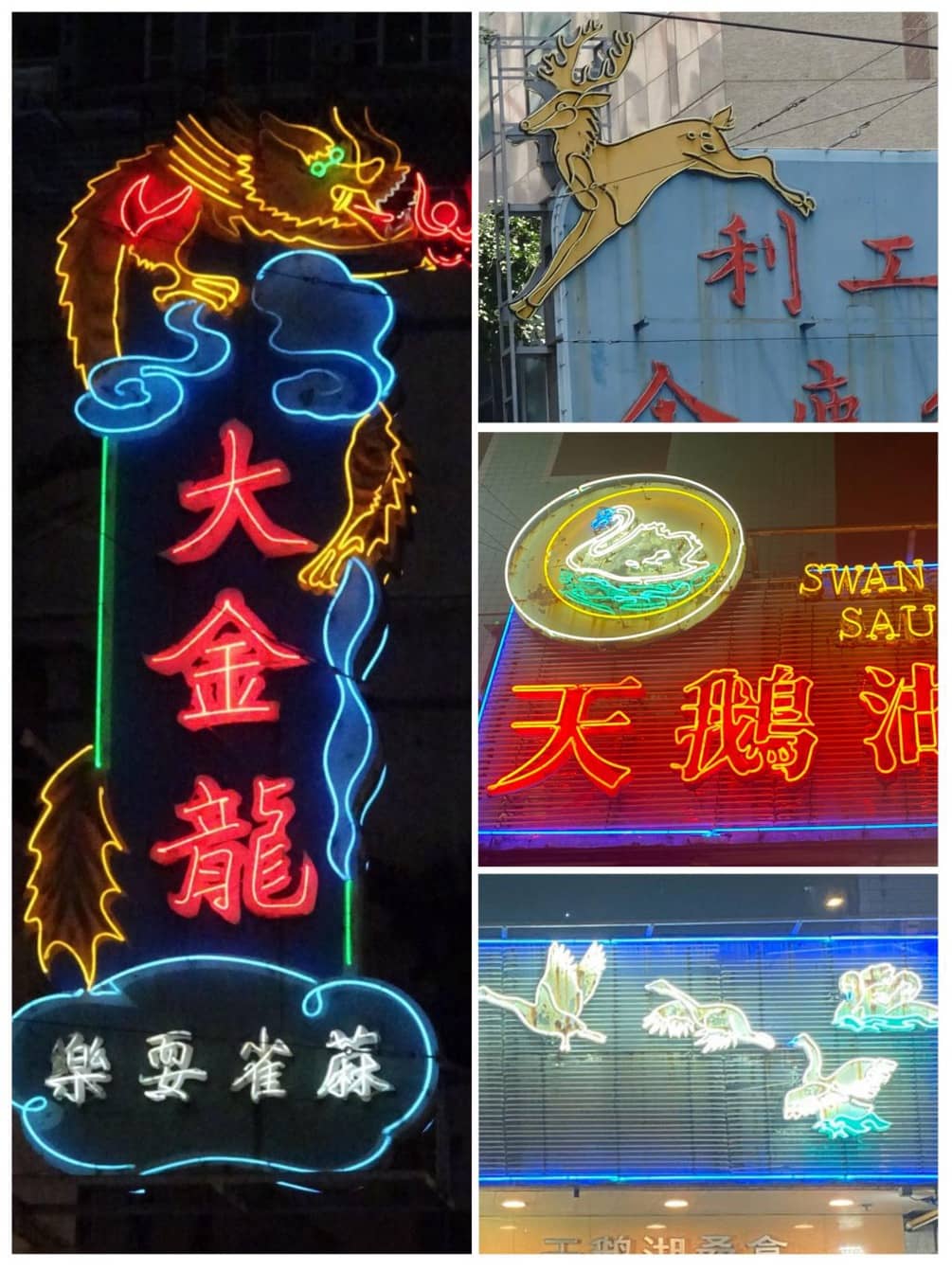
The second category of multimodal translation goes to the visual images that reflect brand identity. The dragon-shaped sign of Great Golden Dragon Mahjong Entertainment (da jinlong maque shuale 大金龍麻雀耍樂) (Figure 5, left) exemplifies this stylistic influence. The dragon image serves as both an inter-semiotic translation of the Chinese name and a visual symbol, becoming a marker of this mahjong house. It combines Chinese mythology (the dragon) with modern neon aesthetics. Similarly, the signage for Golden Deer Shirt (jin lu xian shan 金鹿線衫) integrates a deer symbol (Figure 5, upper right), effectively translating the character 鹿 (lu, deer) into a visual representation, functioning as a form of consumer symbol and visual metaphor (Kwok 2018a: 34). The sign Swan Lake Sauna (tian’e hu sangna 天鵝湖桑拿) features several white swans in addition to the Chinese-English bilingual texts (Figure 5, lower left). The swan image integrates the cultural references of Tchaikovsky’s ballet with Chinese characters. Examples like these, where language and symbols merge, serve to strengthen brand memory and enhance recognition. They also imply the multicultural nature of Hong Kong, as many people may not understand Chinese, necessitating the use of visual language to connect with one another.
Figure 5. Neon signs of Great Golden Dragon, Golden Deer Shirt, and Swan Lake Sauna
 Credit: the author.
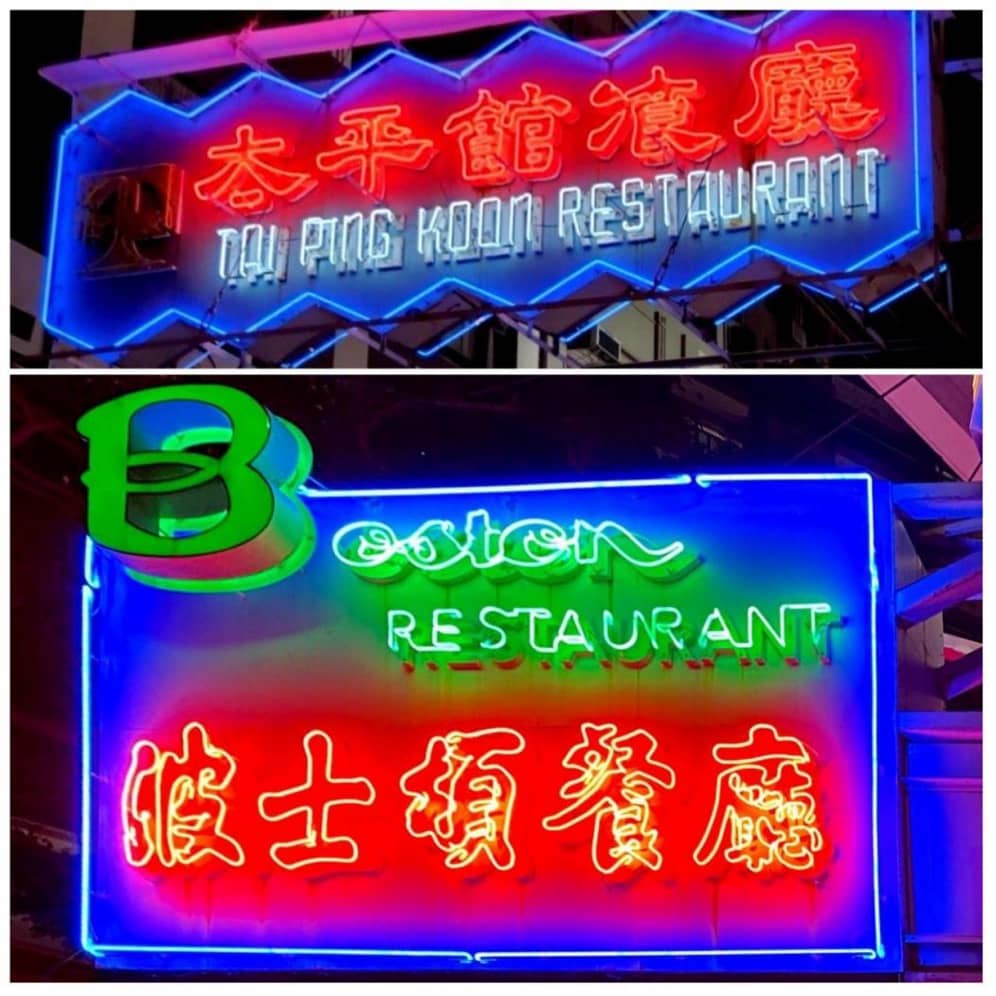
The third category, finally, pertains to special visual art. For instance, consider the sign of Tai Ping Koon Restaurant (taiping guan canting 太平館餐廳), founded in 1964, showing a frame composed of interconnected, subtly undulating hexagonal shapes, and possibly influenced by the Western Art Deco style (Figure 6, upper) (Kwok 2018a). This frame is outlined in blue neon, while the Chinese characters in clerical script are in red – a classic colour scheme in Hong Kong’s neon signs. Another example, Boston Restaurant (Boshidun canting 波士頓餐廳), established in 1966, features green coloured English text with more intricate design elements than its Chinese counterpart in regular script below. The Chinese text is presented in red, symbolising auspiciousness within the Chinese cultural context (Figure 6, lower). These visual innovations, in addition to text, were not commonly seen in the late nineteenth and early twentieth centuries, suggesting their influence from Western visual culture, introduced alongside neon light technology in Hong Kong.
Figure 6. Neon signs of Tai Ping Koon Restaurant and Boston Restaurant
 Credit: the author.
Neon signs became integral to Hong Kong’s cultural identity amid Cold War tensions. While Mainland Chinese immigrants brought signage traditions from the previous Qing dynasty and Republican era, Western neon technology and aesthetics enabled a unique fusion that symbolised Hong Kong’s in-between position. The city’s role as a Western-aligned yet culturally Chinese hub facilitated artistic innovation that defied rigid ideological boundaries. During this pre-digital era, neon sign designers exercised creative freedom that expressed Hong Kong’s distinct position in the global order.
Hong Kong’s transformation from binary cultural division to sophisticated hybridity was not merely aesthetic but reflected its larger role in Cold War geopolitics. As China’s window to the West and the West’s window into China, Hong Kong developed a visual language that could mediate between competing systems while creating something uniquely its own. The resulting neon landscape served as both a symbol and an instrument of Hong Kong as a global city capable of transcending Cold War divisions. Multimodal analysis reveals how these signs encoded cultural meanings. While linguistic interaction was important, interpreting these bilingual landscapes required understanding visual and cultural elements including architecture, colours, and symbols in their contested geopolitical context (Gu 2024a; Gu 2024b; Gu and Song 2024; Song G. 2024: 354). Comprehending this multilingual environment “requires certain types of interpretive knowledge for geographic mobility and understanding place, and thus, signs are products of literacy” (Trinch and Snajdr 2020). Therefore, in this context, it demands a contextual, multimodal understanding of translation against the Cold War power dynamics.
Neon cosmopolitanism
Hong Kong’s distinctive neon landscape emerged partly through the colonial government’s relaxed urban governance, a consequence of its contested position where strict regulation of grassroots activities proved politically difficult. This laissez-faire approach allowed businesses to install elaborate neon signs with minimal oversight. In addition, in the absence of television as a dominant medium, neon signs served as primary visual attractions for restaurants, theatres, and entertainment venues. This technological gap allowed neon to develop beyond functional advertising into a sophisticated visual language, creating a distinct visual identity that differentiated it from both Western and Eastern Bloc cities.
Hong Kong, a city where neon signs illuminate a lively fabric of cultural influences, embodies a cosmopolitan spirit that is deeply intertwined with the act of translation. The translational landscape composed of neon signs offers a window into the essence of Hong Kong culture, along with its colonial and Cold War experience. Driven by pragmatic considerations, neon signs evolved from a bicultural coexistence to an intercultural, engaged interplay. This ultimately resulted in an “organised mess,” free from colonial top-down regulations. Consequently, translation in this city took on multiple yet unpredictable directions, simultaneously navigating between English, Chinese, visual images, and colour schemes, each with varying degrees of interaction. Neon signs reflect this hybrid, in-between positionality. The linguistic and semiotic landscapes embodied by neon signs constitute an evolving space where Chinese traditions and ideology are perpetually intertwined with Western technology and modern aesthetics. This inherent duality is built upon the foundation of a British-ruled Chinese territory.
First, these translations intertwine in a process of cultural hybridisation, ultimately leading to a cosmopolitan urban space. The boundary between self and other dissolves entirely, rendering a binary understanding of translation – clearly-defined source culture and target culture, or source language and target language – obsolete. Instead, a cosmopolitan translation emerges, characterised as “the process of signification and resignification by making use of multiple yet mixed source cultures” (Song G. 2022a: 38) that are “closely linked to cognitive, social, and cultural change in a global and globalizing context” (Sun 2017: 47). This transformation, against the backdrop of the Cold War, led to a circumvention or transformation of the bipolar system (Hon 2022). While we do not deny the existence of a clear social distance between the British and the general Chinese population under colonial rule (Lui 2012: 73), neon signs played a mediating role in the cultural environment of the urban space, bridging the gap between Chinese and Western cultures.
Second, Hong Kong’s cosmopolitan landscape, shaped by neon signs, fostered both emotional connection and Orientalist imagination, and revealed the complex interplay of cultures in the city. For foreigners, prior to China’s reform and opening and the easing of entry restrictions, experiencing Chinese culture in Hong Kong, a capitalist paradise bordering a communist nation, was a significant part of their travel experience. For local Chinese, however, it was difficult to fully immerse themselves in that environment and culture. They grew up under British colonial rule, but as Chinese, they felt a sense of rootlessness (Lui 2012: 106). As a result, neon signs, embodying various layers of translation, became a symbol of both foreigners’ imagination of the mysterious East and locals’ longing for their culturally-connected yet politically distant Chinese homeland. It is important to note that the neon landscape emerged organically from the bottom up, driven by commercial forces.
Third, a significant portion of Hong Kong’s sociocultural realities during the Cold War can be explicitly or implicitly revealed, implied, or hinted at through the hybridisation-turned-cosmopolitan translation represented by its neon signs. Papen (2015: 1) emphasises a “discursive re-construction” of cities to establish connections between text, urban space, and life. However, if we view the neon signs as objects of translation, we can add a layer of “semiotic reconstruction” for a more comprehensive understanding. This elevates translation as a key to deciphering “the cultural life of cities” and revealing “the passages created among communities at specific times” (Cronin and Simon 2014: 119). Consequently, Hong Kong’s neon signs function simultaneously as “the smallest parcel in the world” and as “the totality of the world” (Foucault 2008: 20) due to their wide impact and implications, nostalgic evocations, spaces of power balance, and the injection of capitalism and consumerism into the increasingly densely packed city streets.
The neon signs of Hong Kong illuminate a translational landscape that is deeply intertwined with the city’s cosmopolitan vibe and cultural history. Driven by pragmatic commercial forces, these multilingual, hybrid signs evolved from a bicultural coexistence to an engaged, intercultural interplay. This organised mess of translations navigates between English, Chinese, visual imagery, and colour schemes, reflecting the city’s colonial and Cold War “in-between” experience. The neon signs embody a process of cultural hybridisation, dissolving binary notions of source and target to create a cosmopolitan translation that is closely linked to social, cognitive, and cultural change. They foster both emotional connection and Orientalist imagination, mediating the complex interplay between Chinese and Western cultures under British colonial rule. Ultimately, the semiotic and linguistic landscape of Hong Kong’s neon signs can be read as a key to deciphering the city’s cultural life. The neon signs function as both micro-level “parcels” and macro-level “totalities,” revealing significant sociocultural realities of Hong Kong during the Cold War period.
Acknowledgements
I would like to thank Pr Tze-ki Hon and Dr Heidi Huang for inviting me to write an article on Cold War Hong Kong through the lens of neon signs following our participation in a conference held at The University of Hong Kong in June 2024. I also extend my gratitude to the two anonymous reviewers and the editors of China Perspectives for their constructive feedback. I would also like to thank the Ministry of Education of the PRC for partially supporting this research (Project Code: 23YJCZH186).
Manuscript received on 27 September 2024. Accepted on 10 March 2025.
References
BHABHA, Homi K. 1994. The Location of Culture. London: Routledge.
BIELSA, Esperança. 2016. Cosmopolitan and Translation: Investigations into the Experience of the Foreign. London: Routledge.
BOUDON, Pierre. 1986. “Introduction to the Semiotics of Space.” In Mark Gottdiener, and Alexandros P. LAGOPOULOS (eds.), The City and the Sign: An Introduction to Urban Semiotics. New York: Columbia University Press. 99-113.
BROTO, Vanesa Castán. 2015. “Socio-technical Artefacts and Urban Stories of Energy: Neon and Lighting Politics in Hong Kong.” Unpublished paper. London: University College London.
CHAN, Joseph Man. 1992. “Mass Media and Socio-political Formation in Hong Kong, 1949–1992.” Asian Journal of Communication 2(3): 106-29.
CHAN, Shao-yi. 2018. “From Neon Signs to Skyscrapers: The Spectacle of Fluidity in Hong Kong’s Post/Modern Cityscape.” Hong Kong Studies 1(2): 143-59.
CHIARO, Delia. 2008. “Issues of Quality in Screen Translation: Problems and Solutions.” In Delia CHIARO, Christine HEISS, and Chiara BUCARIA (eds.), Between Text and Image: Updating Research in Screen Translation. Amsterdam: Benjamins Publishing Company. 241-56.
CRONIN, Michael, and Sherry SIMON. 2014. “Introduction: The City as Translation Zone.” Translation Studies 7(2): 119-32.
DUNCAN, James S. 1990. The City as Text: The Politics of Landscape Interpretation in the Kandyan Kingdom. Cambridge: Cambridge University Press.
ENGLAND, Vaudine. 2023. Fortune’s Bazaar: The Making of Hong Kong. London: Corsair.
FOUCAULT, Michel. 2008. “Of Other Spaces.” In Michiel Dehaene, and Lieven De CAUTER (eds.), Heterotopia and the City: Public Space in a Postcivil Society. London: Routledge. 13-29.
GIBBONS, Alison. 2012. Multimodality, Cognition, and Experimental Literature. London: Routledge.
GU, Chonglong. 2024a. “Linguistic Landscaping in Kathmandu’s Thamel ‘Chinatown’: Language as Commodity in the Construction of a Cosmopolitan Transnational Space.” Contemporary South Asia 32(3): 360-85.
——. 2024b. “‘The (Un)making and (Re)making of Guangzhou’s ‘Little Africa’: Xiaobei’s Linguistic and Semiotic Landscape Explored.” Language Policy 24: 51-84.
GU, Chonglong, and Ge SONG. 2024. “‘Al-Hay As-Sini’ Explored: The Linguistic and Semiotic Landscape of Dubai Mall ‘Chinatown’ As a Translated Space and Transnational Contact Zone.” Journal of Multilingual and Multicultural Development: 1-25.
HAMPTON, Mark. 2015. Hong Kong and British Culture, 1945–97. Manchester: Manchester University Press.
HON, Tze-ki (ed.). 2022. Cold War Cities: The Politics of Space in Europe and Asia During the 1950s. London: Routledge.
HON, Tze-ki, and Hok-yin CHAN. 2022. “The Question of People: Cultural Cold War in 1950s’ Hong Kong.” In Tze-ki HON (ed.), Cold War Cities: The Politics of Space in Europe and Asia during the 1950s. London: Routledge. 88-100.
KAINDL, Klaus. 2020. “A Theoretical Framework for a Multimodal Conception of Translation.” In Monica BORIA, Ángeles CARRERES, Marià NORIEGA-SÁNCHEZ, and Marcus TOMALIN (eds.), Translation and Multimodality: Beyond Words. London: Routledge. 49-70.
KOMSKA, Yuliya. 2011. “Ruins of the Cold War.” New German Critique 112: 155-80.
KWOK, Brian Sze Hang. 2018a. Fading Neon Lights: An Archive of Hong Kong’s Visual Culture. Hong Kong: Joint Publishing.
———. 2018b. “Landscape of Light: Chinese Typography and Visual Communication on Hong Kong’s Neon Signs.” Hong Kong Journal of Social Sciences 52(Autumn/Winter): 73-97.
———. 2019. “Dis/re-appearance of Vernacular Chinese Letterform of Beiwei Kaishu in Hong Kong.” Proceedings of Typography Day. 1-15.
KWOK, Brian Sze-Hang, and Anneke Coppoolse. 2017. “Illuminography: A Survey of the Pictorial Language of Hong Kong’s Neon Signs.” Visible Language 51(1): 89-111.
LANDRY, Rodrigue, and Richard Y. BOURHIS. 1997. “Linguistic Landscape and Ethnolinguistic Vitality: An Empirical Study.” Journal of Language and Social Psychology 16: 23-49.
LEE, Ou-Fan. 2008. City Between Worlds: My Hong Kong. Cambridge: Belknap Press of Harvard University Press.
LEUNG, Shuk Man. 2020. “Imagining a National/local Identity in the Colony: The Cultural Revolution Discourse in Hong Kong Youth and Student Journals, 1966–1977.” Cultural Studies 34(2): 317-40.
LI, Cho-kiu. 2021. “Asia’s Refugee City: Hong Kong in the Cold War.” In Kerry Bystrom, Monica Popescu, and Katherine ZIEN (eds.), The Cultural Cold War and the Global South: Sites of Contest and Communitas. London: Routledge. 238-51.
LUI, Tai Lok 呂大樂. 2012. 那似曾相識的70年代 (Na siceng xiangshi de 70 niandai, The familiar 1970s). Hong Kong: Chung Hwa Book Co.
LYNCH, Kevin. 1960. The Image of the City. Cambridge: MIT Press.
MACGREGOR, Keith, and David Clive PRICE. 2002. Neon City Hong Kong. Hong Kong: Cameraman Ltd.
MAN, Eva Kit Wah. 2016. Bodies in China: Philosophy, Aesthetics, Gender, and Politics. Hong Kong: The Chinese University Press.
MARK, Chi-kwan. 2017. “Crisis or Opportunity? Britain, China, and the Decolonization of Hong Kong in the Long 1970s.” In Priscilla ROBERTS, and Odd Arne WESTAD (eds.), China, Hong Kong, and the Long 1970s: Global Perspectives. Cham: Springer. 257-77.
MILES-WATSON, Jonathan. 2015. “Introduction: Ruptured Landscapes.” In Helen Sooväli-Sepping, Hugo REINERT, and Jonathan MILES-WATSON (eds.), Ruptured Landscapes: Landscape, Identities and Social Change. Cham: Springer. 1-8.
MORENO, Michael P. 2022. “The East–West Interstices of Third Space: Charting Hong Kong as a Kaleidoscope of Heterotopic Narratives.” In Kelly Kar Yue CHAN, and Chi Sum Garfield LAU (eds.), Cross-cultural Encounters in Modern and Premodern China: Global Networks, Mediation, and Intertextuality. Cham: Springer. 151-71.
PAPEN, Uta. 2015. “Signs in Cities: The Discursive Production and Commodification of Urban Spaces.” Sociolinguistics Studies 9(1): 1-26.
PRATT, Mary Louise. 1992. Imperial Eyes: Travel Writing and Transculturation. London: Routledge.
RIBBAT, Christoph, and Mathews ANTHONY. 2013. Flickering Light: A History of Neon. London: Reaktion Books Limited.
ROBERTS, Priscilla. 2016. “Cold War Hong Kong: The Foundation.” In Priscilla ROBERTS, and John M. CARROLL (eds.), Hong Kong in the Cold War. Hong Kong: Hong Kong University Press. 15-25.
SENG, Eunice. 2017. “The City in a Building: A Brief Social History of Urban Hong Kong.” studies in History & Theory of Architecture 5: 81-98.
SIMON, Sherry. 2012. Cities in Translation: Intersections of Language and Memory. London: Routledge.
———. 2019. Translation Sites: A Field Guide. London: Routledge.
———. 2021. “The Translational City.” In Tong King LEE (ed.), The Routledge Handbook of Translation and the City. London: Routledge. 15-25.
SONG, Ge. 2021. “Hybridity and Singularity: A Study of Hong Kong’s Neon Signs from the Perspective of Multimodal Translation.” The Translator 27(2): 203-15.
———. 2022a. “Cosmopolitan Translation in Multilingual Cities: A Macao Experience.” Language and Intercultural Communication 22(1): 35-49.
———. 2022b. “The Linguistic Landscape of Chinatowns in Canada and the United States: A Translational Perspective.” Journal of Multilingual and Multicultural Development 45(9): 3505-23.
———. 2024. “Towards a Translational Landscape: A Study of Coloane’s Urban Features through the Lens of Translational Spaces.” Translation Studies 17(2): 352-73.
SONG, Ge, and Xuemei CHEN. 2024. “Re-conceptualizing Cultural Dissemination in the Lens of Translational Spaces: A Case of the English Dubbed Journey to the West.” Perspectives 32(4): 650-68.
SONG, Zijiang 宋子江. 2015. 蘇絲黃的澳門: 從小說到電影, 從在場到缺席 (Su Sihuang de Aomen: Cong xiaoshuo dao dianying, cong zaichang dao quexi, Suzie Wong’s Macao: From novel to film, from presence to absence). In SONG Zijiang 宋子江, and TAN Yongqiu 談詠秋 (eds.), 嘉模講談錄2015: 兩城對讀 (Jiamo jiangtan lu 2015: Liang cheng dui du, Jiamo lectures 2015: Readings from two cities). Macao: Instituto para os Assuntos Cívicos e Municipais. 60-74.
STEELE, Tracy. 2016. “Hong Kong and the Cold War in the 1950s.” In Priscilla ROBERTS, and John M. CARROLL (eds.), Hong Kong in the Cold War. Hong Kong: Hong Kong University Press. 92-116.
SUN, Yifeng. 2017. “Cosmopolitan Translation and Cross-cultural Paradigms: A Chinese Perspective.” Telos 180: 47-66.
———. 2021. Translational Spaces: Towards a Chinese-Western Convergence. London: Routledge.
TRINCH, Shonna, and Edward Snajdr. 2020. What the Signs Say: Language, Gentrification, and Place-making in Brooklyn. Nashville: Vanderbilt University Press.
TSANG, Hiu Lam. 2024 “Illuminating the Trajectories of Hope: A Cultural and Spatial Analysis of Hong Kong’s Neon (1980s-present).” Master’s Thesis. Hong Kong: Hong Kong Baptist University.
VENTURI, Robert, Denise SCOTT BROWN, and Steven IZENOUR. 1972. Learning from Las Vegas: The Forgotten Symbolism of Architectural Form. Cambridge: MIT Press.
WANG, Gungwu. 2016. “Hong Kong’s Twentieth Century: The Global Setting.” In Priscilla ROBERTS, and John M. CARROLL (eds.), Hong Kong in the Cold War. Hong Kong: Hong Kong University Press. 1-14.
WU, Yun, and Mengying JIANG. 2024. “Revisiting Directionality in China’s ‘Outward Translation.’” International Journal of Applied Linguistics. https://doi.org/10.1111/ijal.12616
[1] Gabriella Zanzanaini, “Forgotten Hong Kong Icon: The Neon Master,” Zolima CityMag, 30 November 2016, https://zolimacitymag.com/forgotten-hong-kong-icon-the-neon-master/ (accessed on 20 July 2024).
[2] Ibid.
[3] Christopher Dewolf, “The Lost Cityscape of Do-it-yourself Hong Kong,” Zolima CityMag, 2 July 2024, https://zolimacitymag.com/the-lost-cityscape-of-illegal-do-it-yourself-hong-kong/ (accessed on 25 July 2024).
[4] Birde Tang, “Neon Fades Out,” Neonsigns.hk, Mobile M+, https://www.neonsigns.hk/neon-in-visual-culture/neon-fades-out/?lang=en (accessed on 19 March 2025).
[5] Commonly known as 新加坡 (Xinjiapo) in Chinese, Singapore is sometimes spelled with different characters, such as 星加坡 or 星嘉坡 (Xingjiapo), but also 星洲 (Xingzhou), and 星國 (Xingguo).
[6] Lee Kin-Ming 李健明, 2019, 你看港街招牌 (Ni kan Gangjie zhaopai, Look at Hong Kong Street signs), Hong Kong: Feifan chuban, p. 68.
[7] Christopher Dewolf, “1967: When the Bank of China Building Became a Giant Propaganda Machine,” Zolima Citymag, 8 August 2018,
https://zolimacitymag.com/1967-when-the-bank-of-china-building-became-a-giant-propaganda-machine/ (accessed on 7 March 2025).
[8] The Northern Wei script, adopted by renowned calligraphers in Hong Kong’s neon signs after World War II, embodies a blend of traditional Chinese heritage and modern urban expression. This style, characterised by thick, bold strokes, is associated with strength and vitality. For details, see Keith Tam, “追尋香港的北魏楷書招牌” (Zhuixun Xianggang de Beiwei kaishu zhaopai, Seeking out the Northern Wei regular script signage of Hong Kong), 13 April 2024, https://web.archive.org/web/20170314190506/http://invisibledesigns.org/%E5%8C%97%E9%AD%8F%E6%A5%B7%E6%9B%B8%E6%8B%9B%E7%89%8C/ (accessed on 29 July 2024).
[9] Ibid.
[10] Keith Tam, “The Architecture of Communication: The Visual Language of Hong Kong’s Neon Signs,” Neonsigns.hk, Mobile M+, 2014, https://www.neonsigns.hk/neon-in-visual-culture/the-architecture-of-communication/?lang=en (accessed on 18 March 2025).