 >
>

China Perspective Issues
BOOK REVIEWS
Wong Fei-hung Films and Vernacular Modernism in 1950s Hong Kong
Yu Chang is a life member of the Hong Kong Collectors Society and a former lecturer in the Department of East Asian Studies at the University of Toronto, Canada (changyu1210@gmail.com).
Introduction
Wong Fei-hung 黃飛鴻 (1850–1925)[1] was the legendary late-nineteenth- and early-twentieth-century martial artist from Guangdong Province who has inspired a prolific film series in Hong Kong,[2] with more than 100 movies featuring the real-life martial artist since October 1949.[3] Past scholarship by prominent Hong Kong film scholars such as Yu Mo-wan 余慕雲, Law Kar 羅卡, and Ng Ho 吳昊 has focused on these martial arts (wuxia 武俠) films as a genre, analysing their stylistic and thematic evolution (Yu M. 1980; Law Kar, Ng, and Cheuk 1997).[4] Early Wong Fei-hung films mainly targeted Cantonese-speaking audiences in Hong Kong, South China, and the Chinese diasporic communities in Southeast Asia. Some of these films were also dubbed in other Chinese dialects, including Hoklo (taiyu 台語) in Taiwan (Yeung 2024: 234). For example, How Wong Fei-hung Vanquished the Bully at a Long Dyke (Huang Feihong zhangdi jianba 黃飛鴻長堤殲霸, 1955) was advertised in Min Sheng Daily News 民聲日報 in August 1955 as an “authentic taiyu Wong Fei-hung film” (ibid.). They gradually incorporated new cinematic techniques, such as better choreographed action sequences and the introduction of modern film technologies such as colour film and widescreen[5] in the late 1950s and 1960s. After the rise of the internationally acclaimed Mandarin-dubbed martial arts films produced by studios such as Shaw Brothers and Golden Harvest, as well as the legendary Bruce Lee, Hong Kong martial arts films acquired their signature fast-paced action sequences, an aesthetics of violence, and an overt display of youthful heroism and, in some cases, nationalistic sentiments. Subsequent Wong Fei-hung films and television series in the mid-1970s through 1990s, both in Mandarin and Cantonese, largely incorporated stylistic conventions developed in the early 1970s, including well-choreographed fast-paced fighting sequences. Examples include Jackie Chan’s portrayal of a young Wong Fei-hung in the comedic film Drunken Master (Zui quan 醉拳, 1978) and Lau Kar-leung’s 劉家良 directed box-office successes in the late-1970s.
By the early 1980s, terms such as “long Cantonese-language films” (yueyu changpian 粵語長片) and “crappy Cantonese-language films” (yueyu canpian 粵語殘片) emerged as sarcastic sayings to refer to pre-1970 black-and-white Cantonese-language films, which were often shown on television in late night slots to entertain audiences who stayed up late. Many early Wong Fei-hung films were made available around that time to a new generation of audiences. Undeniably, these films had been churned out by independent filmmakers in the 1950s and 1960s as affordable entertainment for audiences in Hong Kong and the Chinese diasporic communities in Southeast Asia and beyond. Compared to the highly stylised, energetic martial arts films produced since the early 1970s, their pace may now appear too slow and their plot often too simplistic and unsophisticated. Yet, should we simply disregard them as playing inconsequential roles in Hong Kong’s establishment of a modern global film industry?
Fewer than 30 titles from the approximately 70 early Wong Fei-hung films produced between 1949 and the 1960s have survived (Chang Y. 2023: 116). Many of these films were produced by independent companies that no longer exist, making it challenging to reconstruct the contents and production details of non-surviving films. This reconstruction relies on a limited number of film handbills, souvenir booklets, newspaper advertisements, and magazine articles collected over the years by film scholars and collectors, such as Yu Mo-wan. While some of these private collections have formed the basis of Hong Kong Film Archive, numerous unpublished materials remain in the hands of private collectors like myself. In this context, utilising rare sources such as film handbills and promotional publications, this paper argues that, despite its humble origin, the Wong Fei-hung film franchise significantly contributed to articulating and mediating the experience of modernity in Hong Kong, the Chinese diasporic communities in Southeast Asia, and beyond. It achieved this through leveraging a global film industry network and inventing a new film genre that combined Chinese martial arts traditions and Western cinematic techniques and conventions. Specifically, this paper draws on the theoretical framework of “vernacular modernism” established by film scholar Miriam Hansen in her 1999 seminal study of classical Hollywood cinema, “The Mass Production of the Senses: Classical Cinema as Vernacular Modernism.”[6] She defines vernacular modernism as “cultural practices that both articulated and mediated the experience of modernity, such as the mass-produced and mass-consumed phenomena of fashion, design, advertising, architecture and urban environment, of photography, radio, and cinema” (ibid.: 60). She refers “to this kind of modernism as ‘vernacular’ (…) because the term vernacular combines the dimension of the quotidian, of everyday usage, with connotations of discourse, idiom, and dialect, with circulation, promiscuity, and translatability” (ibid.). Hansen points out that although popular cultural forms including cinema have often been overlooked by proponents of high modernism as irrelevant to the global modernisation process, their positive roles in articulating and interpreting modernism should be acknowledged (ibid.: 61-3). According to Morgan’s interpretation of Hansen’s work, the appeal of “classical” Hollywood cinema was that “it provided a compelling image of what it was like to be modern, to be up-to-date with the most advanced trends in the modernizing world. Hollywood cinema not only showed this; it was this” (Morgan 2014: 68). Interestingly, Hansen also applied her theory to the study of 1930s Shanghai silent films, emphasising their incorporation of modern elements from Hollywood, such as art deco backdrops that evoke modern cityscapes (Hansen 2000). More recently, vernacular modernism has been explored in the context of Hong Kong cinema, covering prewar Cantonese films (Chiu 2024), 1950s films produced by the left-leaning Union Film Enterprise (Zhonglian dianying qiye youxian gongsi 中聯電影企業有限公司) (Chang J. 2019), 1950s–1960s Mandarin films directed by Evan Yang 易文 (Tan 2020), and martial arts films from the 1960s to the 1970s (Yip 2017). My paper will extend the application of vernacular modernism to the study of 1950s Wong Fei-hung films, examining how their nuanced expressions of modernism were shaped and complexified by various factors, including Chinese cultural traditions, global film markets, and the Cold War.
The following sections will illustrate the rich expressions of vernacular modernism in the postwar Hong Kong film industry through an examination of Wong Fei-hung films of the late 1940s and early 1950s. Firstly, an analysis of several representative Wong Fei-hung films (see Primary sources), including their plot structures and cinematic techniques, will be contextualised within the Cold War tensions in the Hong Kong film industry, particularly the ideological divide between left- and right-leaning film studios supported by the Chinese Communist Party (CCP) and the Kuomintang (KMT), respectively. Secondly, the significance of Wong Fei-hung films as symbols of the industriousness of the working class in postwar Hong Kong is highlighted, and their contribution to vernacular modernism discussed. Finally, it will be demonstrated that Wong Fei-hung films utilised a globalising Chinese film industry network and hybridised film cultures to project the star persona of Kwan Tak-hing 關德興 (1905–1996) (Figure 1), the principal actor portraying Wong Fei-hung.[7] Kwan starred in about 75 Wong Fei-hung films, while the next most prolific actors in the Wong Fei-hung film series, Jet Li 李連杰 and Vincent Zhao 趙文卓, each appeared in five films (Chang Y. 2023: 259). Collectively, these factors contributed to unique expressions of modernism both within and surrounding the Wong Fei-hung films.
Figure 1. An autographed photo of Kwan Tak-hing (1905–1996), the principal actor portraying Wong Fei-hung on the silver screen
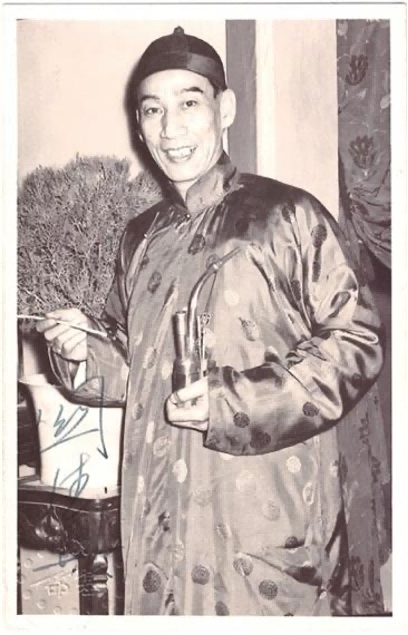
Credit: the author’s collection.
The rise of Wong Fei-hung films in Cold War Hong Kong
Planning for the first two Wong Fei-hung films began in late 1948 and early 1949, coinciding with the last phase of the Chinese civil war between the CCP and KMT and an increasing emphasis on Cold War ideological struggles in a Hong Kong still under British colonial rule. The multiple roles of Hong Kong as a unique battleground for Cold War ideological struggles have been extensively documented (Mark 2000; Roberts and Carroll 2016). As Hong Kong historian David Faure describes it, the cultural Cold War aimed at winning the hearts and minds of the local Hong Kong population was a “small scale Cold War at the periphery” of the broader conflict between the United States and the Soviet Union (Wong and Lee 2009: 14). This characterisation is equally applicable to the film industry. The British colonisers in Hong Kong made concerted efforts to prevent the escalation of Cold War tensions between supporters of the CCP and KMT. To mitigate these tensions within the film sector, the British Hong Kong government implemented measures in the late 1940s and the 1950s such as amending the Societies Ordinance to ban all affiliations with foreign political parties, instituting film censorship, and engaging in negotiations with “Cold War watchers” such as the United States Information Service (USIS)[8] and the Southern Film Corporation, which distributed Mainland Chinese films overseas (Chang J. 2019: 27). Consequently, while Cold War rhetoric in Hong Kong films was defined along ideological lines, it was deliberately muted to avoid exacerbating tensions.
Despite these policies, the cultural Cold War still significantly influenced the Hong Kong film industry in the postwar years, with films subtly conveying contrasting ideological messages. This struggle between CCP and KMT supporters, exemplified through artistic expression, sought political legitimacy from millions of Chinese residents in Hong Kong and the broader diasporic communities. Between 1945 and 1950, Hong Kong’s population surged from 600,000 to 2.3 million, driven by returning war refugees and new immigrants from Mainland China.[9] This demographic boom provided a substantial boost to the film industry. During this period, while Hollywood films with Chinese subtitles remained popular, both Cantonese and Mandarin films, along with films made in other Chinese dialects, attracted dedicated followers locally, as well as in Mainland China and overseas. Consequently, Hong Kong eclipsed Shanghai as the centre of the Chinese film industry, as southbound émigré directors and stars from Shanghai joined newly established film studios in Hong Kong backed by local and Shanghai capitalists. Big-budget Mandarin films began to dominate in the region, often imitating Hollywood. These film studios quickly became political and ideological battlegrounds, with the patriotic and progressive (often labelled as left-wing) camp supported by the CCP clashing with the “Free China,” “Free World” (right-wing) camp backed by the KMT and its US sponsors.[10] Left-leaning Mandarin film studios such as Great Wall Movie Enterprises (Changcheng dianying zhipian youxian gongsi 長城電影製片有限公司) and Cantonese-language film studios such as Union Film Enterprise promoted progressive messages aligned with socialist ideals, rooted in the international socialist movement and the “anti-feudal” drive of the May Fourth Movement in the 1920s.[11] Notable examples include Great Wall’s Nyonyah 娘惹 (1952), which critiques arranged marriage within diasporic Chinese families, and Union Film’s first project, Family (Jia 家, 1953), a social critique melodrama based on a novel by May Fourth intellectual Ba Jin 巴金. Both films present a modern, enlightened vision of modernity through overt criticism of traditional Chinese values and institutions. In contrast, right-leaning studios such as Shaw Brothers (HK) Limited (Shaoshi xiongdi (Xianggang) youxian gongsi 邵氏兄弟(香港)有限公司, established in 1958) and Motion Picture & General Investment Co. (MP&GI) (Guoji dianying mao ye youxian gongsi 國際電影懋業有限公司, established in 1956 and renamed Cathay Organisation (Hong Kong) Ltd. in 1965) inherited and localised cosmopolitan middle-class sensibilities from 1930s Shanghai. Shaw Brothers excelled in big-budget period dramas and Huangmei opera films (Huangmeixi dianying 黃梅戲電影, a form of Chinese opera with rural folk song and dance), while MP&GI produced many cosmopolitan love comedies. Although many MP&GI films were commercially driven and avoided overt propaganda, they subtly expressed modern urban lifestyles and celebrated personal freedom and individualism among youth.[12] More importantly, these right-leaning studios maintained strong relationships with the right-wing Hong Kong and Kowloon Cinema & Theatrical Enterprise Free General Association (Gang Jiu dianying xiju shiye ziyou zonghui 港九電影戲劇事業自由總會) to secure access to the Republic of China (ROC) market, as well as the Nanyang market (mainly Singapore and Malaya), which was firmly under their control.[13]
How should we understand Wong Fei-hung films produced during this historical juncture, when many local and émigré filmmakers in Hong Kong were consciously or subconsciously using films as a medium for expressing political positions and promoting their visions of modernity? Previous studies of Wong Fei-hung films have largely focused on their historical and literary origins, as well as their artistic merits[14] (Yu M. 1980; Po Fung 2010; Po Fung and Lau 2012). Their contribution to the modern experiences of Hong Kong moviegoers has only recently begun to receive full appreciation (Teo 2009; Yip 2017; Chang Y. 2023). This aspect of Wong Fei-hung films will be highlighted below, particularly in contrast to the modernist narratives offered by films produced by left- and right-leaning film studios that actively participated in the Cold War ideological struggles within the Hong Kong film industry.
The first major director of early Wong Fei-hung films was Wu Pang 胡鵬 (1909–2000), who became a respected director of low-budget independent Cantonese-language films for mass consumption. According to his autobiography,[15] Wu learnt about the art of directing from major Chinese directors when he was still a theatre manager in Shanghai in the 1930s. He came to Hong Kong in the late 1930s and began making commercially successful melodrama and martial arts films. In 1948, he conceived the idea of creating a new subgenre of martial arts films, recognising the impending decline of the then-popular fantasy-supernatural wuxia films.[16] Originating from Shanghai in the late 1920s, these fantasy-supernatural wuxia films typically portrayed characters as superheroes with extraordinary abilities. After discussing the concept with Cantonese opera lyricist and screenwriter Ng Yat-siu 吳一嘯 (1906–1964), Wu decided to produce wuxia films that showcased realistic fighting scenes and featured the legendary martial artist Wong Fei-hung, who became famous through many stories written about him and the promotion of his martial arts by his disciples in Hong Kong since the 1930s.
The first two Wong Fei-hung films, released consecutively on 8 and 12 October 1949, were box office successes, becoming the highest grossing Cantonese films of 1949.[17] Wong Fei-hung’s Whip That Smacks the Candle, also known as The Story of Wong Fei-hung, Part One (Huang Feihong zhengzhuan shangji zhi bianfeng mie zhu 黃飛鴻正傳上集之鞭風滅燭, 1949), the first film, opens with a lion dance performed by Wong Fei-hung (portrayed by Kwan Tak-hing) at a Daoist festival organised by Wong’s affluent friend, Mr Chan, in Foshan, a town near Guangzhou. A young man named Leung Foon, played by Tso Tat-wah 曹達華 (1915–2007), gets into a fight and is rescued by Wong, who earns Leung’s admiration and inspires him to become his disciple. Leung and other disciples respect Wong and view him as a stern yet caring father figure. When Wong Fei-hung discovers that a local tyrant has kidnapped Mr Chan’s beautiful wife, he believes he can reason with the tyrant and brings one disciple to the tyrant’s mansion. However, the villain attempts to kill Wong, injuring him in a surprise attack. Fortunately, Wong is saved by a girl named Luk Ah-foon. Meanwhile, Wong’s other disciples successfully rescue Mrs Chan, who is trapped in a snake-infested basement of the mansion. The second part of the film focuses on another villain who, jealous of Wong, verbally insults him during a banquet. Enraged by this, Leung Foon attempts to avenge his master but ends up trapped by the villain. Fortunately, Wong Fei-hung manages to rescue his beloved disciple and engages in a final duel with the antagonist.
According to a 1949 souvenir booklet (reproduced in Chang Y. 2023, souvenir booklet: 5) for the first Wong Fei-hung film, the script was written by Cantonese-opera lyricist Ng Yat-siu, following the style of traditional Chinese “serial fiction” (zhanghui xiaoshuo 章回小說), where each chapter is introduced by a couplet summarising its content. The entire film is structured as a sequence of ten interconnected episodes. Interspersed within this adventurous storyline are demonstrations of various martial arts skills, Cantonese opera songs, lion dances, and surprisingly, Tchaikovsky’s Violin Concerto (Yu S. 2012: 113). This cinematic presentation resembles vaudeville, entertaining audiences with a diverse array of performances rooted in traditional Chinese literary and theatrical conventions, while also incorporating Western classical music – as in the third and fourth Wong Fei-hung films where Beethoven’s Pastoral Symphony serves as background music (ibid.: 110).
Contrary to the common expectation that early Wong Fei-hung films are old-fashioned and didactic, a closer examination of the plot reveals deeper messages conveyed through two strong-willed protagonists: Wong’s disciple, Leung Foon, and Luk Ah-foon, the brave girl who rescues Wong. While Wong is reluctant to disrupt the social status quo, always striving to maintain harmonious relationships and exhibiting humility even after defeating his challengers, Leung Foon is a young man eager to seek justice without considering the consequences. This tension between conservatism and individualism exists in Wong Fei-hung films, creating compelling dramatic effects. Luk Ah-foon, portrayed by the first Miss Hong Kong, Lee Lan 李蘭, is another crucial character. After rescuing Wong, whom she knows to be a renowned martial artist, Luk expresses her love for him. The reserved Wong politely declines her subtle “marriage proposal,” telling her, “If you love me, it doesn’t mean you have to marry me.” (Figure 2) Wong hesitates about marriage, explaining that as a martial artist, he is often travelling and cannot guarantee a stable family life for his wife. Instead, he offers to be Luk’s godfather. However, this is not the end of their relationship, which is further developed in the second film, The Story of Wong Fei-hung, Part Two (Huang Feihong zhuan xiaji 黃飛鴻傳下集, 1949). Now married, Luk sings a Cantonese opera song in her garden, lamenting in the lyrics that nobody is aware of her regret as she is staying in her red chamber. This is a clear allusion to the Qing dynasty novel Dream of the Red Chamber (Honglou meng 紅樓夢), in which the female protagonist buries flowers while mourning her fate. After Luk finishes her song, she notices Wong listening in the garden. She smiles and thanks Wong for his compliment, then gathers her courage to ask why he remains single. Wong smiles awkwardly in response. While Luk boldly professes her love for him, Wong remains confined by traditional social roles. Audiences in Hong Kong, Malaya, and Singapore would have recognised the actress playing Luk as the first Miss Hong Kong, Lee Lan, who gained attention for wearing a swimsuit in the 1946 beauty pageant. Lee’s public persona as a confident, modern Chinese woman likely left a strong impression on viewers, even as she portrayed a late nineteenth-century character in the film. In Wong Fei-hung films, modern sensibilities are often articulated through traditional cultural forms, including singing Cantonese opera, effectively translating and mediating contemporary themes such as gender equality and individualism for the audience.
Figure 2. In the first Wong Fei-hung film, traditional gender roles are reversed as the female protagonist, Luk Ah-foon (right), bravely expresses her love for Wong Fei-hung (left).
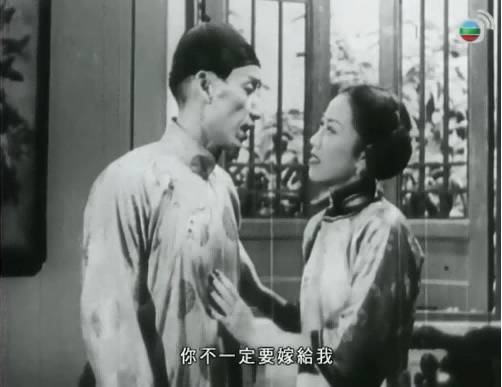
Credit: movie still from Wong Fei-hung’s Whip That Smacks the Candle (1949), directed by Wu Pang and produced by Yongyao Film Company.
Early Wong Fei-hung films are notably more nuanced than the politically-driven films of the 1950s and 1960s, which sought to educate audiences to be less “feudal” and more “modern” or tended to glamorise urban lifestyles based on Western models. The early Wong Fei-hung films vividly portray the challenges of a Chinese society undergoing rapid commercialisation, Westernisation, and economic hardship following the Opium War in the mid-nineteenth century. The villains are often opportunistic or greedy individuals, such as moneylenders and con artists, who exploit the common people, representing the abandonment of traditional Confucian values including benevolence, righteousness, loyalty and filial piety in the pursuit of profit. Wong Fei-hung embodies moral integrity, striving to help and fight for the downtrodden. He serves as a reminder of an old-fashioned yet enlightened sage whose personal quest for moral excellence and social justice resonates with many ethnic Chinese film audiences in colonial Hong Kong and diasporic communities. Wong confronts human dilemmas set against the familiar cultural landscapes of their native towns undergoing modernisation. The depiction of native customs, festivals, and entertainment in these communities offered audiences in Hong Kong and Southeast Asia a cinematic experience that intertwined nostalgia with a modern sensibility.
From wuxia to kung fu: The realism of Wong Fei-hung films
The appeal of the Wong Fei-hung films in the 1950s also stemmed from their invention of a new subgenre of martial arts films, later known as kung fu movies.[18] Kung fu (gung fu 功夫) is the Cantonese term of martial arts made popular worldwide by Bruce Lee and others in the 1960s and 1970s. Literally referring to any skill acquired through persistent training and studious practice, kung fu supposes both authentic skills as well as mental and physical strength. In postwar Hong Kong and Chinese diasporic communities in Southeast Asia, where the majority of working-class people had to endure hardship in the 1950s following wartime devastations, most were hopeful that their industriousness could improve their livelihood in fast-growing capitalistic societies. As will be seen in this section, the qualities associated with kung fu were key selling points of early Wong Fei-hung films from 1949 to the 1950s as realistic demonstrations of martial arts skills were purposefully brought onto the silver screen.
The rise of the kung fu subgenre can be traced back to the collective effort by the second- and third-generation disciples of Wong Fei-hung to promote his martial arts and virtues. One of the earliest efforts was the serialisation of Wong’s biographical stories by Chu Yu-chai 朱愚齋 (1892–1984), Wong’s second-generation disciple, in local newspapers in the early 1930s, culminating in a compiled publication in 1934.[19] In 1948, director Wu Pang and screenwriter Ng Yat-siu visited Chu Yu-chai, whose writings on Wong Fei-hung became the basis of early Wong Fei-hung films, such as the stories about Wong taking Leung Foon as his disciple and being rescued by Luk Ah-foon. They also consulted with Wong Fei-hung’s widow, Mok Kwai-lan (1891–1982), and his son, Wong Hon-hei 黃漢熙, to gather materials and invite them to serve as consultants on early instalments of the Wong Fei-hung film series. Additionally, they enlisted the help of Wong’s third- and fourth-generation disciples in Hong Kong, including Leung Wing-hang 梁永亨, Chan Hon-chung 陳漢宗, and Wu Shuet-fei 胡雪飛, who contributed as action choreographers and stuntmen. This new approach to martial arts films distinguished itself from previous works by featuring realistic combat moves rather than the beautiful yet improbable sequences typical of fantasy-supernatural wuxia films. To emphasise this shift, screenwriter Ng wrote a short article for the souvenir booklet entitled 黃飛鴻傳 (Huang Feihong zhuan, The Story of Wong Fei-hung) which was distributed or sold during the screening of the first Wong Fei-hung film in 1949. After praising the success of Chu Yu-chai’s 1934 biography of Wong Fei-hung, Ng reiterated the message from its preface: the promotion of martial arts was intended for “strengthening the Chinese race” (qiangzhong 強種) and building the nation. He lamented the proliferation of “bizarre and uncanny” (liqi guiyi 離奇詭異) wuxia films, vowing to create a “documentary and realistic” (jishi 紀實) wuxia film instead (Chang Y. 2023, souvenir booklet: 1).
From the outset, director Wu Pang, screenwriter Ng Yat-siu, and their team of consultants intentionally shaped the early Wong Fei-hung films to follow a docudrama format. This approach aimed to achieve two primary goals: to showcase authentic Wong Fei-hung martial arts on screen and to highlight his martial virtues through a straightforward storyline. An advertisement placed in newspapers on 7 October 1949 – just one day before the premiere of the first Wong Fei-hung film – promised audiences an exciting experience (Figure 3). In addition to lion dances and real fighting scenes, the films would feature demonstrations of renowned martial arts techniques, including the Tiger and Crane Fists, which were said to have been passed down from Shaolin-trained martial artist Hong Xiguan 洪熙官 (Chang Y. 2023: 138-9). A slogan in the movie publication boldly claimed: “You learn more about martial arts by watching this film once than eating evening congee [meaning martial arts training] for a decade”[20] (Chang Y. 2023, souvenir booklet: 2). Director Wu Pang later recounted in his autobiography that many moviegoers watched the first two Wong Fei-hung films multiple times just to learn the martial arts moves presented on screen.[21] The success of these initial films prompted the production company to request two more, The Story of Wong Fei-hung, Part Three: The Battle by Lau Fa Bridge (Huang Feihong zhuan di san ji: Xuezhan Liuhuaqiao黃飛鴻傳第三集: 血戰流花橋) and The Story of Wong Fei-hung, Part Four: The Death of Leung Foon (Huang Feihong zhuan di si ji: Liang Kuan guitian 黃飛鴻傳四集: 梁寬歸天), which were released on 13 and 16 April 1950, respectively. This time, Wong Fei-hung’s widow, Mok Kwai-lan, was invited to showcase the Mother/Son Twin Swords (a kung fu technique) on the silver screen. As Wong’s fourth wife, Mok hailed from a distinguished martial arts family and had persuaded her late husband to teach her all his skills, which she hoped to pass on to later generations while using her abilities to earn a living. With the rise of commercialism in Hong Kong, fuelled by newspapers and cinema, Wu Pang, Mok Kwai-lan, and other disciples of Wong Fei-hung seized the opportunity to promote traditional Chinese martial arts and their associated virtues to a broader audience.
Figure 3. Advertisement for the first Wong Fei-hung film, released the day before its premiere on 8 October 1949 in the newspaper Wah Kiu Yat Po
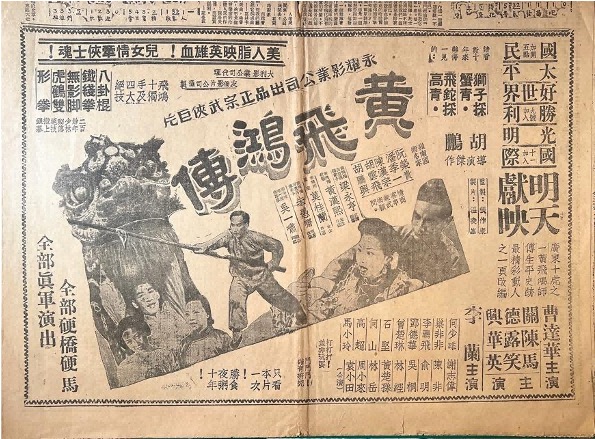
Credit: the author’s collection.
Note: the ad featured a list of five martial arts skills transmitted by Wong Fei-hung, on the top left corner, and emphasised, on the bottom left, that the “performance consisted entirely of real fighting.”
The early Wong Fei-hung films were significant precursors to the kung fu movies of the 1970s that became one of the hallmarks of Hong Kong cinema. Inspired by traditional martial arts and moral ideals, the kung fu movies served as a means of reinventing Chinese traditions within a modern context (Teo 2009; Yip 2017). They reflected the experiences of modernity for the working-class people in Hong Kong’s fast-growing capitalist society, where the demand for a good work ethic was emphasised. As the film scholar Man-Fung Yip notes:
The robust bodies of the action heroes [in martial arts films] (…) conjured up in many ways the capitalist ethos of hard work, competition and conquest, and ascetic perseverance widely considered as the driving force for Hong Kong’s phenomenal economic growth in the 1960s and 1970s. (Yip 2017: 24)
Yip argues that these “action bodies (…) constituted a site/sight that registered and mediated an array of competing social imaginaries associated with Hong Kong colonial-capitalist modernity” (ibid.). While Yip does not delve deeply into the early Wong Fei-hung films of the 1950s, my paper suggests that these early instalments already showcased the modern experiences of postwar Hong Kong, as the modern technology of cinema facilitated new cinematic aesthetics rooted in the body semiotics of martial artists performing real Chinese kung fu skills.
Global film markets, star personae, and cultural hybridisation
The first four Wong Fei-hung films, released between October 1949 and April 1950, achieved commercial success not only in the local Hong Kong market but also in Mainland China and Southeast Asia. This success can be attributed to strategic casting choices. Both Kwan Tak-hing and Tso Tat-wah, who respectively portrayed Wong Fei-hung and his disciple Leung Foon, were well-known actors in Singapore and Malaya – key markets for Cantonese-language films produced in Hong Kong. The strategic casting catered to a broader regional audience, setting the stage for the Wong Fei-hung franchise to expand its reach and popularity beyond Hong Kong (Rodriguez 1997: 2-3).
Unfortunately, the outbreak of the Korean War in June 1950 posed significant challenges for the Hong Kong film industry, hitting the burgeoning Wong Fei-hung film franchise particularly hard. Following the People’s Republic of China’s (PRC) decision to send troops to the Korean Peninsula to support the Democratic People’s Republic of Korea in its conflict with United Nations-led forces supporting the Republic of Korea, the USA imposed a Western embargo on the PRC. In response, the PRC implemented stricter media controls, effectively banning the import of Hong Kong films from the British colony into Mainland China. At that time, the Wong Fei-hung films had established a global network of markets, including Hong Kong, Macao, North and South America, Vietnam, and territories under British or Dutch rule, as well as Guangdong and Guangxi Provinces. According to director Wu Pang, the Mainland Chinese market accounted for more than 20% of the global revenue for any single Cantonese-language film made in Hong Kong.[22] With the ban on imports of Hong Kong-produced films into Mainland China, Southeast Asian film producers became reluctant to invest in the Wong Fei-hung series. After the release of the fifth Wong Fei-hung film in March 1951 – notably entitled The Story of Wong Fei-hung, Grand Conclusion (Huang Feihong zhuan da jieju 黃飛鴻傳大結局) – there were no plans for additional instalments (Figure 4).
Figure 4. Handbill for The Story of Wong Fei-hung, Grand Conclusion (1951)
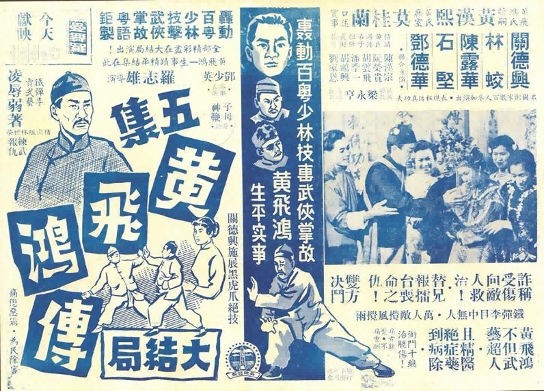
Credit: the author’s collection.
Note: it states that the film will depict “Wong Fei-hung’s life story and his martial arts skills, passed down from the Shaolin Temple, which caused a sensation in Guangdong Province.”
The Korean War thus interrupted the development of the Wong Fei-hung franchise, revealing a crucial insight: the franchise had relied on a global industry chain for its sustainability. This chain included a production team in Hong Kong, enriched by a large pool of film talent, many of whom had relocated from Guangzhou and Shanghai in the immediate postwar period. Hong Kong’s status as a free port further facilitated significant capital investment in various industries, including the establishment of film studios and the importation of advanced film equipment from the West. Moreover, the Wong Fei-hung franchise had, from the start, tapped into a network of global film markets eager for cinematic innovation. Its success was not merely a local phenomenon; it stemmed from the franchise’s ability to appeal to a broader international audience.
Following the onset of the Korean War, production of Wong Fei-hung films experienced a two-year hiatus from 1951 to 1953. However, with news of the war’s impending conclusion, investors quickly sought to revive the franchise. Ethnic Chinese investors from Singapore and Malaya were particularly eager to fund Hong Kong-produced films, recognising the profitability of screening these movies in Southeast Asian theatres catering to ethnic Chinese communities. They offered advance payments to film companies in Hong Kong to cover part of the production costs, provided they produced popular genre films featuring well-known actors. This new investment model led to a surge of Wong Fei-hung films, leveraging the cross-border network of the Sinophone film industry.
The swift recovery of the Wong Fei-hung franchise after the Korean War demonstrated not only the resilience of global film markets and modern cinema circuits for Sinophone films but also the strong appeal of Wong Fei-hung films as a cultural form that expressed both traditional values and modern sensibilities via the modern technology of filmmaking. Apart from global film markets, the star persona of Kwan Tak-hing was also a key factor in mediating vernacular modernism through cultural hybridisation. In particular, Kwan’s long-time experimentation with merging Hollywood elements with traditional Chinese theatrical forms played a decisive role (Rodriguez 1997; Ng 2012; Wong W. 2024). By the 1950s, Kwan was a seasoned Cantonese opera performer, known by the stage name Sun Liang Chau 新靚就. He had trained in Guangzhou and Singapore, gaining fame in places such as Guangzhou, Vietnam, Indonesia, Hong Kong, and San Francisco during the 1930s. Kwan was celebrated for his martial roles, such as the loyal general Guan Yu 關羽 and the righteous outlaw Wu Song 武松, heroes from the classic Chinese novels Romance of the Three Kingdoms (Sanguo yanyi 三國演義) and The Water Margin (Shui hu zhuan 水滸傳), respectively. As a fan of Hollywood silent films, which enjoyed multiple screenings in Hong Kong, Kwan keenly identified similarities between these Chinese heroic figures and Western heroes such as Zorro and Robin Hood, both played by Douglas Fairbanks (1883–1939) in The Mark of Zorro (1920) and Robin Hood (1922).
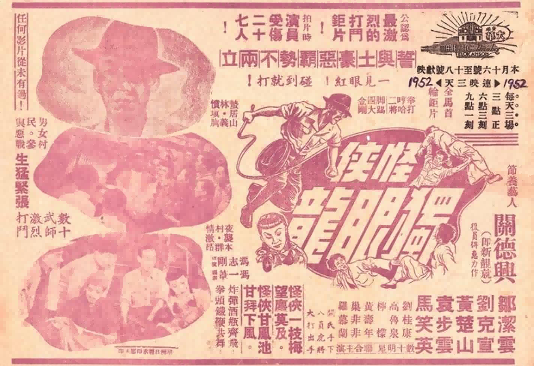
Between 1932 and 1933, Kwan spent over a year performing Cantonese opera in San Francisco’s Chinatown, where Bruce Lee was born seven years later in 1940. There, Kwan developed an interest in cowboy culture, acquiring attire, whips, ropes, and guns. After practicing for 14 months in the basement of his residence, he became proficient enough with his 18-foot whip to extinguish flames on 104 out of 110 candles.[23] Kwan aimed to incorporate elements from the Western into Cantonese opera, notably planning a piece inspired by Zorro, the champion of the oppressed. In December 1936, just seven months before Japan’s full-scale invasion of China, Kwan starred in The Knight of the Whip (Shen bian xia 神鞭俠) as Tang Axing (Tong Ah-hing in Cantonese). The story follows Axing as he leaves his village in search of martial arts skills, inadvertently provoking a feud between Tang Village and Huang Village. A martial arts expert, Tiger Yang, is invited to help Huang Village defeat Tang Village. After mastering whipping skills, Axing returns to find that Tiger Yang has become a tyrant, prompting him to defeat Yang and promote peace and unity before leaving again to join the national army. After World War II, Kwan continued to explore Western themes in The Strange Hero, One-eye Dragon (Guaixia duyanlong 怪俠獨眼龍), released in Hong Kong in December 1947 (Figure 5). In this film, he plays a young man who learns whip skills in the United States and returns to China to confront oppressive local tyrants and Japanese invaders. Kwan’s character embodies a Zorro-like hero, fighting for the downtrodden and solidifying his role as a cultural icon in martial arts films.
Figure 5. Handbill showing Kwan Tak-hing dressed as a cowboy in The Strange Hero, One-eye Dragon (1947)
Credit: the author’s collection.
It was no coincidence that one of the final scenes of the first Wong Fei-hung film showcases Kwan Tak-hing’s extraordinary whip skills, reflecting a cinematic attempt to hybridise images of Chinese and Western heroes. Wong Fei-hung uses a cowboy whip – not a traditional Chinese whip – to extinguish the flames on candles, leaving his enemies in awe and prompting them to pay their respects. This scene symbolises Kwan’s successful adaptation of modern individual heroism into traditional Chinese martial virtues. Wong Fei-hung is often reluctant to use brute force against his opponents, concerned about the potential for endless feuds. Interestingly, his skilful demonstration using a Western cowboy whip conveys a Confucian moral message: the true achievement of a martial artist lies not in defeating others, but in cultivating goodness in humanity through years of training and self-discipline.
In short, the vernacular modernism reflected in the Wong Fei-hung films exemplifies East-West cultural hybridisation and the invention of martial arts tradition through cinematic discourse.[24] The next section will briefly discuss the new film technologies and cinematic expressions adopted during the late 1950s, as well as the demise of the first golden age of Wong Fei-hung films.
Adoption of new film technologies and the demise of the franchise in the late 1950s
In 1956–1957, the number of Cantonese-language films produced in Hong Kong reached a historic high of 249, fluctuating between 162 and 222 until the mid-1960s. However, by 1967–1968, the count dropped below 100 and fell to zero by 1972–1973 (Jarvie 1977: 129). Similarly, Wong Fei-hung films experienced a decline, peaking at 59 films in the 1950s before falling to 13 in the 1960s and dwindling to just seven and three in the 1970s and 1980s, respectively (Chang Y. 2023: 116). A significant challenge for the Wong Fei-hung franchise was competition from the influential Shaw Brothers and MP&GI, which produced big-budget, award-winning colour films based on classic Chinese history and legends as well as successful Hollywood stories. The grandeur, innovation and modern sensibilities of these films captivated both local and diasporic Chinese audiences, rendering the predictable storylines and familiar cast of Wong Fei-hung films less appealing by comparison. Despite this downturn, the franchise maintained a loyal following, prompting investments in new cinematic technologies.
One significant advancement was the introduction of colour film. Although some Hong Kong films had experimented with colour as early as the late 1930s, high production costs limited its widespread adoption. During the immediate postwar period, most Hong Kong films were produced in black-and-white. However, starting in late 1957, several Wong Fei-hung films began to incorporate partial colour filming, including Wong Fei-hung’s Rival for a Pearl (Huang Feihong erlong zhengzhu 黃飛鴻二龍爭珠, 1957), Wong Fei-hung’s Story: Five Poisonous Devils Against Twin Dragons (Huang Feihong wudu dou shuanglong 黃飛鴻五毒鬥雙龍, 1958), How Wong Fei-hung Stormed Phoenix Hill (Huang Feihong da nao fenghuang gang 黃飛鴻大鬧鳳凰崗, 1958), Wong Fei-hung’s Victory at Ma Village (Huang Feihong dapo Ma jiazhuang 黃飛鴻大破馬家莊, 1958), and How Wong Fei-hung Pitted an Iron Cock Against the Eagle (Huang Feihong tie ji dou shen ying 黃飛鴻鐵鷄鬥神鷹, 1958) (Chang Y. 2023: 270-3).
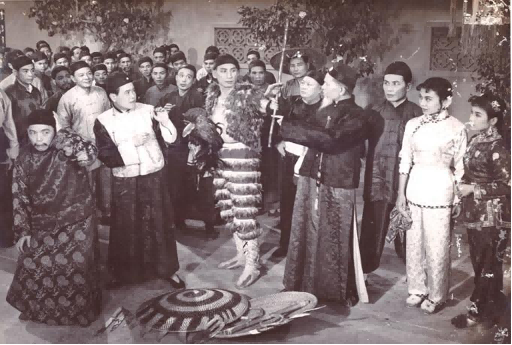
The climactic fight scene in How Wong Fei-hung Pitted an Iron Cock Against the Eagle (Figure 6) utilised Eastman Kodak colour film to enhance its visual impact. In this scene, Wong Fei-hung, dressed as an iron cock, battles his arch-rival portrayed by Shek Kin, who appears as an eagle.[25] The first full-colour Wong Fei-hung film, Wong Fei-hung on Rainbow Bridge (Huang Feihong yi guan caihong qiao 黃飛鴻義貫彩虹橋), premiered on 1 February 1959. Despite its high budget, the film performed poorly at the box office. By the mid-1960s, major studios such as Shaw Brothers, with their advanced facilities, actor training schools, and Hollywood-style production systems, began to dominate the industry. Alongside other Cantonese-language films, the Wong Fei-hung franchise experienced a brief revival in the early 1960s before facing a swift decline.
Figure 6. A black-and-white production still of How Wong Fei-hung Pitted an Iron Cock Against the Eagle (1958), partially filmed in colour
Credit: the author’s collection.
After a tragic airplane accident in June 1964 that claimed the lives of the owner and several top executives of MP&GI, the Shaw Brothers emerged to dominate the Hong Kong film industry. They had established the studio complex Movietown in Hong Kong, owned cinema circuits across Southeast Asia, and introduced a modern management system within their film production unit. This rise of the Shaw Brothers marked a new phase in Hong Kong film history, where the studio system increasingly dictated market dynamics by producing a large volume of films and controlling their distribution in Southeast Asia and Hong Kong (Fu 2008, 2023: 109-48). This success coincided with rapid technological advances during Hong Kong’s industrialisation between 1963 and 1970,[26] when imports of high-tech film equipment and resources for production and marketing became concentrated in the hands of major film companies. As a result, the Wong Fei-hung film franchise, which had previously relied on independent production companies with limited budgets, experienced a significant decline in production, producing only 13 films in the 1960s and seven in the following decade.
Concluding remarks
In short, the enduring popularity of Wong Fei-hung films stemmed from their blend of traditional Chinese values and Western pop culture elements, the nostalgic allure of their docudrama approach, and the innovative performances of the charismatic actor Kwan Tak-hing. These factors facilitated a rapid recovery of the franchise after the Korean War. The sixth Wong Fei-hung film premiered on 16 July 1953, just over a week before an armistice was signed on 27 July, officially ending the conflict. In the subsequent years, the franchise solidified, resulting in the release of 59 Wong Fei-hung films throughout the 1950s, supported by a transnational network within the Cantonese-language film industry.
A cursory examination of surviving handbills for Wong Fei-hung films reveals that principal audience bases were largely located in Hong Kong, Singapore (which gained self-governance in 1959), and Malaya (independent Malaysia founded in 1957). Although many of these films featured simplistic plots, they offered compelling, “realistic” portrayals of Guangzhou, Foshan, and other towns in Guangdong, tracing audiences’ cultural lineage back to these places. Notable examples include Wong Fei-hung’s Fight in Foshan (Huang Feihong da nao Foshan 黃飛鴻大鬧佛山, 1956), How Wong Fei-hung Set Fire to Dashatou (Huang Feihong huoshao Dashatou 黃飛鴻火燒大沙頭, 1956), How Wong Fei-hung Vanquished the Ferocious Dog in Shamian (Huang Feihong Shamian fu shen quan 黃飛鴻沙面伏神犬, 1956), and Wong Fei-hung’s Battle at Saddle Hill (Huang Feihong diexue Ma’anshan 黃飛鴻喋血馬鞍山, 1957). The meticulously recreated scenes of lion dances, Cantonese opera singing, local festivals, and martial arts evoked a strong sense of nostalgia among the first and second-generation Overseas Chinese moviegoers for their hometowns in Guangdong Province.
Furthermore, the early Wong Fei-hung films established the expectation of authentic kung fu skills among actors, which became a core appeal of internationally acclaimed Hong Kong martial arts films. Kwan Tak-hing, who portrayed Wong Fei-hung in most films, became the first in a lineage of icons synonymous with real martial arts prowess, performing his own stunts. Super kung fu movie stars following Kwan included Lau Kar-leung, Lau Kar-fai (Gordon Liu) 劉家輝, Bruce Lee, Jackie Chan, Sammo Hung 洪金寶, Donnie Yen 甄子丹, and Jet Li. Notable action choreographers, including Yuen Siu-tien 袁小田 and Lau Kar-leung, contributed to the Wong Fei-hung franchise, reinforcing this authenticity. Reports of injuries sustained during filming further emphasised the realism of their fight sequences, marking a significant contribution to the maturation of the kung fu subgenre in the 1960s and 1970s.
Examining the Wong Fei-hung film franchise through genre and industry perspectives reveals how vernacular modernism could be articulated, mediated, and circulated by mass media for Hong Kong and other Chinese communities, particularly during the Cold War. These communities experienced significant urbanisation and modernisation postwar while preserving traditional values. The franchise skilfully navigated the ideological tensions of the Cold War, providing ethnic Chinese audiences with an alternative lens to experience modernity. Within its cinematic universe, traditional values and cultural motifs articulate the complex relationship between tradition and modernity. As competition from studios such as Shaw Brothers grew, the Wong Fei-hung franchise adopted modern technologies, such as colour film, to rejuvenate its offerings and meet audience demand. However, without sustained support from independent production companies, the franchise struggled to remain relevant. The dominance of larger studios ultimately contributed to its decline.
Finally, the rapid industrialisation of Hong Kong since the mid-1960s transformed citizens’ modern experiences, diminishing the nostalgic appeal of early Wong Fei-hung films. This shift created a demand for new cinematic experiences that the early films could no longer satisfy, rendering them outdated and old-fashioned. Consequently, the evolution of the Wong Fei-hung franchise mirrored Hong Kong’s unique approach to modernism in the 1950s, rooted in tradition and folk practices while navigating broader global influences and the complexities of Cold War ideologies.
Acknowledgements
This paper originated from a panel presentation at “Hong Kong Convergence: (Re)connection: communication, and contact,” an academic conference organised by the Faculty of Arts at The University of Hong Kong in early June 2024. I would like to thank my fellow panellists, Pr Tze-ki Hon, Dr Heidi Huang, and Dr Henry Choi, for their feedback, ideas, and encouragement during the preparation of the early drafts. I also greatly appreciate the detailed suggestions from the two anonymous reviewers.
Manuscript received on 27 September 2024. Accepted on 12 December 2024.
Primary sources – Wong Fei-hung films mentioned in the paper
| Date of release | Director | Title |
| 8/10/1949 | Wu Pang 胡鵬 | Wong Fei-hung’s Whip That Smacks the Candle, also known as The Story of Wong Fei-hung, Part One (Huang Feihong zhengzhuan shangji zhi bianfeng mie zhu 黃飛鴻正傳上集之鞭風滅燭) |
| 12/10/1949 | Wu Pang 胡鵬 | The Story of Wong Fei-hung, Part Two (Huang Feihong zhuan xiaji 黃飛鴻傳下集) |
| 13/04/1950 | Wu Pang 胡鵬 | The Story of Wong Fei-hung, Part Three: The Battle by Lau Fa Bridge (Huang Feihong zhuan di san ji: Xuezhan Liuhuaqiao黃飛鴻傳第三集: 血戰流花橋) |
| 16/04/1950 | Wu Pang 胡鵬 | The Story of Wong Fei-hung, Part Four: The Death of Leung Foon (Huang Feihong zhuan si ji: Liang Kuan guitian 黃飛鴻傳四集: 梁寬歸天) |
| 15/03/1951 | Law Chi-hung 羅志雄 | The Story of Wong Fei-hung, Grand Conclusion (Huang Feihong zhuan da jieju 黃飛鴻傳大結局) |
| 11/12/1955 | Wu Pang 胡鵬 | How Wong Fei-hung Vanquished the Bully at a Long Dyke (Huang Feihong changdi jianba 黃飛鴻長堤殲霸) |
| 14/01/1956 | Wu Pang 胡鵬 | Wong Fei-hung’s Fight in Foshan (Huang Feihong da nao Foshan 黃飛鴻大鬧佛山) |
| 28/01/1956 | Wu Pang 胡鵬 | How Wong Fei-hung Set Fire to Dashatou (Huang Feihong huoshao Dashatou 黃飛鴻火燒大沙頭) |
| 19/07/1956 | Wang Tianling (aka Wong Tin-lam) 王天林 | How Wong Fei-hung Vanquished the Ferocious Dog in Shamian (Huang Feihong Shamian fu shen quan 黃飛鴻沙面伏神犬) |
| 17/04/1957 | Wu Pang 胡鵬 | Wong Fei-hung’s Battle at Saddle Hill (Huang Feihong diexue Ma’anshan 黃飛鴻喋血馬鞍山) |
| 01/12/1957 | Wu Pang 胡鵬 | Wong Fei-hung’s Rival for a Pearl (Huang Feihong erlong zhengzhu 黃飛鴻二龍爭珠) |
| 26/01/1958 | Wu Pang 胡鵬 | Wong Fei-hung’s Story: Five Poisonous Devils Against Twin Dragons (Huang Feihong wudu dou shuanglong 黃飛鴻五毒鬥雙龍) |
| 15/04/1958 | Wu Pang 胡鵬 | How Wong Fei-hung Stormed Phoenix Hill (Huang Feihong da nao Fenghuang gang 黃飛鴻大鬧鳳凰崗) |
| 14/08/1958 | Wu Pang 胡鵬 | Wong Fei-hung’s Victory at Ma Village (Huang Feihong dapo Majiazhuang 黃飛鴻大破馬家莊) |
| 21/09/1958 | Wu Pang 胡鵬 | How Wong Fei-hung Pitted an Iron Cock Against the Eagle (Huang Feihong tie ji dou shen ying 黃飛鴻鐵鷄鬥神鷹) |
| 01/02/1959 | Wu Pang 胡鵬 | Wong Fei-hung on Rainbow Bridge (Huang Feihong yi guan caihong qiao 黃飛鴻義貫彩虹橋) |
| 16/07/1969 | Wong Fung 王風 | Wong Fei-hung’s Combat with the Five Wolves (Huang Feihong hu he dou wulang 黃飛鴻虎鶴鬥五狼) |
| 05/10/1978 | Yuen Woo-ping (aka Yuen Wo-ping) 袁和平 | Drunken Master (Zui quan 醉拳) |
References
CHANG, Jing Jing. 2019. Screening Communities: Negotiating Narratives of Empire, Nation, and the Cold War in Hong Kong Cinema. Hong Kong: Hong Kong University Press.
CHANG, Yu 張彧. 2023. 香江飛鴻: 黃飛鴻傳奇與嶺南文化 (Xiangjiang Feihong: Huang Feihong chuanqi yu Lingnan wenhua, Wong Fei-hung legend and Lingnan culture). Hong Kong: Chung Hwa Book Company Limited.
CHEN, Lingchei Letty. 2020. “Cultural Imagining of the Cold War: An Introduction.” China Perspectives 125: 3-6.
CHIU, Henry Kit-fung 趙傑鋒. 2024. 市井香港: 戰前香港的粵語電影, 宣傳電影和文化空間 (Shijing Xianggang: Zhanqian Xianggang de yueyu dianying, xuanchuan dianying he wenhua kongjian, Hong Kong informality: Cantonese cinema, propaganda film, and the cultural field in prewar Hong Kong). Hong Kong: Hong Kong University Press.
FENG, Xiaoyun 封小雲, and GONG Weiping 龔唯平 (eds.). 1997. 香港工業2000 (Xianggang gongye 2000, Hong Kong industries 2000). Hong Kong: Joint Publishing.
FU, Po-Shek. 2008 (ed.). China Forever: Shaw Brothers and Diasporic Cinema. Champaign: University of Illinois Press.
———. 2023. Hong Kong Media and Asia’s Cold War. Oxford: Oxford University Press.
FU, Po-Shek, and Man-Fung YIP (eds.). 2020. The Cold War and Asian Cinemas. London: Routledge.
HANSEN, Miriam. 1999. “The Mass Production of the Senses: Classical Cinema as Vernacular Modernism.” Modernism/Modernity 6(2): 59-77.
———. 2000. “Fallen Women, Rising Stars, New Horizons: Shanghai Silent Film as Vernacular Modernism.” Film Quarterly 54(1): 10-22.
HOBSBAWM, Eric, and Terence RANGER. 1992. The Invention of Tradition. Cambridge: Cambridge University Press.
JARVIE, Ian Charles. 1977. Window on Hong Kong: A Sociological Study of the Hong Kong Film Industry and Its Audience. Hong Kong: Centre of Asian Studies, University of Hong Kong.
KANG, Ling. 2020. “CinemaScope’s Chinese Journey: The Technological Modernisation and the Logistics of Perception of the Cold War.” China Perspectives 125: 7-13.
LAW KAR 羅卡, NG Ho 吳昊, and CHEUK Pak-tong 卓伯棠. 1997. 香港電影類型論 (Xianggang dianying leixing lun, On Hong Kong film genres). Oxford: Oxford University Press.
LEE, Sangjoon, and Darlene ESPENA (eds.). 2024. Remapping the Cold War in Asian Cinemas. Amsterdam: Amsterdam University Press.
LEE, Vivian P. Y. 2020. The Other Side of Glamour: The Left-wing Studio Network in Hong Kong Cinema in the Cold War Era and Beyond. Edinburgh: Edinburgh University Press.
MARK, Chi-kwan. 2000. Hong Kong and the Cold War: Anglo-American Relations, 1949-1957. Oxford: Oxford University Press.
MORGAN, Daniel. 2014. “‘Play with Danger’: Vernacular Modernism and the Problem of Criticism.” New German Critique 41(2): 67-82.
NG, May Kwan-yuk 吳君玉. 2012. “從新靚就到黃飛鴻: 關德興戲影生涯點滴” (Cong Xin Jingjiu dao Huang Feihong: Guan Dexing xiying shengya diandi, From Sun Liang Chau to Wong Fei-hung: The life and career of Kwan Tak-hing). In PO FUNG 蒲鋒, and LAU Yam 劉嶔 (eds.), 主善為師: 黃飛鴻電影研究 (Zhu shan wei shi: Huang Feihong dianying yanjiu, Mastering virtue: The cinematic legend of a martial artist). Hong Kong: Hong Kong Film Archive. 84-97.
PO FUNG 蒲鋒. 2010. 電光影裡斬春風: 剖析武俠片的肌理脈絡 (Dianguangying li zhan chunfeng: Pouxi wuxiapian de jili mailuo, Cutting spring air in the light and shadow: Analysing the development of martial arts films). Hong Kong: Hong Kong Film Critics Society.
PO FUNG蒲鋒, and LAU Yam 劉嶔 (eds.). 2012. 主善為師: 黃飛鴻電影研究 (Zhu shan wei shi: Huang Feihong dianying yanjiu, Mastering virtue: The cinematic legend of a martial artist). Hong Kong: Hong Kong Film Archive.
ROBERTS, Priscilla, and John M. CARROLL (eds.). 2016. Hong Kong in the Cold War. Hong Kong: Hong Kong University Press.
RODRIGUEZ, Hector. 1997. “Hong Kong Popular Culture as an Interpretive Arena: The Huang Feihong Film Series.” Screen 38(1): 1-24.
TAN, Jessica. 2020. “Vehicles of Modernity: Gender, Mobility and Music in Evan Yang’s MP&GI Films.” In Po-Shek FU, and Man-Fung YIP (eds.), The Cold War and Asian Cinemas. London: Routledge. 139-57.
TEO, Stephen. 2009. Chinese Martial Arts Cinema: The Wuxia Tradition. Edinburgh: Edinburgh University Press.
WONG, Ain-ling 黃愛玲. 2001. “Preface.” In WONG, Ain-ling 黃愛玲 (ed.), 香港影人口述歷史叢書之二. 理想年代: 長城, 鳳凰的日子 (Xianggang yingren koushu lishi congshu zhi er. Lixiang niandai: Changcheng, Fenghuang de rizi, Oral history of Hong Kong filmmakers series 2. An age of idealism: Great Wall and Feng Huang days). Hong Kong: Hong Kong Film Archive. vi-xxvii.
WONG, Ain-ling黃愛玲, and LEE Pui-tak 李培德 (eds.). 2009. 冷戰與香港電影 (Lengzhan yu Xianggang dianying, Cold War and Hong Kong cinema). Hong Kong: Hong Kong Film Archive.
WONG, Wayne. 2024. “Kwan Tak-hing: Pioneer of Kung fu Cinema.” In Kyle BARROWMAN (ed.), Fighting Stars: Stardom and Reception in Hong Kong Martial Arts Cinema. London: Bloomsbury Academic. 19-40.
YEUNG, Jessica Siu-yin. 2024. “Film Circulation and Mutual Influences between Hong Kong and Taiwan during the Cold War.” In Chris BERRY, Wafa GHERMANI, Corrado NERI, and Ming-yeh T. RAWNSLEY (eds.), Taiwanese-language Cinema: Rediscovered and Reconsidered. Edinburgh: Edinburgh University Press. 232-54.
YIP, Man-Fung. 2017. Martial Arts Cinema and Hong Kong Modernity: Aesthetics, Representation, Circulation. Hong Kong: Hong Kong University Press.
YU, Mo-wan 余慕雲. 1980. “黃飛鴻電影的初步研究” (Huang Feihong dianying de chubu yanjiu, A preliminary study of Wong Fei-hung films). Nan bei ji (南北極) 118(16): 79-84.
YU, Siu-wah 余少華. 2012. “五十年代黃飛鴻電影音樂及其承載的歷史音樂文化” (Wushi niandai Huang Feihong dianying yinyue ji qi chengzai de lishi yinyue wenhua, The music of Wong Fei-hung in the 1950s and the historical music culture within). In PO FUNG 蒲鋒, and LAU Yam 劉嶔 (eds.), 主善為師: 黃飛鴻電影研究 (Zhu shan wei shi: Huang Feihong dianying yanjiu, Mastering virtue: The cinematic legend of a martial artist). Hong Kong: Hong Kong Film Archive. 106-27.
[1] The birth year of Wong Fei-hung is sometimes cited as 1847, but 1850 has been established based on information from his widow Mok Kwai-lan 莫桂蘭, and her adopted son and disciple Li Chan-wo 李燦窩. I interviewed Mr Li on 25 March 2023.
[2] The first full-length biographical account of Wong Fei-hung, based on interviews with his disciple Lam Sai-wing 林世榮, was serialised in Hong Kong’s Kung Sheung Evening News 工商晚報 from June 1932 to August 1933, before being published in 1934 as 粵派大師黃飛鴻別傳 (Yuepai dashi Huang Feihong biezhuan, Unofficial biography of Guangdong martial arts master Huang Feihong) (Chang Y. 2023: 84-95). Throughout the 1950s, many stories inspired by Wong Fei-hung’s biography were written and published in newspapers and magazines.
[3] I provide the most comprehensive list of films based on the Wong Fei-hung character from 1949 to 1999 (Chang Y. 2023: 262-83). During that period, a total of 98 films were produced, with even more Wong Fei-hung films created since then.
[4] The scholarly study of Wong Fei-hung films has a rich history. The first systematic examination was conducted by the film scholar Yu Mo-wan in the 1980s and 1990s. Since then, a number of other researchers have built upon this foundational work, providing more detailed analyses of the Wong Fei-hung film franchise. Scholars such as Po Fung, Lau Yam, Law Kar, Ng Ho, Hector Rodriguez, Stephen Teo, Yao Chaowen, and Wayne Wong have all contributed to the understanding of these films. Their studies have delved deeper into the cultural, historical, and ideological dimensions of the Wong Fei-hung cinematic universe.
[5] CinemaScope widescreen technology, imported into Mainland China in 1957, was employed by the People’s Republic of China as a propagandist strategy during the Cold War (Chen 2020: 3-6; Kang 2020). The first Wong Fei-hung film to adopt the widescreen format was Wong Fei-hung’s Combat with the Five Wolves (Huang Feihong hu he dou wulang 黃飛鴻虎鶴鬥五狼, 1969).
[6] According to Miriam Hansen, “classical Hollywood cinema could be imagined as a cultural practice on a par with the experience of modernity, as an industrially-produced, mass-based, vernacular modernism” (1999: 65).
[7] Kwan’s onscreen arch-rival in most Wong Fei-hung films is the martial artist Shek Kin 石堅 (1913–2009), who created a star persona in his own right.
[8] In August 1953, existing USIS posts operating out of US embassies worldwide since World War II became field operations offices of the United States Information Agency (USIA).
[9] Government Information Services, 1978, Hong Kong 1978: A Review of 1977, Hong Kong: Government Printer, p. 209.
[10] The complex and nuanced Cold War ideological struggles in the postwar Hong Kong film industry have been extensively researched for decades. More recent works include Chang J. (2019), Lee (2020), Fu and Yip (2020), Fu (2023), and Lee and Espena (2024). It is important to note that even with US financial support, all right-leaning studios – such as Asia Pictures Limited (Yazhou yingye youxian gongsi 亞洲影業有限公司), funded by the US Asia Foundation and active in the 1950s – opted for subtlety in expressing their political stance (Wong and Lee 2009: 125-37). The same can be said for the left-leaning studios.
[11] A group of prominent left-leaning filmmakers and actors of Cantonese films, including Ng Cho-fan 吳楚帆, viewed cinema as a tool for public education and sought to elevate film quality. In the early 1950s, they founded the South China Film Industry Workers Union (Huanan dianying gongzuozhe lianhehui 華南電影工作者聯合會) and the Union Film Enterprise to promote meaningful, educational films.
[12] Examples of MP&GI productions include Mambo Girl (Manbo nülang 曼波女郎, 1957), Our Sister Hedy (Si qian jin 四千金, 1957), Air Hostess (Kongzhong xiaojie 空中小姐, 1959), and The Wild, Wild Rose (Ye meigui zhi lian 野玫瑰之戀, 1960). For a discussion of modernist expressions in several MP&GI films directed by émigré director Evan Yang from Shanghai, see Tan (2020).
[13] In 1953, the filmmaker Zhang Shankun 張善琨 and others organised a troupe to entertain ROC troops. In 1956, they established the right-wing Hong Kong and Kowloon Filmmakers Free General Association, which in the following year was renamed Hong Kong and Kowloon Cinema & Theatrical Enterprise Free General Association. The Free General Association controlled film distribution to the ROC, which was experiencing rapid economic growth and developing a strong appetite for Mandarin films from Hong Kong (Wong 2001).
[14] Wu Pang 胡鵬, 1995, 我與黃飛鴻 (Wo yu Huang Feihong, Wong Fei-hung and I), Hong Kong: Sanhe maoyi gongsi.
[15] Ibid.
[16] Ibid. p. 4-5.
[17] Ibid. p. 25.
[18] Teo (2009) and Yip (2017) provide two full-length studies in English of the development of kung fu movies. Also refer to Po Fung (2010) and Wong (2024).
[19] Chu Yu-chai (Chai-kung) 朱愚齋 (齋公), 1934, 粵派大師黃飛鴻別傳 (Yuepai dashi Huang Feihong biezhuan, Unofficial biography of Guangdong martial arts master Huang Feihong), Hong Kong: Guoxue congshu she.
[20] In the past, many martial artists in Hong Kong practised their skills after work in the evening, often enjoying congee afterward. Thus, “eating congee” became a colloquial expression referring to those skilled in martial arts.
[21] Wu Pang 胡鵬, 1995, 我與黃飛鴻 (Wo yu Huang Feihong, Wong Fei-hung and I), op. cit., p. 27.
[22] Wu Pang 胡鵬, 1995, 我與黃飛鴻 (Wo yu Huang Feihong, Wong Fei-hung and I), op. cit., p. 42.
[23] Ma Wan 馬雲 (ed.), 1996, 愛國藝人關德興的一生 (Aiguo yiren Guan Dexing de yisheng, The life story of the patriotic artist Kwan Tak-hing), Hong Kong: Editorial Board of The Life Story of Kwan Tak-hing, p.66-7.
[24] The “invention of traditions” is evident in many modern nations (Hobsbawm and Ranger 1992).
[25] Wu Pang 胡鵬, 1995, 我與黃飛鴻 (Wo yu Huang Feihong, Wong Fei-hung and I), op. cit., p. 194.
[26] Hong Kong industrialised rapidly from 1963 to 1970. Existing industries continued to prosper, while new industries emerged and thrived as well. The number of factories increased 67% while the number of workers increased 15%. The number of factories and workers in 1970 were 16,507 and 549,000 respectively (Feng and Gong 1997: 30).