 >
>

China Perspective Issues
BOOK REVIEWS
Education and the Disintegration of Rural Communities: Effects of Rural Educational Migration in China
Yuan Teng is Associate Professor at the Faculty of Education in Central China Normal University, Room 623, Tianjiabing Building, No. 152 Luoyu Road, Hongshan District, Wuhan, Hubei, China 430079 (yuanteng2009@126.com).
Kwok Kuen Tsang is Assistant Professor at the Department of Education Policy and Leadership in the Education University of Hong Kong, Room D2-1/F-41, 10 Lo Ping Road, Tai Po, New Territories, Hong Kong SAR, China (tkwokkuen@eduhk.hk).
Introduction
Now, only people over 70 are at home. Those who are slightly healthier are accompanying children to study in townships or county seats. (...) If anyone a bit timid visited our village, they might feel frightened. (Interview with S-Daorui’s mother, June 2018)
This comment reflects the experience of an emptying and disorganised rural community affected by the prevalent trend of 陪讀 (peidu, literally accompanying studies), which essentially means that rural adults migrate from rural to urban areas (usually within their county) with their children or grandchildren for the sake of the latter’s education. Peidu families usually assign one or more adults referred to as “guardian,” typically mothers or grandparents, to take care of their children and either buy or rent an apartment near the urban school (Lei 2018). Peidu adults are usually unemployed or working part-time. They focus on serving children’s education rather than their own immediate economic advancement (Wu, Wu, and Chen 2019). Meanwhile, the fathers or both parents become migrant workers in large cities to support family’s expenses. Most young and middle-aged peidu individuals are unwilling to return to rural villages later in life (Chen and Liang 2015). However, the well-known term peidu cannot fully capture the migration characteristics of this phenomenon. In this study, peidu is considered as rural educational migration[1] – referring to rural families migrating to nearby urban areas for children’s education. Although rural-to-urban labour migration has been common in China, migration for educational purposes is new.
Peidu has become prevalent across rural China over the last decade (Lei 2018; Wang and Pan 2019). Shan’s (2021) fieldwork in one town in western China suggested that 90% of rural pupils were attending the township school instead of a village school in 2015, and half of them were accompanied by their guardians. Another study indicates that two-thirds of rural families in a village located in Jiangxi Province sent their children to the primary school in the county capital[2] rather than to their village school in 2020 (Zhang and Zhu 2021). Similarly, Ding, Luo, and Wang (2019) showed that 25% of students in a township school were peidu students from rural villages located in Jiangsu Province in 2017.
Previous literature has found a mixed impact of peidu on children’s academic achievement (Long et al. 2020), and a negative influence on children’s mental stress (Ding, Luo, and Wang 2019). It has also identified harmful effects on adults’ social adaptation (Chen and Liang 2015), career development (Wu, Wu, and Chen 2019), and marital relationships (Ding, Luo, and Wang 2019), along with a financial burden on the family (Lei 2018). However, these studies have mostly limited their treatment of the phenomenon to the private sphere of the families’ and individuals’ well-being, ignoring its broader impact on rural communities.
Like labour migration, rural educational migration has caused losses in the rural labour force and a potential brain drain. Existing studies on rural-to-urban labour migration have shown that it harms rural communities by damaging community interactions (Qin and Flint 2012) and social structure (Li 2004). The educational exodus of peidu is likely to hamper rural community development even further. Unlike labour migrants, who tend to join their fellow villagers and share job opportunities (Yue et al. 2013), educational migrants are more isolated from one another in urban areas, indicating a deep disruption of their rural ties. However, the impact of educational migration on rural community cohesion and the underlying educational logic contributing to this phenomenon remains unexplored.
Rural revitalisation has been a national strategy in China since the 19th National Congress of the Chinese Communist Party (CCP) in 2017. Cohesive communities are thus not only necessary for promoting rural economic, social, and ecological development but are also a key element of rural reinvigoration (Zhang et al. 2022). Therefore, this study adopts a community perspective to understand the consequences of educational migration and situates education in relation to rural revitalisation.
Literature review
Rural community
The study of communities can be traced back to the works of Tönnies (2001) and Durkheim (1997). For them, a community (Gemeinschaft) is characterised by close and dense relationships between people and a common habitat; community members cooperate, support each other, and coordinate activities for the common good. Community has been defined in myriad ways – for example, as a territory or as a relation like a professional association, as Hillery (1959) summarised. Gusfield (1975) argued that defining “community” as a territory oversimplifies the concept, as the relational dimension is what matters. Nearly all definitions of a cohesive community involve dense social ties (Brint 2001), a strong sense of commitment to the community (Forrest and Kearns 2001), and collective activities for achieving shared goals (Wilkinson 1991). Additionally, social organisations and leadership play a significant role in mobilising community members and motivating collective actions (Yang, Feldman, and Li 2020). Therefore, a cohesive rural community could be understood as a rural place in which people are connected to one another, have a high level of commitment to the community, and engage in collective activities to pursue the good of all community members.
Rural communities in China have undergone significant changes over time. In the imperial and republican periods, a rural community was defined as an entity constituted of acquaintances and dependent on traditional kinship ties based on clans (Fei 1985), a meaning close to Durkheimian Gemeinschaft. After the foundation of the People’s Republic of China (PRC), the traditional social structure was replaced by the people’s commune, a formal organisation in which rural people were equally positioned, closely connected, and organised to achieve common living and production goals (Gao 2018). People’s communes in rural villages were abandoned in 1978 and have since been replaced by village committees, which are self-organising institutions (ibid.).
Since China’s reform and opening up, rural communities have faced significant losses in labour force. China has shifted to an export-oriented economy focused on large cities, which resulted in a wide rural‒urban gap and a severe shortage of labour for urban development in large cities (Unger 2002). Meanwhile, the retreat of the government from rural development has led to the centrality of the market and capital in both agricultural production and rural life, leaving household-based farming unable to support the livelihoods of rural families (Yan and Chen 2015). Therefore, many rural people (292.51 million in 2021) have migrated to cities for job opportunities since the 1980s.[3]
Labour migration has modified the social structures of traditional rural communities (Qin and Flint 2012). It has given rise to the phenomenon of “hollow villages” (kongxin cun 空心村), causing the breakdown of social networks and a weakening of the communication and cooperation needed for community development (ibid.). In particular, the departure of rural elites previously active in formal and informal institutions has transformed rural communities’ social structure (Li 2004). Although the national plan of rural revitalisation has promoted rural economic development, it did not give much attention to the necessity of establishing cohesive communities.
In sum, rural communities in China have experienced rapid changes due to political and economic factors. In particular, the widespread trend of rural-to-urban labour migration has harmed rural communities. In this context of decreased attraction of rural areas and desire for upward mobility, rural families have developed strong educational aspirations, which translate, among other phenomena, into rural educational migration (Huang 2012). Consequently, education has become a critical factor shaping rural communities.
Education and rural communities
The development of rural communities matters for national food security, rural residents’ well-being, social stability, environmental sustainability, and cultural heritage (Yan, Bun, and Xu 2021). However, the modern school system is not closely tied to local rural communities and rather tends to reflect metropolitan values (Yu 2005; Roberts and Green 2013).
In a context of economic globalisation, schooling across the globe has focused on enhancing human capital for global economic competition (Gruenewald and Smith 2008). Education has increasingly been disconnected from local communities, with learning content not always relevant to local contexts and with an implicit aim of learning as a way to leave one’s locality (Sobel 2006; Corbett 2007). Some researchers have identified a placeless discourse in the educational system and its curriculum in Australia and Canada, characterised by dominant metropolitan-cosmopolitan values and knowledge, while rural and local knowledge remains marginalised (Corbett 2007; Roberts and Green 2013). Isolated from the local context, schooling has primarily sought to equip individuals for success in the labour market (Gruenewald and Smith 2008). Teachers, parents, and students all regard individual social and economic mobility as the main goal of schooling (Roberts and Green 2013). Formal education teaches children to “leave home for better job opportunities and good life while ignoring the home community” (Gruenewald and Smith 2008: xiv). As a result, the school has come to exacerbate the underdevelopment of local communities by emphasising the fostering of individual talent for urban jobs and the global market (Corbett 2007; Gruenewald and Smith 2008).
Similarly, rural education in China has been designed to be placeless and urban-biased. During most of China history, only the ruling class had access to education (Rao and Ye 2016). In the late Qing dynasty, modern schools began to be established in rural areas, with a placeless curriculum (Pepper 1996). In the 1960s and 1970s, almost every village in the PRC had its own school, and this situation did not change significantly until the late 1990s (Rao and Ye 2016; Zhang 2019). The modern Chinese school, imported from more developed countries such as Japan, Germany, and the USA, has remained an essentially elite institution that has served to select members of the rural elite for incorporation into urban society, with the exception of the Mao era. The curricula are more based on knowledge drawn from metropolitan areas and less relevant to rural communities (Yu 2005). For example, a greater number of illustrations in seventh-grade Chinese textbooks reflect urban life, and the city is usually described as “modern,” while the rural village is portrayed as “backward” (luohou 落後) (ibid.). Although local curricula have been encouraged since the new curriculum reform in 2001,[4] they are often overlooked in formal teaching and relegated to an inferior status compared with the urban-biased academic curriculum (Xu and Wong 2011). Wu Jinting’s (2016) fieldwork in Guizhou Province found that the spread of compulsory schooling has exacerbated rather than addressed the challenges faced by rural ethnic communities, as the urban-centred curriculum marginalised local ethnic culture. The allocation of educational financial, physical, and human resources also favours urban schools, resulting in a severe rural–urban educational disparity (Zhang 2019; Wang and Teng 2022).
Until the late 1990s, although this educational model was disconnected from the countryside, the schools were still physically located in villages, so it neither caused a significant trend in population loss nor disrupted community cohesion (Zhou 2020). Since the implementation of school consolidation policy[5] in the early 2000s, which caused the disappearance of primary schools in many villages, the educational system has become even further alienated from rural communities (Rao and Ye 2016). Between 2000 and 2010, the number of rural schools and teaching points across the nation decreased by 52% and 58%, respectively (Zhang 2019). As a result, rural children who lost their village schools had to go to boarding schools in other villages or townships, most of which were far from home and offered inferior schooling due to a lack of quality teachers (Rao and Ye 2016). Some rural families with higher socioeconomic status abandoned these assigned schools and opted for better urban schools in the county capitals, engendering the peidu or educational migration trend (Lei 2018).
Even after the central government abolished the national school consolidation policy in 2012, more schools in rural communities continued to close as part of the local government’s strategy for county urbanisation. Indeed, the influx of rural families resulting from school consolidation contributed to the improvement of local urbanisation rates (Hillman 2013). Local governments in counties across many provinces intentionally closed rural schools to boost the urban population (Hillman 2013; Zhang 2019). Meanwhile, more urban schools have been established in county capitals or large townships to accommodate rural students (Zhang 2019).
Confronted with the continual closure of rural schools and the persistent rural–urban educational gap, an increasing number of rural families now migrate to county capitals or large towns to enable their children to attend urban schools (Lei 2018). Rural educational migration has thus driven both adults and children from their communities. In this context, a systematic investigation of peidu is needed to uncover its impact on rural community cohesion, to reveal what type of education stimulates this phenomenon and the resulting community outcomes, and, finally, to elucidate the relationship between education and community.
Data from County G
This study was conducted in County G, Hubei Province in 2018 and 2023. Hubei being a major grain-producing province, its rural development is of great significance for China’s agriculture and rural progress. Hubei Province’s experience in rural educational migration has been similar to that of other provinces (Shan 2021; Zhang and Zhu 2021). According to the local prefecture statistics yearbook, in 2018, County G had a population of 358,109, with 75% categorised as rural residents.
The study relied on data from questionnaires (with rural guardians taking care of their peidu child) and interviews (with rural guardians, villagers, village and educational officials), supplemented by school archival data. Questionnaires focused on the influence of rural educational migration on migrant families’ community interaction. Semi-structured interviews explored the reasons behind educational migration and explained on a deeper level how it influenced rural communities’ social development. Guardian interviews gathered information on family background, reasons for educational migration, as well as changes of social participation in the rural community after educational migration. Villagers and village official interviews addressed educational migration trends in their villages, and the relationship between social changes in the community and educational migration.
Regarding the sample, the study focused on primary schools because young pupils need more care and thus are associated with higher levels of educational migration among adults. Based on the principals’ willingness to participate, six urban primary schools and six rural primary schools were included. Urban primary schools included all three public primary schools in the county capital and three township primary schools in three towns. Six rural primary schools included five full-grade schools and one teaching point in the same three towns.
Rural guardians[6] – both peidu guardians whose children attended urban schools and non-migrant guardians whose children remained in rural schools – were recruited with the help of teachers and through snowball sampling. Specifically, for questionnaire respondents, as rural migrant guardians were dispersed among different schools and classes, we randomly selected two homeroom teachers from each of Grades 2, 4, and 6 in the sampled urban schools,[7] and asked them to introduce all rural educational migrant guardians in their classes for the survey. A similar method was used to select non-migrant guardians from rural schools. A total of 563 educational migrant guardians and 356 non-migrant guardians completed the survey, yielding response rates of 80% and 86%, respectively. Questionnaires with missing values on key variables were excluded. Ultimately, a total of 814 valid questionnaires were collected, comprising 494 educational migrant guardians and 320 non-migrant guardians. For the key scale, “social ties with the origin community,” 73% of the variance was explained and the Cronbach’s α was 0.814, showing a high validity and reliability. Rural guardian interviewees were selected through recommendations from homeroom teachers and snowball sampling. The researchers conducted individual interviews with 128 rural guardians (83 educational migrants and 45 non-migrants). The sample of guardians was balanced in terms of gender, age, occupation, and educational level.
Eight villages that had experienced educational migration were selected from the area serviced by the sampled rural schools. Villagers who had lived in the same village for more than five years and village or town officials were included in the study. Fourteen villagers, eight village officials, and 45 non-migrant rural guardians were thus interviewed to collect data about their rural communities. Five county education bureau officials were also interviewed to gain their perspective on educational migration. Table 1 presents information about the samples.
Table 1. Interviewees and questionnaire respondents
| Guardian type | Number of interviewees | Number of questionnaire respondents | ||
| Educational migrant guardians | In the county capital | Father | 1 | 21 |
| Mother | 31 | 169 | ||
| Grandparent | 16 | 161 | ||
| Other relative | 0 | 2 | ||
| Total | 48 | 353 | ||
| In the towns | Father | 3 | 4 | |
| Mother | 9 | 37 | ||
| Grandparent | 23 | 99 | ||
| Other relative | 0 | 1 | ||
| Total | 35 | 141 | ||
| Non-migrant guardians | Father | 7 | 71 | |
| Mother | 15 | 87 | ||
| Grandparent | 23 | 155 | ||
| Other relative | 0 | 7 | ||
| Total | 45 | 320 | ||
| Total number of guardians | 128 | 814 | ||
| Non-guardian villagers | 14 | |||
| Village officials | 8 | |||
| Educational officials | 5 | |||
Source: the authors.
For quantitative data, descriptive analyses and mean comparison were performed, and Tobit and Ordinary Least Squares regressions were applied to analyse the impact of rural educational migration on family’s community interactions. The qualitative data were coded with NVivo software. A five-step coding approach (Creswell 2012) was used: divide data into different information segments; develop code segments (with code names provided by participants and literature); sort the names into themes; code all units based on the themes; and sort coded data into groups of the same theme.
Findings
Prevalent educational migration in rural communities
Educational migration was observed both in villages that had a school and in villages that did not, but villages without a school were affected more severely. In the villages of Luo, Shan, Tan, Ping, and Ban,[8] which had schools, 13% to 51% of the students had migrated to the county seat or to towns to study (Table 2). By contrast, in the villages of Jin, Miao, and Xue, where the local school had been closed, the percentage of educational migrant children was 54%, 69%, and 81%, respectively. Although children in these three villages had been assigned to rural schools located in other villages, most of them did not attend these rural schools. The reasons cited included distance from their homes and the inconvenience of the available transportation, as illustrated in this dialogue:
Guardian: No children from our village study in Tan School [the assigned school in another village]. They chose the primary school in the town. There is no bus to Tan School, but transportation to the town is convenient.
Interviewer: How far is it from here to Tan School?
Guardian: Too far. It takes an adult two to three hours to get there on foot. (Interview with S-Xu’s grandmother, June 2018)
Educational migrants reported that the long distance between the chosen urban school and their home in the village had made peidu a necessity. With the exception of one township school, none of the township or county seat schools offered boarding services or school buses; consequently, all rural families who chose an urban school had to assign at least one adult to accompany the child(ren). All the interviewed migrant guardians stated that they had moved to the town or the county capital for children’s education rather than for jobs. As emphasised by S-Ke’s mother, “I came here to take care of my son. He studies here and needs my company. Otherwise, I would go to work in Guangzhou to make money.” (Interview, March 2018) The county seat and the towns, situated in a mountainous area, did not provide abundant job opportunities for migrant workers, as secondary industries made up only a small percentage (28.8%) of their economy according to the county’s statistical report of its economic and social development in 2016. Among the interviewed educational migrants, 63% did not work and 67% of questionnaire respondents did not have a job.
Table 2. Educational migration in eight villages in county G
| Village | School on site | Distance to county capital | Distance to nearest town | Total school-aged children | Children enrolled in assigned rural school | Educational migrant children in county capital | Educational migrant children in towns | Percentage of educational migrant children | Children accompanying migrant-worker parents in large cities | Other children* |
| Luo | Yes | 66.1 km | 11.0 km | 136 | 85 | 10 | 8 | 13.2% | 31 | 2 |
| Shan | Yes | 35.8 km | 11.2 km | 23 | 7 | 4 | 2 | 26.1% | 2 | 8 |
| Tan | Yes | 72.2 km | 13.7 km | 190 | 89 | 16 | 46 | 32.6% | 34 | 5 |
| Ping | Yes | 24.8 km | 12.9 km | 96 | 37 | 29 | 15 | 45.8% | 12 | 3 |
| Ban | Yes | 15.0 km | 13.0 km | 118 | 34 | 60 | 0 | 50.9% | 16 | 8 |
| Jin | No | 12.0 km | 20.4 km | 65 | 7 | 33 | 2 | 53.9% | 8 | 15 |
| Miao | No | 58.1 km | 13.9 km | 29 | 6 | 3 | 17 | 69.0% | 1 | 2 |
| Xue | No | 81.3 km | 23.2 km | 43 | 0 | 2 | 33 | 81.4% | 7 | 1 |
Note: “other children” includes other scenarios, such as children who commute between the town and the village, as well as children who board at another school.
Source: data provided by village cadres.
Loss of community members and leaders
In rural communities, the increase in educational migration has caused the loss of village members and community leaders, weakened the communities’ social ties, hindered the organisation of collective activities and cooperation, and resulted in the defamiliarisation and detachment of villagers.
All this took place in a context where labour migration has already led to a deficit in young and middle-aged labourers in rural areas, and educational migration has exacerbated this trend by reducing the numbers of both elders and young adults. For example, approximately 60 adults from Ban Village (with 430 families) had accompanied children to urban areas, and approximately 35 adults from 278 families in Jin Village had migrated to the county seat for children’s education.
A few years ago, there were several large courtyards [where a group of families with the same surname live together] in our village, and there were many people. In recent years, many people have migrated away for jobs or peidu. Many doors are now closed, and some courtyards are entirely uninhabited. Only those who are older than me stay in the village. (Interview with S-Anxu’s grandmother, 54 years old, May 2018)
Although people over the age of 50 usually did not migrate for work anymore, many had left their rural communities to accompany their grandchildren to towns or to the county capital. Only those deemed too old to care for children (often 80 or older) stayed behind in the village.
Many of the people who left had been active in promoting cohesion in their home communities. For example, three members of a dancing group in Ping Village (with 399 families) had become educational migrants in the county seat, leaving only six dancers in the group. By contrast, the dancing group in Luo Village (with 328 families) had kept all 20 of its members, since that village had experienced only a low level of educational migration.
It is likely that rural communities lose leaders to educational migration, as families with higher socioeconomic status are more prone to undertake such migration compared to lower-status families (Wang and Teng 2022). Of the 494 educational migrants who responded to the questionnaire, 21 were members of the CCP, and 14 were village cadres. According to the villagers, Ping Village lost the leader of its dancing group and a leader of the villager group to educational migration.
Weakened social ties
Educational migration has weakened social ties in rural communities because it is accompanied by decreased communication and social connections between departed migrants and other community members who stayed in the village.
Educational migrants rarely contact other villagers after moving to urban areas except on important occasions such as weddings or funerals. In the questionnaire, 90% of educational migrants reported that they did not have frequent contact with other villagers. By contrast, 73% reported frequent communication before their migration.
Compared with non-migrants (n = 320, Mean = 0.995, Standard Deviation = 0.578), educational migrants (n = 494, M = -0.644, SD = 0.612) had significantly looser ties with other members of their origin communities, as the result of the T-test is significant (t (812) = 38.599, p < 0.001). The regression results (Table 3) further show that after controlling for background variables, educational migration was still negatively related to adults’ ties with their villages of origin.
Table 3. Relationship between educational migration and adults’ social ties with the origin community
| Basic model | Effect of educational migration | |||
| Coef. | SE | Coef. | SE | |
| Constant | -0.548 | 0.360 | 0.557 | 0.332 |
| Adult’s gender (ref. = female) | 0.363*** | 0.060 | 0.171** | 0.055 |
| Adult’s age | -0.009** | 0.003 | -0.006* | 0.003 |
| Family annual income (ref. = under RMB 40,000) | ||||
| 40,000-80,000 | 0.030 | 0.078 | 0.070 | 0.069 |
| Over 80,000 | -0.089 | 0.096 | -0.015 | 0.086 |
| Adult’s education level (ref. = illiterate) | ||||
| Primary school | 0.043 | 0.074 | 0.039 | 0.066 |
| Junior middle school | -0.026 | 0.089 | -0.025 | 0.080 |
| High school and above | 0.067 | 0.118 | 0.149 | 0.106 |
| Adult’s occupation (ref. = unemployed) | ||||
| Farmer | 0.807*** | 0.077 | 0.135 | 0.085 |
| Worker | 0.262** | 0.081 | 0.071 | 0.074 |
| Businessperson, professional, or official | 0.630*** | 0.123 | 0.267* | 0.113 |
| Village cadre | 0.132 | 0.135 | 0.137 | 0.120 |
| Party member | 0.220 | 0.137 | 0.196 | 0.122 |
| Experience of labour migration | 0.019 | 0.060 | -0.005 | 0.053 |
| Urban preference | -0.089 | 0.051 | -0.070 | 0.045 |
| Number of children | 0.002 | 0.045 | 0.001 | 0.041 |
| One-parent family | 0.001 | 0.092 | -0.011 | 0.082 |
| Number of labourers | 0.000 | 0.035 | -0.006 | 0.031 |
| Ratio of migrant labourers | -0.267* | 0.113 | -0.209* | 0.101 |
| Ratio of local labourers | -0.447*** | 0.118 | -0.313** | 0.106 |
| From a remote village | -0.026 | 0.088 | -0.048 | 0.079 |
| Educational migrant family | -1.240*** | 0.092 | ||
| Village dummies | Yes | Yes | ||
| R2 | 0.642 | 0.714 | ||
| Adjusted R2 | 0.594 | 0.675 | ||
| N | 814 | 814 | ||
Note: the variable “social ties with the origin community” was the standardised score of the result of a principal factor analysis of three items: “I frequently contact other villagers”; “I frequently meet with other villagers”; “I usually exchange labour with other villagers.”
*p < 0.05, **p < 0.01, ***p < 0.001.
Source: the authors.
One migrant mother reported that her contacts with other villagers had become less frequent through educational migration than they had been when she was a migrant worker, explaining:
When we were migrant workers in Guangdong, people from the same village usually worked in the same area and communicated frequently, but now our children are not in the same school and we don’t work together. (Interview with S-Menghui’s mother, March 2018)
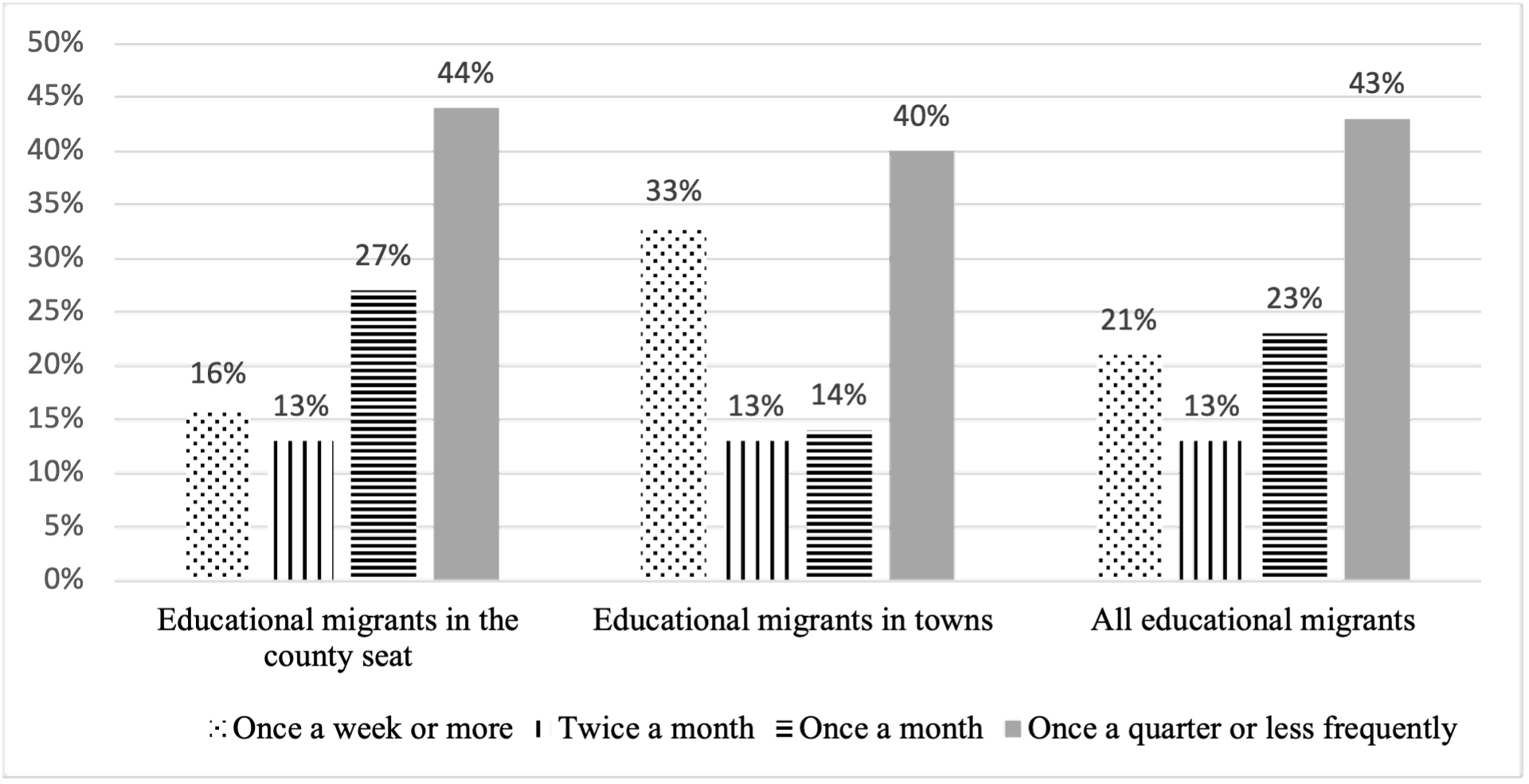
In contrast to labour migrants, who maintained relatively strong ties with other migrant villagers (Yue et al. 2013), educational migrants from the same village had relatively loose ties with each other. The fact that educational migrants seldom returned to their villages (due to financial consideration) further decreased their social ties with other villagers. Less than one-third of educational migrants reported that they returned to their origin villages no more than once a month (see Figure).
Figure. Frequency of educational migrants’ visits to their origin villages
Source: the authors.
Decline in collective activities
The trend of educational migration has made rural communities less likely to organise collective activities for the communal good, may they be social, economic, or cultural.
First, educational migrant adults rarely return to participate in their communities’ collective events, such as Party meetings, village elections, and village meetings. The frequency of their participation in such activities (n = 494, M = 2.427, SD = 1.819) was only one-quarter of the participation frequency of non-migrants (n = 320, M = 8.416, SD = 3.147); t (458.083) = 30.863, p < 0.001. Educational migration thus has a significantly negative correlation with rural adults’ participation in the activities of their origin communities (Table 4).
Table 4. Relationship between educational migration and participation in community activities
| Basic model | Effect of educational migration | |||
| Coef. | SE | Coef. | SE | |
| Constant | 1.001 | 1.506 | 5.778*** | 1.370 |
| Adult’s gender (ref. = female) | 1.141*** | 0.250 | 0.302 | (0.228) |
| Adult’s age | -0.035** | 0.012 | -0.019 | 0.011 |
| Family annual income (ref. = under RMB 40,000) | ||||
| 40,000-80,000 | -0.093 | 0.327 | 0.077 | 0.290 |
| Over 80,000 | 00.276 | 0.407 | 0.048 | 0.360 |
| Adult’s education level (ref. = illiterate) | ||||
| Primary school | 0.598 | 0.315 | 0.571* | 0.278 |
| Junior middle school | 0.362 | 0.378 | 0.367 | 0.334 |
| High school and above | 0.763 | 0.493 | 1.096* | 0.437 |
| Adult’s occupation (ref. = unemployed) | ||||
| Farmer | 3.546*** | 0.322 | 0.641 | 0.351 |
| Local worker | 1.420*** | 0.341 | 0.571 | 0.307 |
| Businessperson, professional, or official | 3.406*** | 0.514 | 1.822*** | 0.468 |
| Village cadre | 2.383*** | 0.570 | 2.398*** | 0.503 |
| Party member | 1.571** | 0.568 | 1.468** | 0.502 |
| Experience of labour migration | 0.087 | 0.250 | -0.023 | 0.221 |
| Urban preference | -0.142 | 0.213 | -0.056 | 0.188 |
| Number of children | 0.242 | 0.191 | 0.236 | 0.169 |
| One-parent family | -0.139 | 0.390 | -0.195 | 0.345 |
| Number of labourers | -0.049 | 0.145 | -0.082 | 0.128 |
| Ratio of migrant labourers | -0.035 | 0.480 | 0.177 | 0.425 |
| Ratio of local labourers | -0.047 | 0.496 | 0.515 | 0.441 |
| From a remote village | -0.091 | 0.373 | -0.180 | 0.329 |
| Educational migrant family | -5.314*** | 0.379 | ||
| Village dummies | Yes | Yes | ||
| Log likelihood | -1786.857 | -1699.951 | ||
| LR χ2 | 733.38 | 907.19 | ||
| Prob > χ2 | 0.0000 | 0.0000 | ||
| Pseudo R2 | 0.170 | 0.211 | ||
| N | 814 | 814 | ||
Note: the variable “participation in community activities” was the sum of eight items: attendance in villagers’ weddings and funerals; participation in village’s activities; participation in village’s public meetings; participation in social organisations in the villages; contact with officials about issues of local concern; cooperation with other villagers to solve the village’s problems; voting in the village’s elections; and serving on the village committee or Party committee.
*p < 0.05; **p < 0.01; ***p < 0.001.
Source: the authors.
Educational migrants’ infrequent participation has hampered the implementation of collective activities in villages. For example, the leader of Jin Village reported a shortage of volunteer labour for laying water pipes in the village:
There is a lack of labour to lay water pipes to provide tap water to villagers. It has already taken us half a year and it is not finished yet. Many young labourers leave to earn money, while many grandparents, who could have helped, migrate to the county seat for their grandchildren’s studies. (Interview with V-Wei, cadre in Jin village, June 2018)
Laying water pipes used to be a voluntary and collective activity in the community, but today there are not enough volunteers. Miao Village also faced a labour shortage when building a pool in the village. The loss of leadership and the weakened social ties have impeded the development of collective industry, as a village cadre complained:
People now are not connected. They don’t live together and show little trust in each other. (...) I have thought about undertaking some industry in our village. However, there is no leader (lingdaozhe 領導者). Also, to undertake a project, it is better to organise the land together, but it is not easy. (Interview with V-Yang, cadre in Ping Village, April 2018)
Three villages that have experienced high levels of educational migration – Jin, Miao, and Xue – all reported a lack of collective industry. By contrast, in Luo Village, which has not suffered greatly from educational migration, the villagers engage in large-scale collective cultivation of grapes and kiwi fruit, and in the raising of chickens and rabbits.
Educational migration has undermined nonlabour communal activities as well. For example, S-Nian’s grandmother, a village group leader in Miao Village, planned to organise a square-dancing group for Miao ethnic dancing, but there was a shortage of women, as many had migrated to the towns for peidu. This has made it difficult for the remaining residents to preserve the village’s cultural heritage through a dancing group or to diffuse local ethnic culture by other means:
Last month, the provincial educational TV station came to report on our culture and customs. As many students and adults were in the towns, I could not find enough people to give them a cultural performance. (Interview with V-Feng, cadre in Miao Village, May 2018)
The villagers lost an opportunity to publicise their culture and promote their village because there were not enough people for a collective cultural performance.
Defamiliarisation and emotional detachment
When living in urban areas, rural children and young adults have little chance to maintain closeness with their rural communities. Consequently, they grow up unfamiliar with these communities, including their agricultural traits and practices, and their members. Nearly 86% of educational migrant children in the study could not recognise various crops cultivated in their home communities, as they seldom farmed or observed adults farming. For example, S-Siyang’s mother said, “My daughter cannot identify many crops such as tobacco and wheat, as she has not lived in the village for a long time.” (Interview, March 2018) By contrast, few non-migrants said that their children were ignorant of their communities’ crops: “He is familiar with the crops. When we farm, we usually bring them [the family’s children]. They help us.” (Interview with S-Zihao’s grandfather, May 2018)
Not only could non-migrant children identify many crops, they also sometimes participated in farming. S-Bei helped her mother pick tea leaves, and S-Ju herded sheep and helped harvest corn on the weekends. Further, educational migrant children were not familiar with the villagers and children who remained in the villages. The mother of a migrant child (S-Menghui) stated, “My daughter’s best friends live in the county seat,” (interview, March 2018) while the mother of a non-migrant child (S-Qiang) found that “peidu children do not play with [her] son. They dress differently and look like urban children.” (Interview, June 2018)
More than half of all migrant parents/guardians reported that their children were unfamiliar with other villagers. Six young mothers who had left the village to accompany their students also admitted to a sense of unfamiliarity with villagers on their own part. By contrast, non-migrant adults indicated that their children knew the villagers and the community well.
Being unfamiliar with their rural communities of origin, the children and adults who had migrated showed little emotional attachment to these communities. Only one-third of educational migrant children were reported to be willing to return to the villages. Approximately half of educational migrant adults aspired to become urban residents; this was especially true of young people under the age of 35 (of whom about 70% wished to stay in cities). Indeed, many of the educational migrant families did not intend to ever return to the rural community. Of the 83 interviewed migrant parents, 13 had already purchased an apartment in the county seat and a further 21 planned to do so. Another five migrant parents stated explicitly that they would not return to their villages until they were in their old age. In total, 47% of the interviewed rural educational migrants said that they would continue to live in the county seat or in other towns even after their children finished their studies.
The migrant children’s emotional detachment from the rural communities was not surprising, since they had already developed an urban identity:
I let them go back to our rural home to have a look. They are not willing to return. They said, “I grew up here; why should I go to the village?” (Interview with S-Diao’s father, April 2018)
Educational migration has thus caused rural children to become urban children, both physically and emotionally, at the early stage of primary school education. Their unfamiliarity with and emotional detachment from rural communities mean that the countryside is likely to lose a significant portion of the next generation.
Placeless education as a catalyst
Education has become a catalyst for the disintegration of rural communities because of the closure of many village schools and of the wide rural‒urban educational gap. Both have prompted people to move to towns or county seats for their children’s education. The questionnaire revealed that 72% of educational migrants in towns had left their villages because of the unavailability of village schools. This was also the main reason cited by 20 of the 35 interviewees who had left their villages for towns. The closure of village schools led to the prospect of long and unsafe commutes to schools further away. To avoid such commutes and guarantee safe education for their children or grandchildren, many adults decided to move to urban areas to accompany the students:
I come here because I need to accompany my two grandchildren. They need to go to school. Our home is far from the school, and we will not be at ease if no one accompanies them. (Interview with S-An’s grandfather, April 2018)
While closing village schools, the local government established new urban schools in the county seat to enrol rural students. One of these schools was intentionally established in 2016 to accommodate rural peidu students, as admitted by educational officials. The vice director of the county education bureau stated: “Through peidu, rural people can automatically come to urban areas. (…) Education should meet the needs of urbanisation and establish more schools for those coming to urban areas.” (Interview, April 2018) Placeless education has therefore become a strategy for local urbanisation.
Providing rural students with quality education was the pretext the government used to attract rural students to county seats. Indeed, due to the long-term rural‒urban educational gap, school quality was the top reason rural families migrated to the county capital, according to 82% of migrant questionnaire respondents who had moved there.
From the perspective of rural adults, better educational quality and higher levels of education represent the best way for their children to permanently abandon rural life and communities:
We sent her to the urban school because its quality is better than that of the village school. We ourselves are not very educated, so we have to earn a living as migrant workers, which is hard. We hope our children can be better educated, and then their life will be less stressful and their work will be lighter. It will be better than farming and working as a migrant labourer. (Interview with S-Xuan’s mother, March 2018)
Having experienced the hardships of life as migrant workers or farmers, rural educational migrants wanted their children to find good, stable jobs as, for example, civil servants (a wish expressed by the mothers of S-Yan and S-Kexin), and such jobs were thought to be available only in cities. The responses indicated that almost all parents, both migrants and non-migrants, expected their children to find employment in urban areas. The overwhelming majority (97%) thought that farming was the only possible work option in rural villages and that no secure jobs were available in the countryside. Besides, farming could “make only a little money, which is not enough to cover all expenses.” (Interview with S-Bei’s mother)
Not only did people in rural communities express that farming had low status; they also felt that their communities are far behind cities in terms of transportation, living conditions, entertainment options, medical services, and other quality-of-life factors:
There is more entertainment in urban areas. There are more physical as well as cultural and artistic activities in the county seat than there are in rural villages. You can walk along the river after dinner and enjoy the nightscape. (Interview with S-Xin’s grandfather, March 2018)
Therefore, rural adults expect the next generation to live and work in urban areas. Education has become rural parents’ avenue of choice to achieve this goal, as it is closely tied to social mobility and teaches children to aim for better job opportunities (Gruenewald and Smith 2008). Further, as education has been globalised, the perception that it can take place “anywhere” has become widespread, fuelling educational migration. The educational system in China has become increasingly separated from rural communities under urbanisation development and is closely anchored in the job market, driving the migration of rural parents who desire a bright future for their children.
Discussion and conclusions
This study of County G has corroborated the prevalence of rural educational migration documented in other studies (Lei 2018; Wang and Pan 2019), with some villages in County G having lost up to 80% of their school-aged children along with these children’s adult caregivers to urban areas within the county. Unlike the individual focus of previous literature, this study adopts a communal perspective and links the educational phenomenon of rural educational migration to broader community development. According to the findings, three significant contributions of the study are highlighted. First, the study suggests the deleterious effects of educational migration on the development of rural communities. In the existing literature, numerous studies (e.g., Long et al. 2020) generally discussed the possible benefit of education migration to rural children, such as accessing better quality schools and enhancing job prospects in cities. However, the studies ignore an important point as observed in the current study: these individual-level improvements are realised at the expense of rural communities. Educational migration has contributed to the disintegration of rural communities by causing community members and leaders to leave, weakening communities’ social ties, curtailing rural communities’ collective activities, and increasing former villagers’ defamiliarisation and emotional detachment from their communities of origin.
Second, the study can advance our understanding of how placeless and urban-biased education has contributed to educational migration. Although scholars like Gruenewald and Smith (2008) have suggested that placelessness can be the catalyst for this community loss, the current study is the first attempt to illustrate how this happens in Mainland China. In China, the educational system is guided by an idea of education as human or cultural capital associated with overall economic development and individual socioeconomic status; however, neither of these goals attends to the needs of local communities (Sobel 2006; Gruenewald and Smith 2008). At the individual level, placeless education helps to increase the human capital needed to secure a better job in the labour market (Gruenewald and Smith 2008), as recognised by the rural parents in this study. Consequently, these parents were eager to send their children to urban schools for better academic results. Clearly, most of the parents saw education as the best path for their children to succeed in the labour market. Education was understood as a private instrument for individual development and social mobility, a perspective that granted little weight to the community or public good (Sobel 2006; Roberts and Green 2013).
When the educational system is geared towards preparing children for the urban job market, it distributes educational resources unequally in favour of urban areas (Gruenewald and Smith 2008). This is the case with China, where a significant rural‒urban educational gap exists in both resources (particularly human resources) and study outcomes (Zhang 2019). Inhabitants of rural areas come to see rural schools as “inferior” and choose educational migration for their children. This trend has been further exacerbated by the early school consolidation policy and recent school closures due to urbanisation, both of which have deprived rural communities of local schools and make urban schools the only or best alternative for many rural students. In fact, the placeless form of education has increasingly become a direct instrument of urbanisation, as depriving rural communities of local schools has become a strategy to push the rural population into urban areas within the county.
Accordingly, the study illustrates that the intertwined relationship between a placeless and urban-biased educational system and educational migration may be a structural reason for the weakening of China’s rural communities. In the past, the negative impact of such migration on rural communities was minimal, as only a few talented individuals left their villages this way (Andreas 2004). The vastly more harmful effect of the current educational migration trend should not be overlooked. Current educational policies, focused on the job market and driven by the idea of social mobility, have made education the main avenue through which rural people can obtain better job opportunities. Meanwhile, placeless education, owing to its urban-biased resource allocation and the closure of rural schools, has encouraged or, in some cases, forced rural parents to move to towns or county seats for their children’s education. As a result, the integrity of many rural communities has been seriously compromised.
Although rural communities in China were already affected by decollectivisation in the 1970s and subsequent labour migration (Qin and Flint 2012; Gao 2018), educational migration has hastened their decline. However, dynamic rural communities are important for national food security, social stability, environmental sustainability, and cultural heritage (Zhang et al. 2022). A dynamic rural community also benefits rural individuals, as they can work and reside locally, without enduring what often constitutes the hardships of labour migration and family separation, heavy workloads, poor working and living conditions, and relatively low wages (Zhang et al. 2016). The disintegration of rural communities has obstructed the sustainable development of rural areas and the successful implementation of the national plan of rural revitalisation. This situation raises serious questions about current educational policies and practices, which have isolated rural education from the countryside and pushed rural families to leave their home communities.
Therefore, the findings of this study point to a need for community-based education as an alternative that would reorient rural education towards the needs and priorities of rural and local areas and regenerate and sustain rural communities. This approach would incorporate rural and local community development into its educational goals (Theobald 1997). Community-based education would both cultivate human resources for local development and make schools into important institutions in the development of local communities. Furthermore, within this model, the economic, social, cultural, and natural characteristics of rural and local communities would be an important element of educational materials (Gruenewald and Smith 2008) and integrated with academic subjects. Such a curriculum would arm students with the necessary knowledge for local communal development, in a context where migrating to urban areas for education is often associated with financial burdens, family separation, and limited access to quality urban schools (Lei 2018; Long et al. 2020).
Acknowledgements
This study was supported by the National Natural Science Foundation of China (Project No. 72304109).
Manuscript received on 25 October 2023. Accepted on 5 February 2025.
References
ANDREAS, Joel. 2004. “Leveling the Little Pagoda: The Impact of College Examinations, and their Elimination, on Rural Education in China.” Comparative Education Review 48(1): 1-47.
BRINT, Steven. 2001. “Gemeinschaft Revisited: A Critique and Reconstruction of the Community Concept.” Sociological Theory 19(1): 1-23.
CHEN, Feng 陳鋒, and LIANG Wei 梁偉. 2015. “生命歷程視角下農村家長陪讀經歷及其影響研究” (Shengming licheng shijiaoxia nongcun jiazhang peidu jingli jiqi yingxiang yanjiu, Experience and influence of rural parents accompanying children to study). Nanjing nongye daxue xuebao (shehui kexue ban) (南京農業大學學報(社會科學版)) 15(5): 55-63.
CORBETT, Michael John. 2007. Learning to Leave: The Irony of Schooling in a Coastal Community. Nova Scotia: Fernwood Publishers.
CRESWELL, John W. 2012. Educational Research: Planning, Conducting, and Evaluating Quantitative and Qualitative Research (4th ed.). London: Pearson.
DING, Yuzhao 丁於釗, LUO Xiaolong 羅小龍, and WANG Shaobo 王紹博. 2019. “基礎教育城鎮化特徵及其動力機制研究: 以新沂市為例” (Jichu jiaoyu chengzhenhua tezheng jiqi dongli jizhi yanjiu: Yi Xinyi shi weili, The characteristics and driving mechanisms of the urbanisation of basic education: The case of Xinyi City). Xiandai chengshi yanjiu (現代城市研究) 8: 109-17.
DURKHEIM, Émile. 1997. The Division of Labor in Society. New York: Free Press.
FEI, Xiaotong 費孝通. 1985. 鄉土中國 (Xiangtu Zhongguo, From the Soil). Shanghai: Shenghuo dushi xinzhi sanlian shudian.
FORREST, Ray, and Ade KEARNS. 2001. “Social Cohesion, Social Capital and the Neighbourhood.” Urban Studies 38(12): 2125-43.
GAO, Mobo. 2018. Gao Village Revisited: The Life of Rural People in Contemporary China. Hong Kong: Chinese University of Hong Kong Press.
GRUENEWALD, David A., and Gregory A. SMITH. 2008. Place-based Education in the Global Age: Local Diversity. Mahwah: Lawrence Erlbaum.
GUSFIELD, Joseph R. 1975. Community: A Critical Response. New York: Harper & Row.
HILLERY, George A. 1959. “A Critique of Selected Community Concepts.” Social Forces 37(3): 237-42.
HILLMAN, Ben. 2013. “The Causes and Consequences of Rapid Urbanisation in an Ethnically Diverse Region: Case Study of a County Town in Yunnan.” China Perspectives 95: 25-32.
HUANG, Yuqin. 2012. “‘Jumping out of the Agricultural Gate’ (tiaochu nongmen): Social Mobility and Gendered Intra-household Resource Distribution among Children in a Central Chinese Village, 1950–2012.” China Perspectives 92: 25-33.
LEI, Wanghong 雷望紅. 2018. “階層流動競爭與教育風險投資: 對甘肅寧縣‘陪讀’現象的解讀” (Jieceng liudong jingzheng yu jiaoyu fengxian touzi: Dui Gansu Ning xian “peidu” xianxiang de jiedu, Class mobility and educational risk investment: An interpretation of the “accompanied study” phenomenon in Ning County, Gansu Province). Zhongguo qingnian yanjiu (中國青年研究) 12: 88-94.
LI, Qiang 李強. 2004. 農民工與中國社會分層 (Nongmingong yu Zhongguo shehui fenceng, Urban migrant workers and social stratification in China). Beijing: Shehui kexue wenxian chubanshe.
LONG, Wenjin, Xiaopeng PANG, Xiaoyuan DONG, and Junxia ZENG. 2020. “Is Rented Accommodation a Good Choice for Primary School Students’ Academic Performance? Evidence from Rural China.” China Economic Review 62. https://doi.org/10.1016/j.chieco.2020.101459
PEPPER, Suzanne. 1996. Radicalism and Education Reform in 20th-Century China: The Search for an Ideal Development Model. Cambridge: Cambridge University Press.
QIN, Hua, and Courtney FLINT. 2012. “The Impacts of Rural Labor Out-migration on Community Interaction and Implications for Rural Community-based Environmental Conservation in Southwest China.” Human Organization 71(2): 135-48.
RAO, Jing, and Jingzhong YE. 2016. “From a Virtuous Cycle of Rural-urban Education to Urban-oriented Rural Basic Education in China: An Explanation of the Failure of China’s Rural School Mapping Adjustment Policy.” Journal of Rural Studies 47: 601-11.
ROBERTS, Philip, and Bill GREEN. 2013. “Researching Rural Places: On Social Justice and Rural Education.” Qualitative Inquiry 19(10): 765-74.
SHAN, Liqing 單麗卿. 2021. “製造同意: ‘後撤點並校’時代的農村擇校問題研究. 基於西部地區L鎮的個案” (Zhizao tongyi: “Hou chedian bingxiao” shidai de nongcun zexiao wenti yanjiu. Jiyu xibu diqu L zhen de ge’an, Making consent: A study on the problem of rural school selection in the era of “withdrawal of schools and merging schools.” The case of L town in the west of China). Hangzhou shifan daxue xuebao (杭州師範大學學報) 2: 122-30.
SOBEL, David. 2006. Place-based Education: Connecting Classrooms & Communities. Great Barrington: Orion Society.
THEOBALD, Paul. 1997. Teaching the Commons: Place, Pride, and the Renewal of Community. Boulder: Westview Press.
TÖNNIES, Ferdinand. 2001. Community and Civil Society. Cambridge: Cambridge University Press.
UNGER, Jonathan. 2002. The Transformation of Rural China. Armonk: M.E. Sharpe.
WANG, Dan 王丹, and PAN Lu 潘璐. 2019. “農村教育上移: 形成, 慣性與反思. 以廖原縣為例” (Nongcun jiaoyu shangyi: Xingcheng, guanxing yu fansi. Yi Liaoyuan xian weili, Formation, inertia, and introspection of upward moving of rural education: The case of Liaoyuan County). Hunan nongye daxue xuebao (shehui kexue ban) (湖南農業大學學報(社會科學版)) 5: 38-44.
WANG, Dan, and Yuan TENG. 2022. “Educational Migration and Rural Decline in China.” The China Journal 88(1): 100-25.
WILKINSON, Kenneth P. 1991. The Community in Rural America. Santa Barbara: Greenwood.
WU, Huifang 吳惠芳, WU Yunrui 吳雲蕊, and CHEN Jian 陳健. 2019. “陪讀媽媽: 性別視角下農村婦女照料勞動的新特點. 基於陝西省Y縣和河南省G縣的調查” (Peidu mama: Xingbie shijiaoxia nongcun funü zhaoliao laodong de xintedian. Jiyu Shanxi sheng Y xian he Henan sheng G xian de diaocha, Accompanying mothers: New dimensions of rural women’s care work from a gender perspective. The case of Y County in Shanxi Province and G County in Henan Province). Funü yanjiu luncong (婦女研究論叢) 4: 28-38.
WU, Jinting. 2016. Fabricating an Educational Miracle: Compulsory Schooling Meets Ethnic Rural Development in Southwest China. Albany: State University of New York Press.
XU, Yuzhen, and Hongbo WONG. 2011. “School-based Curriculum Development in China.” Chinese Education & Society 44(4): 44-63.
YAN, Hairong, Ku Hok BUN, and Siyuan XU. 2021. “Rural Revitalization, Scholars, and the Dynamics of the Collective Future in China.” Journal of Peasant Studies 48(4): 853-74.
YAN, Hairong, and Yiyuan CHEN. 2015. “Agrarian Capitalization without Capitalism? Capitalist Dynamics from Above and Below in China.” Journal of Agrarian Change 15(3): 366-91.
YANG, Bo, Marcus W. FELDMAN, and Shuzhuo LI. 2020. “The Status of Perceived Community Resilience in Transitional Rural Society: An Empirical Study from Central China.” Journal of Rural Studies 80: 427-38.
YU, Xiulan 余秀蘭. 2005. “中小學教學內容的城市偏向分析: 以語文教科書為例” (Zhongxiaoxue jiaoxue neirong de chengshi pianxiang fenxi: Yi yuwen jiaoke shu weili, Urban deflection of teaching contents in primary and middle schools: Taking language textbooks as an example). Nanjing shida xuebao (sheke ban) (南京師大學報(社科版)) 5: 91-7.
YUE, Zhongshan, Shuzhuo LI, Xiaoyi JIN, and Marcus W. FELDMAN. 2013. “The Role of Social Networks in the Integration of Chinese Rural–urban Migrants: A Migrant–resident Tie Perspective.” Urban Studies 50(9): 1704-23.
ZHANG, Huan 張歡, and ZHU Zhanhui 朱戰輝. 2021. “農村青少年教育城鎮化的家庭策略, 實踐困境及其出路” (Nongcun qingshaonian jiaoyu chengzhenhua de jiating celüe, shijian kunjing jiqi chulu, Family strategies, practical difficulties, and ways out for the urbanisation of rural youth’s education). Zhongguo qingnian yanjiu (中國青年研究) 1: 29-36.
ZHANG, Li, Rhonda Vonshay SHARPE, Shi LI, and William A. DARITY Jr. 2016. “Wage Differentials between Urban and Rural-urban Migrant Workers in China.” China Economic Review 41: 222-33
ZHANG, Ruoyan, Yuan YUAN, Hongbo LI, and Xiao HU. 2022. “Improving the Framework for Analyzing Community Resilience to Understand Rural Revitalization Pathways in China.” Journal of Rural Studies 94: 287-94.
ZHANG, Yulin 張玉林. 2019 “中國鄉村教育40年: 改革的邏輯和未預期效應” (Zhongguo xiangcun jiaoyu 40 nian: Gaige de luoji he weiyuqi xiaoying, Forty years of rural education in China: The logic of reform and its unintended effects). Xuehai (學海) 1: 65-76.
ZHOU, Yuxiang 周宇香. 2020. “中國‘90後’人口特徵及其形成原因解析” (Zhongguo “90 hou” renkou tezheng jiqi xingcheng yuanyin jiexi, Analysis of the demographic characteristics of China’s “post-90s” and its causes). Zhongguo qingnian yanjiu (中國青年研究) 11: 43-51.
[1] Rural educational migration does not encompass rural labour migration, wherein rural adults migrate for job opportunities and bring their children along, as the primary objective of this type of migration is not education.
[2] This is made possible through renting or buying an apartment close to the school.
[3] National Bureau of Statistics 國家統計局, 2022, 2021年農民工監測調查報告 (2021 nongmingong jiance diaocha baogao, 2021 monitoring survey report), http://www.gov.cn/xinwen/2022-04/29/content_5688043.htm (accessed on 14 November 2022).
[4] Ministry of Education 教育部, “基礎教育課程改革綱要(試行)” (Jichu jiaoyu kecheng gaige gangyao (shixing), Outline of Basic Education Curriculum Reform (Trial Implementation)), 8 June 2001, https://www.gov.cn/gongbao/content/2002/content_61386.htm (accessed on 20 March 2025).
[5] State Council 國務院,“關於基礎教育改革與發展的決定” (Guanyu jichu jiaoyu gaige yu fazhan de jueding, Decision of the State Council on the Reform and Development of Basic Education), 29 May 2001, https://www.gov.cn/gongbao/content/2001/content_60920.htm (accessed on 20 March 2025).
[6] Guardians were coded as “S-Pseudonym’s guardian” based on child’s pseudonym and guardian’s relation with the child. Teachers were coded as “T-Pseudonym,” and principals were coded as “P-Pseudonym.”
[7] There was no Grade 6 in one newly established county school.
[8] The anonymised names are used for all the sampled villages.