 >
>

China Perspective Issues
BOOK REVIEWS
Interagency Collaboration and Blame Avoidance: An Investigation of China’s Childcare Service Development
Weiyue Yang is a lecturer at the School of Public Administration at Guangzhou University, Waihuanxi Road No. 230, Higher Education Mega Centre, 510006 Guangzhou, China (weiyue.yang@gzhu.edu.cn).
Introduction
Care services for children under three years old are considered an important welfare programme, as they not only contribute to children’s development and socialisation (Plantenga, Remery, and Camilleri-Cassar 2009) but also support women’s labour market participation, advancing gender equality (Lewis 1992). Empirical evidence suggests that accessible and affordable childcare services reduce the financial burden of raising children, making them an effective governmental tool to tackle declining birth rates and maintain fertility (Rindfuss et al. 2010). This is particularly significant for countries such as China, where the problem of an ageing population is increasingly severe. Since the early twenty-first century, China has faced accelerated ageing and low fertility rates (Zhang, Guo, and Zheng 2012), leading to a period of negative population growth beginning in 2022.[1] In response, the Chinese central government abrogated its decades-long One-child policy and introduced measures to encourage higher birth rates, including the universal Two-child policy in 2015 and the Three-child policy in 2021. Alongside the relaxation of birth control, the State Council announced in 2019 the expansion of childcare services for infants under three years old as a core component of its birth-support strategy, which would require close collaboration across 17 government departments, including agencies of health (weisheng jiankang 衛生健康), development and reform (fazhan gaige 發展改革), administration for market regulation (shichang jiandu guanli 市場監督管理), civil affairs (minzheng 民政), and education (jiaoyu 教育). Notably, the National Health Commission (NHC) was assigned a pivotal role in this joint action as the “host department” (qiantou danwei 牽頭單位).[2]
Since then, the Chinese government has issued a series of policies to promote the development of childcare services. For example, to encourage private investment, the central government launched a programme to fund the construction of model childcare facilities.[3] It further juxtaposed childcare with eldercare in its 14th five-year plan with the slogan “one elderly, one young” (yi lao yi xiao 一老一小) as the country’s strategic responses against its deteriorating demographics.[4] In July 2022, the Chinese government once again put the stress on fertility support, with an emphasis placed on increasing childcare service provision by reducing operating costs for childcare institutions and enhancing personnel training.[5] Subsequently, an interministerial joint meeting (lianxi huiyi 聯席會議) was introduced to streamline cooperation between functional sectors during policy implementation.[6] These policies clearly signal that childcare services have become a focal point of China’s population and social policies, warranting particular research attention.
By far, the development of childcare services in Chinese society has generally remained underexplored. Some scholars have reviewed historical patterns of service provision, discussing these within the framework of gender equality and social welfare (Li 2017; Wallace 2020). China’s experience confirms that the availability of childcare services positively affects maternal labour force participation (Liu, Qi, and Xiong 2022). However, grandparenting still plays a critical role in childcare provision (Silverstein and Cong 2013), while formal services from care facilities remain scarce in Chinese society. Empirical evidence further indicates that this shortage of childcare institutions has become a constraining factor in the fertility desires of Chinese couples, especially those who live in urban areas (Ji et al. 2020). With accelerated ageing and growing demand for childcare services under the Three-child policy era (Liu et al. 2022), expanding inclusive childcare facilities has become increasingly important.
Nevertheless, limited research has tracked the current development of childcare services at the local level in China. Through nationwide surveys and interviews with parents and childcare institution staff, Hong et al. (2022) highlight serious deficiencies in service accessibility, affordability, and quality, along with an absence of established institutional management and government oversight. Yet, empirical studies examining the implementation of childcare service expansion policies by local governments are still lacking. Observing how central policies are localised is particularly important, because it is not rare for local policy enforcement in China to diverge from the central government’s intentions due to inadequate institutional incentives (Ran 2013; Zhou et al. 2013). Investigating how local officials expand childcare policies has become even more critical, given that this process may be significantly impacted by the challenges of interagency collaboration.
Addressing these research gaps, this study presents a case analysis of policy implementation in three county-level regions in Shaanxi Province, referred to below as W District, C County, and L County. Underpinned by data collected through interviews with local officials, it focuses on the following questions: How local officials have responded to the central government’s decision to expand childcare services? How their policy enforcement has been influenced by institutional structures and incentives within the Chinese bureaucracy? What insights does this offer for understanding interagency collaboration issues within the Chinese government? By answering these questions, this case study aims to enhance our understanding of the ongoing expansion of childcare services in China, which is of increasing significance given the country’s demographic challenges. Additionally, it provides a broader perspective on the policy implementation of Chinese local governments, particularly when interagency collaboration is required.
Institutional incentives: Performance evaluation and blame avoidance
Rational choice institutionalism assumes that while individuals seek to maximise their personal interests, their preferences and strategies can only develop within the institutions in which they are embedded. Consequently, a decision in politics turns out to be a synthesis of both individual preference and institutional impacts (Ostrom 1986; Shepsle 1989). Weaver (1986) further distinguishes three types of incentives for politicians and bureaucrats: credit claiming, good policy, and blame avoidance. While government officials may pursue a successful career by either maximising their credits or minimising blame, Weaver points out a tendency to place a much higher value on losses than over equivalent gains in interest calculation. Hood (2002, 2007) describes such a preference among officials as negativity bias and summarises three kinds of strategies frequently applied to avoid blame, namely agency strategies, presentational strategies, and policy strategies.
In the Chinese context, the performance evaluation system deserves special attention as an institutional framework that profoundly shapes the work strategies of local officials (Heberer and Trappel 2013; Landry, Lü, and Duan 2018).[7] The system has enabled the central authorities to regulate the behaviour of local officials based on sets of rewards and punishments attached to their work performance. On the one hand, local officials are driven by credit-claiming incentives to actively implement plans devised by higher authorities. As argued by Zhou L. (2016), the Chinese central authorities have successfully motivated their local agents to foster economic growth by prioritising the promotion of those who achieve better results in developing economies. These credit-claiming incentives also encourage local officials to enthusiastically pursue policies that offer them greater career advancement prospects (Deng, O’Brien, and Chen 2018), while neglecting those that hold limited value for their promotion (O’Brien and Li 1999). On the other hand, the threat of political penalties may compel local officials to rigorously enforce less popular policies, such as family planning. However, institutional incentives can also prompt officials to adopt strategies such as collusion or “muddling through,” presenting superficially satisfactory performance to avoid sanctions (Zhou X. 2010; Zhou et al. 2013). Conspicuously, blame avoidance also counts as a major self-interest motive for local officials in their pursuit of a successful career.
Particularly, officials’ blame-avoiding motivations are often found to complicate interagency cooperation within China’s fragmented bureaucracy. Lieberthal (1992) explains that functional sectors in the Chinese bureaucracy are highly fragmented and lack the ability to oversee each other at equivalent levels, making policy enforcement reliant on interdepartmental collaboration. However, achieving effective collaboration is often challenging, as agencies tend to show varied, if not conflicting, interests when undertaking joint actions (Tsai and Liao 2020). Moreover, because the complex bureaucratic structure often blurs organisational boundaries, officials are further encouraged to shift responsibilities to their subordinates, peers, or even superiors to avoid potential blame caused by failure in policymaking and enforcement (Tu and Gong 2022).[8] This tendency is clearly illustrated in Ran’s (2017) study, which highlights the dysfunction of China’s environmental governance due to blame-shifting dynamics between the central and local governments. Similarly, Kostka and Mol (2013) argue that China’s fragmented bureaucracy is a key institutional barrier to effective policy implementation, particularly in policies requiring multi-departmental cooperation. Zang’s (2017) research on urban governance further demonstrates this point: although a metropolitan government established a joint task force involving the urban management bureau and other departments to address urban issues, the initiative failed because members of the task force were primarily engaged in buck-passing, each seeking to avoid being singled out to tackle the identified problems. This outcome is unsurprising, as the local urban management bureau often has overlapping jurisdictions with other agencies, resulting in ongoing disputes over responsibility boundaries. Similar challenges in interagency collaboration are documented in studies of China’s tobacco management (Qian 2016) and river sand mining control (Chen and Hu 2022).
Existing research has explored in depth the blame-avoidance motivations and strategies of Chinese local officials. However, there remains a gap in research exploring the factors that may influence the effectiveness of interagency collaboration, particularly through comparative analysis across different joint actions. In cases such as river sand mining control (ibid.) and poverty alleviation (Tsai and Liao 2020), the government established “leading small groups” (lingdao xiaozu 領導小組) or “command centres” (zhihuibu 指揮部) to strengthen interdepartmental coordination. In contrast, for childcare service development, the Chinese government has sought to improve collaboration by introducing joint meetings. This strategic variation may lead to differing levels of effectiveness in policy implementation across joint actions. Therefore, research on childcare service development is essential to shed light on interagency collaboration within the Chinese government.
Research method
This study is oriented towards exploring the development of childcare services and the enforcement of relevant policies at the local level in China, rather than generalising their patterns. A qualitative design is therefore applied due to its compatibility with exploratory research (Ambert et al. 1995). Moreover, since this research is committed to accurate description and in-depth analysis while attempting to provide explanations that best fit the discovered phenomenon, it takes the case study approach, which is well suited to qualitative research design (Yin 1981).
Fieldwork for this research was conducted in three county-level regions in Shaanxi Province: W District, C County, and L County. Although the study does not aim for sample representativeness, regional differences in demographics and government revenue were considered in the selection of research sites (Table 1). Located in central Shaanxi, W District is a subordinate of Xi’an Prefecture, the provincial capital, making it a typical urban region. This also explains its relatively larger population size and higher fiscal revenue compared to the other two regions. In contrast, C County is situated in the south of the province and L County in the north. Both are considered rural areas. Notably, L County is one of the counties with the lowest public budget revenue in Shaanxi, whereas C County represents the middle level in the province.
Table 1. Population and government revenue of the research sites (2020)
| Research site | Permanent residents | General public budget revenue |
| W District | 733,403 | RMB 3,022.93 million |
| C County | 442,035 | RMB 257.52 million |
| L County | 201,663 | RMB 125.86 million |
Source: Shaanxi Province Bureau of Statistics 陝西省統計局, 2021, 陝西統計年鑑 (Shaanxi tongji nianjian, Shaanxi statistical yearbook), https://tjj.shaanxi.gov.cn/tjsj/ndsj/tjnj/sxtjnj/index.html?2021 (accessed on 4 March 2025).
Primary data for this study were collected through rounds of interviews with ten government leaders from the research sites. In addition, 15 rural residents from L County and C County were also interviewed to understand their perspectives on the current development of local childcare services. All interviews were conducted in semi-structured form, which allowed informants sufficient freedom of narration while enabling the interviewer to concentrate on the research topic (Garner and Scott 2013: 282-3). Six out of the ten interviewed government officials serve local health bureaus.[9] They are either the bureau’s heads and deputies, or the section chiefs who take direct charge of local childcare service expansion. These interviewees possess comprehensive knowledge of both local policy enforcement and service provision by virtue of their positions in the bureaucratic system, making them ideal informants for this research. Besides, four leaders of the Administration for Market Regulation (shichang jiandu guanliju 市場監督管理總局, AMR) were also interviewed for their comparative perspectives on the joint action. The interview questions mainly centred around the current childcare service provision in the three county-level regions, the local governments’ efforts in supporting the service expansion, as well as the difficulties perceived by local officials during policy implementation. All interviewees were well informed about the research purpose and confidentiality protection measures. Interviews were conducted after consent was obtained.
Childcare service development in Chinese localities
Current service provision and government support
In general, childcare services in the research sites are characterised by a limited number of facilities and high prices. At the time of fieldwork, W District had 12 institutions offering both full-day and half-day childcare services, while the less populated C County and L County had four and two institutions, respectively. All of these facilities were privately funded and operated on a for-profit basis. In W District, daycare services typically cost around RMB 3,000 per month. Given that the local annual disposable income per capita was RMB 40,214 in 2022, this fee was quite high for local residents, representing nearly 44.8% of a couple’s combined monthly disposable income. Although the service fees in L County and C County were only approximately half of those in W District, they still accounted for 31.2% and 36.4% of a couple’s monthly disposable income, respectively.[10] This reveals a significant gap between the current state of childcare services and the central government’s expectations, which emphasise affordable and inclusive access to childcare.[11]
Table 2. Childcare facilities and average service charges
| Research site | Number of facilities | Monthly service charge (RMB) | Monthly disposable income per capita (2022) (RMB) | Service charge compared to couple income (%) |
| W District | 12 | 3,000 | 3,351 | 44.8 |
| L County | 2 | 1,750 | 2,404 | 36.4 |
| C County | 4 | 1,300 | 2,082 | 31.2 |
Source: author.
Meanwhile, fieldwork also reveals a lack of official support measures from local governments. According to interviewed health bureau officials, their role in the childcare service expansion is limited to “policy enforcers,” implying that they are merely supposed to carry out decisions made by higher-level governments rather than develop local policies to support local childcare service expansion. Among the three research sites, only W District provides local childcare facilities with an annual subsidy of RMB 400 per child, as mandated by the prefectural authority. In contrast, interviewees from C County and L County reported no local support measures due to their economic constraints. As the head of the health bureau in L County explained:
Our county’s fiscal revenue is very limited, and the finances have been really tight in recent years. Because the provincial and prefectural governments have not formulated policies for subsidising childcare institutions, we are unable to provide any special funds. Only a few richer regions can afford [such subsidies]. It is far beyond our capability. (Interview, October 2021)
Furthermore, local officials showed no interest in participating in the centrally-initiated pilot programme[12] for establishing model childcare institutions. Launched in September 2019, the programme aimed to create a number of elite private facilities that would provide both childcare services and parenting support to the public. To encourage wider participation, the central government offered a substantial subsidy of RMB 10,000 per child for these model institutions. However, accessing this subsidy necessitates a joint application by childcare facilities and local governments, as well as two commitment lists outlining their respective contributions. Local governments are obliged to list preferential policies covering areas such as venue provision, staff training, and tax incentives, while childcare institutions must detail their service responsibilities and pledge to uphold them. Both lists contain mandatory items and options for additional bonus commitments. Applying for the national subsidy therefore requires local governments to prepare a robust support policy. In practice, however, the interviewed health bureau leaders plainly stated that the pilot programme was not on their agenda. They noted that participation would require local governments to offer significantly more generous incentives – such as rent-free venues and increased financial support – to improve their chances of a successful application. This would place an excessive burden on local finances and significantly increase interdepartmental coordination costs.
Health agents’ reluctance in policy implementation
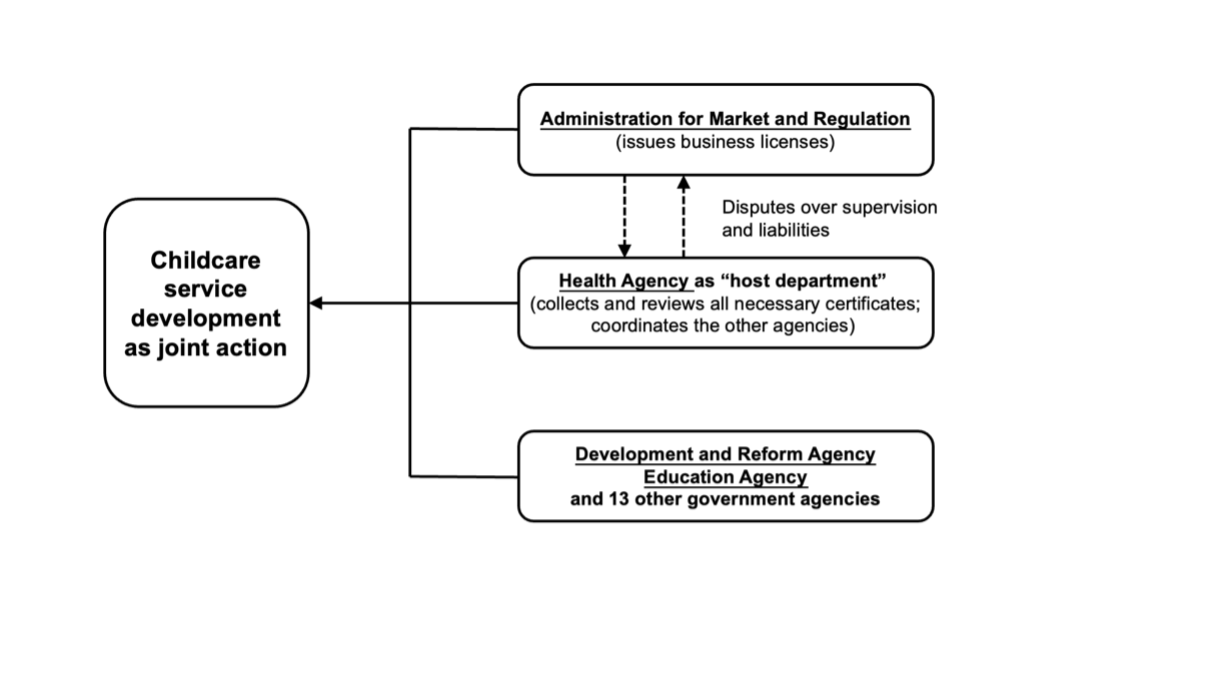
Health bureau officials particularly underscored the blurred division of accountability among government sectors as a major obstacle to their commitment to childcare service expansion. Their most frequent complaints revolved around the supervision of childcare institutions. According to the central government’s policy design,[13] the operation of childcare institutions requires a two-step approval process by local authorities. First, a for-profit childcare institution must obtain a business license from the AMR, whereas a nonprofit institution must secure a registration certificate from the civil affairs bureau. In the second step, the institution must submit its business license or registration certificate, along with other required documentation, such as staff health certificates, and hygiene and fire safety certificates for the facility, to the local health bureau to complete the final qualification for service provision. If all these standards are met, the institution receives formal approval from the government to open its doors to the public.
Figure 1. The role of health agencies in childcare service development
Source: author.
However, despite a relatively clear description of their functions in the joint action, it remains uncertain which department should be to blame in the event of misconduct within a childcare institution. Such an ambiguous liability distribution between government sectors has led to a lack of motivation among health bureau officials to support the development of childcare facilities. For example, all the health bureau officials interviewed explicitly expressed their concerns about the potential for being held accountable in cases of child abuse scandals at for-profit childcare institutions.[14] As one section chief from the health bureau in W District said:
We are particularly worried about accidents in for-profit childcare institutions. By far, nobody can clearly tell which government agency is going to be punished for them. Is it us or the AMR? From our perspectives, officials from the AMR should be held accountable because their issued business license formally recognises an institution’s qualifications for service provision, not to mention the convention that whichever agency issues the certificate should be responsible for supervision. Besides, our function in the whole approval process is merely confined to document collection and thus is utterly irrelevant. (Interview, February 2021)
Health agents further justified their concerns by pointing out that the second approval step was not mandatory, as there were no penalties for childcare institutions that failed to submit the required materials to the local health bureau. In fact, all institutions in W District and L County bypassed the second approval and opened to the public directly after obtaining a business licence. Despite this, local health bureau officials had no authority to shut them down. As a result, they felt it was particularly unfair to be blamed for not engaging in regulation. Even in C County, where local institutions completed the required two-step approval process, the health agents interviewed described the situation as “pure luck that these institutions were cooperative,” while arguing that they played a similarly marginal role in regulation and supervision (interview, August 2022). Nevertheless, given that the central government defines the health agency as the “host department” in childcare service expansion, this status provides legitimacy for other departments, including the AMR, to shift accountability to health agents. As the head of the AMR in C County put it:
The division of liabilities should be in line with the central policy. This is not decided by us but by the central authority. The central document says the health agency is the leading unit in this task, so health agents should take full accountability. By the way, they are in charge of the last step of qualification approval, not us. They have all the materials in their hands, and thus they know best whether an institution is qualified or not. (Interview, August 2022)
Furthermore, local health agents also reported that they lacked the enforcement power to adequately perform duties that clearly fell within their jurisdictions. For example, they have not been granted the authority to impose administrative penalties on childcare institutions that violate hygiene regulations. Instead, health agents may only respond by issuing verbal or written warnings, which are allegedly not binding and therefore hardly help correct the violation. Subsequently, the increase in childcare facilities turns out to carry a higher risk of hygiene scandals as well as a greater political threat to health bureau officials. Their concerns can be seen in the words of a section chief in W District:
We are mainly responsible for implementing hygiene standards and providing relevant instructions. However, it will be difficult for us to enforce the rules if an institution breaches them. We can only urge them to make corrections by sending them warning letters, but we cannot fine them or impose any administrative penalties. We have not been delegated the power to do so. As you see, this will not fix the problem. Anyhow, if something goes wrong in the end, we will be held accountable. This is unreasonable. (Interview, February 2021)
Finally, in addition to the mismatch between liability and power, tasks with higher priority also forced local health bureaus to downplay childcare service development. As noted by the interviewed health agents, childcare service expansion had not been designated as a key performance evaluation item. Instead, they were required to devote their limited time and manpower to implementing the “zero-Covid policy” after the pandemic outbreak, as it was defined by the central leadership as a top political priority. The head of L County’s health bureau even suggested that other government departments take over the responsibility for developing local childcare services:
We have long been shorthanded in managing a large number of medical institutions against the pandemic, not to mention that we also lack experience in supervising institutions such as kindergartens and childcare facilities. I think it is inadequate to let us take charge of [childcare service expansion]. It would be better placed under the education agency. (Interview, October 2021)
To enhance multisectoral coordination in expanding childcare services and to strengthen local policy enforcement, the Chinese central government established the Interministerial joint meeting for optimising birth policies in August 2022, led by a vice premier of the State Council and attended by representatives from 26 functional sectors.[15] The central role of the NHC as the “host department” is once again emphasised in this new structure. The joint meeting’s office, which is responsible for organising sessions and coordinating all participating departments, is set up within the NHC, and the head of the NHC is designated as one of the two deputy conveners. Similar institutional frameworks have been quickly adopted by subnational governments as well. For example, at the time of fieldwork, the prefectural government overseeing C County had established its own joint meeting, chaired by the prefectural vice-governor. However, this has done little to improve policy implementation at the county level, as health bureau officials continued to report significant difficulties in the joint action due to their persistent “separation between function and authority” (zhiquan fenli 職權分離). Consequently, the slow development of local childcare services remains largely unchanged. As the health bureau leader in C County stated:
The prefectural government leaders have already set up this joint meeting, but to be honest, it does not really impact us much. We still have not resolved the “separation between function and authority,” right? It is unfair to hold us accountable if something goes wrong, yet that has not been addressed. Additionally, we do not have real authority to direct other departments. And frankly, childcare service development is not really prioritised that highly. So, we will just let things progress step by step as they are. (Interview, August 2022)
Understanding local policy enforcement: Inadequate institutional incentives
Ran (2013) emphasises the importance of considering institutional incentives when understanding the gap between the Chinese central government’s policies and their implementation outcomes at the local level. Fieldwork in the three county-level regions in Shaanxi reveals an insufficient provision of inclusive childcare services as well as a reluctance among local officials to support the service expansion, despite its importance in addressing China’s population challenges. Although the central authorities expect accelerated service development through the joint action, inappropriate institutional incentives have hindered local health agents from fully committing to the expansion of childcare services. Specifically, the lack of clearly defined accountability between the participating departments has led to interagency collaboration problems in policy implementation, further reinforcing local officials’ blame-avoiding motivations and obstructing effective policy implementation.
Insufficient credit for policy implementation
From a rational choice perspective, Chinese local officials are motivated by the potential for career advancement in their policy implementation. However, in the context of childcare service development, they are more likely to pursue this goal by avoiding potential blame rather than earning credits. This is because, as interview narratives indicate, childcare expansion is only loosely tied to their performance evaluations, offering minimal positive incentives. Chinese government officials typically earn career credits by implementing highly prioritised policies that are characterised by quantified “hard targets,” such as the growth of gross domestic product for economic development (Zhou L. 2016). By contrast, childcare service expansion has been set as a “soft target” that has a minor impact on the careers of local officials, given that its development goals are either nonbinding or completely missing at the local level (interview with health bureau leader, W District, August 2021). This is evident, for example, in the 14th Five-year Plan for Health Care Development published by the prefectural government of Xi’an in 2022.[16] While the plan announces an ambitious goal to establish 150 childcare facilities and increase childcare positions per thousand people from 1.5 in 2020 to 4.8 by 2025, it defines this objective as “desirable” (yuqi xing 預期性) rather than “binding” (yueshu xing 約束性). Moreover, when the Xi’an government released its Plan for Children’s Development (2021–2030) six months later, it included various specified targets and quotas in the performance evaluation system, but childcare coverage was entirely omitted – without any assigned quotas.[17] This is in stark contrast to other public services such as preschool education, where the document stipulates that preschool enrolment rate must be maintained above 93% over the next decade. The limited political significance assigned to childcare service expansion implies that local health agents’ commitment to the task would have minimal influence on their promotion prospects. As a result, they are poorly motivated to support childcare service development, especially given the demands of higher-priority tasks such as enforcing the “zero-Covid policy” and maintaining stability for bereaved single-child families (Yang 2023).
Health agents’ blame-avoiding motivations and strategies
Instead, blame-avoidance has largely driven the behaviour of local health bureau officials in the development of childcare services. Fieldwork for this study reveals two main sources of potential blame they face: first, local health officials risk being held accountable for issues that arguably fall outside their remit; second, they lack the necessary authority to adequately address responsibilities that are clearly within their jurisdiction. Against this backdrop, they naturally choose not to fully commit to childcare service development in order to avoid potential threats to their career advancement.
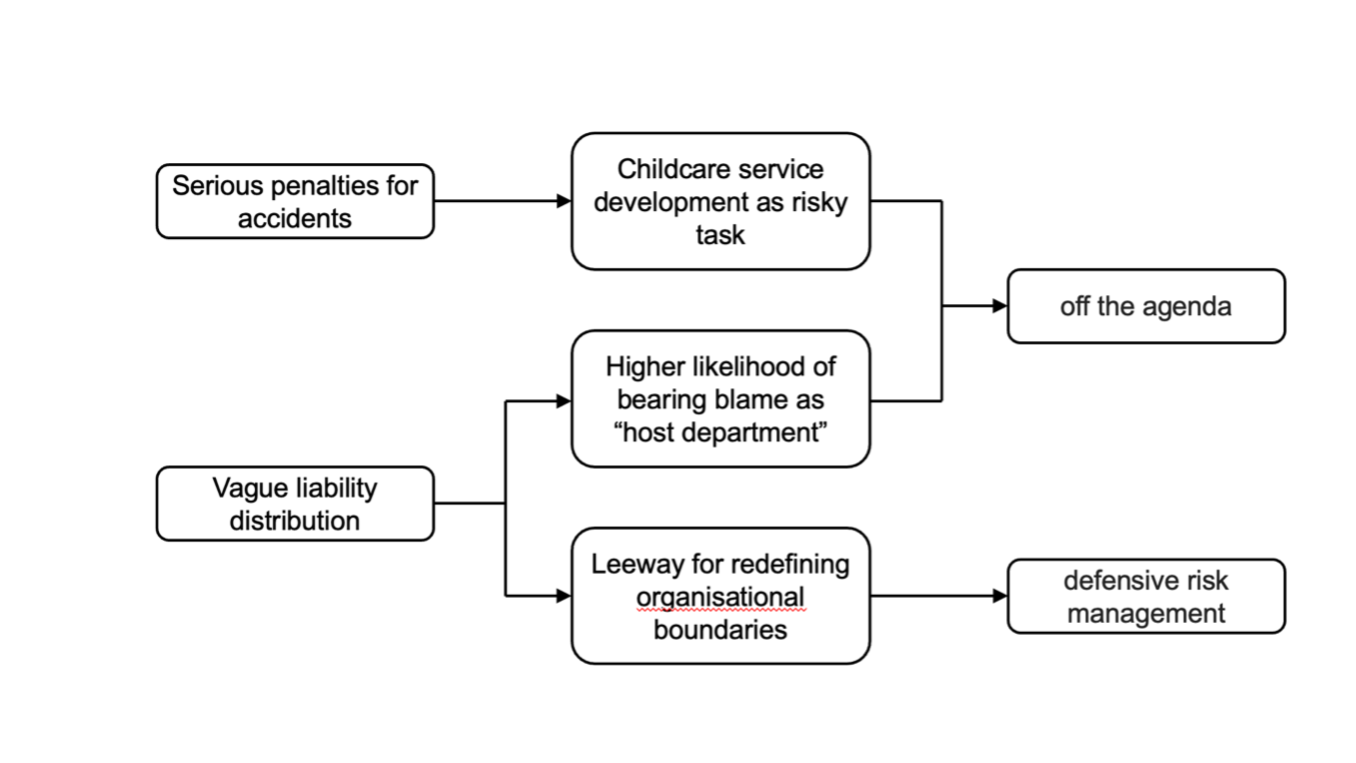
Weaver (1986) argues that most officeholders are blame minimisers while being credit-claiming satisfiers. This is particularly true for Chinese lower-level officials, as they usually face much higher pressure stemming from political penalties (Chen and Hu 2022). Local health officials view childcare services for children under three as inherently high-risk, given the particular vulnerability of this age group. If children’s safety is compromised, the supervising government department risks severe punishment, since safety issues are typically set as a veto target for Chinese local officials, the failure of which will nullify all other achievements and thus strike a severe blow to their political careers (Edin 2003). For this reason, local health agents rationally focus on minimising potential blame in childcare service expansion. Their optimal strategy, therefore, is to sideline the task, since an increase in childcare facilities also raises the likelihood of incidents. This confirms Weaver’s (1986) claim that the best strategy for officeholders to prevent potential political harm is to keep the blame-generating issue off the agenda in the first place. Local health agents are further motivated to do so given the absence of a binding target for childcare service development, which allows for a relatively relaxed pace in expanding these services.
Figure 2. Blame-avoiding motivation and strategies of local health agents
 Source: author.
Particularly, the vague distribution of accountability across departments has significantly enhanced the blame-avoiding motivations among local health agents in childcare service expansion. While the central authorities mandate 17 participating departments to contribute in line with their traditional functions, it leaves their overlapping jurisdictions and undefined liability unaddressed. Since each department operates with considerable discretion within its own domain, none has the authority to unilaterally allocate responsibilities, which has led to ongoing disputes between local health agencies and the AMR. However, the current institutional arrangements have placed local health agents at a clear disadvantage in managing blame from childcare service expansion due to their pivotal role in childcare service development as the “host department” (interview with health bureau leader, W District, August 2021; interview with health bureau leader, C County, August 2022). Local health agents thus face a heightened risk of bearing blame if issues arise. This further incentivises health agents to withdraw from active involvement in joint action as a preventive measure against potential penalties.
In fact, the ambiguous liability allocation also offers local health agents some leeway for blame-shifting within the joint action. In addition to keeping the task off their agenda, these officials adopt “defensive risk management” strategies, as suggested by Hood (2002). This involves redefining their organisational boundaries within the collaboration, often by depicting their function in the joint action as marginal, for example, by arguing that their work is “merely confined to document collection” while stressing the importance of other departments (interview with health bureau leader, W District, February 2021). Through this reframing, health agents attempt to detach from their pivotal role and justify their blame-shifting.
Notably, blame avoidance has arguably gained even greater importance for Chinese local officials over the past decade. Centralisation reforms under Xi Jinping have tightened accountability for all Party members and officials (Guo 2020), making local agents more cautious about policy implementation to mitigate the risk of penalties. Especially given the absence of a fault-tolerant mechanism within the Chinese bureaucracy (Tu and Gong 2022), policy exploration and innovation carry high political risks due to the potential for failure. Thus, while there has been a national trend towards reduced policy innovation and experimentation (Hasmath, Teets, and Lewis 2019), it is unsurprising that local health agents are reluctant to engage in the newly launched childcare service expansion. Instead, they are prompted to opt for a “less effort, fewer mistakes” (shaozuo shaocuo 少做少錯) approach to avoid potential errors under the central authorities’ stringent oversight.
Implications: Interagency collaboration within the Chinese government
The development of childcare services in China offers further insights into the country’s interagency collaboration issues. The central government proposed a joint meeting mechanism to streamline multisectoral coordination in childcare service expansion and thereby improve policy implementation. However, this attempt has not yielded the expected outcomes in terms of accelerating local childcare service expansion. Although joint meetings have been introduced, the development of childcare services lacks the intervention of top local authorities and a high political priority attached to the policy, which have proven effective in overcoming blame-avoiding behaviours among local officials in successful joint actions in other policy areas.
Intervention of top local authority
Zhou Xueguang (2012) suggests that the interagency collaboration problem in China can be understood as a failure of the conventional bureaucratic administration, which necessitates campaign-style governance as a correction. Typically, campaign-style governance is characterised by the establishment of an ad hoc “leading small group” or “command centre” by local authorities. These temporal leading units are usually chaired by the top leader, for example, the local Party secretary, and include the heads of all functional sectors, who are placed under the top leader’s direct command. For this reason, leading small groups and command centres gain a superior position in the administrative hierarchy due to their strong leadership of all departments engaged in joint action.
Empirical investigations into policy implementation in China reveal that the establishment of such superior leading units, coupled with intervention by top local leaders, can effectively ameliorate interagency collaboration problems. For instance, in the case of river sand mining control (Chen and Hu 2022), officials from different government departments initially exploited gaps in accountability to deflect responsibility for regulating mining practices, wary of potential political fallout from quarry owners’ grievances and petitions. However, they quickly ceased this buck-passing and began to cooperate after the county’s Party secretary intervened, assuming ultimate responsibility for the outcomes and establishing a leading small group to oversee joint action. Similarly, Tsai and Liao (2020) found that a command centre headed by the local Party secretary greatly facilitated the implementation of poverty alleviation policies by reducing conflicts of interest between government departments. These cases illustrate that integrating functional sectors into a leading small group or command centre can streamline interdepartmental coordination by lowering communication barriers. Moreover, the intervention of the top local leader not only directs officials’ attention to the policy but also clarifies accountability structures within joint actions, alleviating concerns about unjust blame. Through this, fragmented authorities in the Chinese bureaucracy become sufficiently integrated to enable more effective policy implementation. Thus, superior leading units empowered by top local leaders are argued to be essential for fostering interagency collaboration in the Chinese context (Zhou C. 2019).
In comparison, the joint meeting mechanism, as seen in the example of childcare service development, may only have a marginal impact on improving interagency collaboration. Similar to leading small groups and command centres, joint meetings are also set up to facilitate the implementation of policies involving multiple functional sectors. However, whereas leading small groups and command centres are often chaired by the highest local authority, namely the Party secretary, joint meetings are mostly led by government deputies. In the case of childcare service development, for instance, the joint meeting leaders at the central and local levels are the vice-premier and vice-governors, respectively. This lower ranking somewhat diminishes the task’s importance as perceived by local officials, thereby reducing the political pressure put on them to enforce related policies. Thus, joint meetings are often described as a “less formal coordination platform” rather than a leading unit that overrides all participating departments (Zhou and Jiang 2013).
In particular, the development of childcare services illustrates that clarifying the respective accountability of participating departments may not be a required purpose of establishing joint meetings. When the central government introduced the joint meeting, the health agency’s key role in horizontal coordination was reemphasised, but without granting it a superior position within this new mechanism. Consequently, coordination relies on consultation and consensus among departments of equal standing, rather than on directive orders. Furthermore, because the accountability of the “host department” remains entirely unspecified, local health agencies continue to encounter disputes with other departments over the blurred assignment of liability, as in the past. These factors suggest that joint meetings have not effectively removed institutional barriers to interagency collaboration in childcare service expansion. Therefore, while joint meetings may improve interdepartmental communication, they are likely to make only a limited contribution to integrating fragmented authorities and enhancing interagency cooperation. Without the intervention of top local leaders, joint actions by Chinese government departments remain vulnerable to officials’ blame-avoiding tendencies.
Policy’s political priority
The development of childcare services in China also demonstrates that policies assigned a lower political priority by the central government may face greater challenges in implementation. This is evident when comparing it to the rapid development of preschool education in China over the past decade. Recognising the underdevelopment of preschool services in the country’s vast rural and western regions, the State Council published in 2010 its Three-year Action Plan for Preschool Education (xueqian jiaoyu sannian xingdong jihua 學前教育三年行動計劃) as a solution.[18] Similar to childcare service development, the expansion of preschool education was also designed as a joint action involving multiple functional sectors, such as education, development and reform, and finance departments. However, the Three-year Action Plan was defined as a “crucial policy decision” (zhongda juece 重大決策) by the State Council. Subsequently, the central government allocated substantial financial resources for kindergarten construction and teacher training, and it closely monitored the performance evaluation of local officials. Specifically, it required local governments at all levels, down to the county level, to set concrete targets for improved enrolment rates and kindergarten construction.[19] Additionally, it mandated that rewards and penalties would align with officials’ performance in meeting these targets. Given that quantified targets are often applied to high-priority tasks (Gao 2015), subnational government officials are effectively incentivised to commit to preschool education development. As a result, the preschool enrolment rate in China increased dramatically from 62.3% to 88.1% within a decade, following three rounds of Three-year plans.[20]
In contrast, joint actions lacking a similar political priority – such as childcare service expansion – encounter more substantial resistance in implementation due to limited political incentives and resources. According to central policies,[21] Chinese families are expected to take primary responsibility for childcare, while institutional care serves a supplementary role. Thus, while the central government has repeatedly advocated for expanding childcare services, this should largely be viewed as a symbolic gesture. On the one hand, as previously discussed, the development of childcare services has not been set as a binding performance indicator for local officials; on the other hand, the centrally designed development approach frames official support from local governments as optional rather than mandatory. This approach shifts the responsibility for childcare provision onto families and individuals, allowing the state to better cope with the tension between its limited fiscal resources and underdeveloped public services, as in the case of elderly care (Alpermann and Zhan 2019). However, this also leads local officials to downplay their engagement in the joint action. As a result, institutional childcare provision in China is primarily dependent on private sector investment rather than state funding, resembling the country’s marketisation of eldercare services (Maags 2022). These factors suggest that childcare service expansion holds a relatively low priority on the central government’s policy agenda. Additionally, limited demand for childcare services in rural areas further diminishes the urgency of expanding childcare facilities on a national scale.[22] Consequently, even though the central government has identified interagency collaboration problems within childcare service development, it has not chosen the more effective solution of establishing leading small groups or command centres for the joint action. This has led to significant differences in policy implementation outcomes between childcare service expansion and preschool education development. In the Chinese context, policies with lower political priority may face greater obstacles in local implementation due to insufficient financial resources and a lack of strict political oversight. Without intervention from the top authorities, these joint actions become more susceptible to the blame-avoidance motivations of local officials, who may deprioritise engagement in tasks lacking clear accountability structures.
Conclusion
Given China’s declining birth rates and rapid population ageing, improving the provision of services for children under three years old have gained increased significance. However, this case study highlights that the current provision of childcare services is characterised by a limited number of facilities and high costs, with local health bureau officials reluctant to actively support service expansion. While the government’s limited financial resources undoubtedly play a role in these constraints, this study primarily examines the institutional impacts on policy enforcement. It emphasises the need to consider China’s fragmented authorities and its performance evaluation system to fully understand the slow growth in childcare services. Under current institutional arrangements, local officials receive minimal career advancement incentives for committing to the expansion of childcare services. However, they face higher risks of punishment if any incidents occur within childcare facilities. The ambiguous distribution of liability in joint action further reinforces officials’ tendency towards blame avoidance. Consequently, they tend to marginalise childcare service expansion in their daily work and deliberately downplay their functional roles in the joint action. This case study also offers insights into wider interagency collaboration issues within the Chinese government. It reflects how both a lack of high-level oversight and low political priority can weaken the effectiveness of interagency collaboration, particularly when local officials are already prone to blame-avoiding behaviour.
This study does not claim that childcare service development across China follows the same pattern as observed in the three county-level regions in Shaanxi. On the contrary, it is reasonable to expect uneven implementation of childcare policies among different Chinese localities, as local governments have the discretion to adapt central policies based on their specific regional conditions (Göbel 2011). Comparative studies with empirical analysis are therefore essential to develop a more comprehensive understanding of China’s childcare service expansion. Furthermore, this study calls for a focus on the blame-avoiding tendency of grassroots officials under Xi’s rule. Earning credits for promotion has been emphasised in previous literature as an important motivation for Chinese local officials to actively carry out policies, as in the cases of economic growth (Li and Zhou 2005) and public welfare upgrade (Zuo 2015). Yet, enhanced accountability and tightened central control currently place local officials under greater pressure at work. In this context, blame avoidance and responsibility shirking have reasonably gained increased significance for them. How such a strategy shapes the implementation of other Chinese public policies, and what the responses from upper-level authorities are, also deserve further research attention.
Acknowledgements
This research was supported by the National Social Science Foundation of China under grant number 23&ZD185. The author wishes to thank the reviewers for their valuable comments and suggestions.
Manuscript received on 8 March 2024. Accepted on 7 January 2025.
References
ALPERMANN, Björn, and Shaohua ZHAN. 2019. “Population Planning after the One-child Policy: Shifting Modes of Political Steering in China.” Journal of Contemporary China 28(117): 348-66.
AMBERT, Anne-Marie, Patricia A. ADLER, Peter ADLER, and Daniel F. DETZNER. 1995. “Understanding and Evaluating Qualitative Research.” Journal of Marriage and the Family 57(4): 879-93.
CHEN, Yongjie 陳永傑, and HU Peiyan 胡沛驗. 2022. “激勵失衡, 多權威中心與基層跨部門協作困境: 基於X縣的治砂案例” (Jili shiheng, duo quanwei zhongxin yu jiceng kuabumen xiezuo kunjing: Jiyu X xian de zhisha anli, Imbalanced incentives, multiple authorities, and interdepartmental cooperation dilemma at the grassroots level: Based on the sand control case of X county). Zhongguo xingzheng guanli (中國行政管理) 6: 123-30.
DENG, Yanhua, Kevin J. O’BRIEN, and Jiajian CHEN. 2018. “Enthusiastic Policy Implementation and its Aftermath: The Sudden Expansion and Contraction of China’s Microfinance for Women Programme.” The China Quarterly 234: 506-26.
EDIN, Maria. 2003. “State Capacity and Local Agent Control in China: CCP Cadre Management from a Township Perspective.” The China Quarterly 173: 35-52.
GAO, Jie. 2015. “Political Rationality vs. Technical Rationality in China’s Target-based Performance Measurement System: The Case of Social Stability Maintenance.” Policy and Society 34(1): 37-48.
GARNER, Roberta, and Gregory M. SCOTT. 2013. Doing Qualitative Research: Designs, Methods, and Techniques. Boston: Pearson Education.
GÖBEL, Christian. 2011. “Uneven Policy Implementation in Rural China.” The China Journal 65: 53-76.
GUO, Baogang. 2020. “A Partocracy with Chinese Characteristics: Governance System Reform under Xi Jinping.” Journal of Contemporary China 29(126): 809-23.
HASMATH, Reza, Jessica C. TEETS, and Orion A. LEWIS. 2019. “The Innovative Personality? Policy Making and Experimentation in an Authoritarian Bureaucracy.” Public Administration and Development 39(3): 154-62.
HEBERER, Thomas, and René TRAPPEL. 2013. “Evaluation Processes, Local Cadres’ Behaviour and Local Development Processes.” Journal of Contemporary China 22(84): 1048-66.
HONG, Xiumin, Qianqian LIU, Mingzhu ZHANG, and Hui LI. 2022. “The Accessibility, Quality, and Administration of Childcare Services for Birth to Three Years under China’s Universal Two-child Policy.” Early Education and Development 33(3): 508-22.
HOOD, Christopher. 2002. “The Risk Game and the Blame Game.” Government and Opposition 37(1): 15-37.
——. 2007. “What Happens when Transparency Meets Blame-avoidance?” Public Management Review 9(2): 191-210.
JI, Yingchun, Huiguang WANG, Yue LIU, Ruonan XU, and Zhenzhen ZHENG. 2020. “Young Women’s Fertility Intentions and the Emerging Bilateral Family System under China’s Two-child Family Planning Policy.” The China Review 20(2): 113-42.
KOSTKA, Genia, and Arthur P. J. MOL. 2013. “Implementation and Participation in China’s Local Environmental Politics: Challenges and Innovations.” Local Environmental Politics in China 15(1): 3-16.
LANDRY, Pierre F., Xiaobo LÜ, and Haiyan DUAN. 2018. “Does Performance Matter? Evaluating Political Selection along the Chinese Administrative Ladder.” Comparative Political Studies 51(8): 1074-105.
LEWIS, Jane. 1992. “Gender and the Development of Welfare Regimes.” Journal of European Social Policy 2(3): 159-73.
LI, Hongbin, and Li-An ZHOU. 2005. “Political Turnover and Economic Performance: The Incentive Role of Personnel Control in China.” Journal of Public Economics 89(9-10): 1743-62.
LI, Yunrong. 2017. “The Effects of Formal and Informal Child Care on the Mother’s Labor Supply: Evidence from Urban China.” China Economic Review 44: 227-40.
LIEBERTHAL, Kenneth G. 1992. “Introduction: The ‘Fragmented Authoritarianism’ Model and its Limitations.” In Kenneth G. LIEBERTHAL, and David M. LAMPTON eds.), Bureaucracy, Politics, and Decision Making in Post-Mao China. Berkeley: University of California Press. 1-30.
LIU, Cong, Mohd Nazri Abdul RAHMAN, Xinyi WANG, and Yanan MAO. 2022. “Parental Demands for Childcare Services of Infants and Toddlers in China under the Three-child Policy.” Child Care in Practice. https://doi.org/10.1080/13575279.2022.2109596
LIU, Jing, Liangshu QI, and Yanyan XIONG. 2022. “Non-parental Childcare Services and Time Allocation of Mothers with Young Children in China.” Feminist Economics 28(2): 303-28.
MAAGS, Christina. 2022. “Marketization of Eldercare in Urban China: Processes, Effects, and Implications.” Modern China 48(6): 1140-78.
O’BRIEN, Kevin J., and Lianjiang LI. 1999. “Selective Policy Implementation in Rural China.” Comparative Politics 31(2): 167-86.
OSTROM, Elinor. 1986. “An Agenda for the Study of Institutions.” Public Choice 48(1): 3-25.
PLANTENGA, Janneke, Chantal REMERY, and Frances CAMILLERI-CASSAR. 2009. The Provision of Childcare Services: A Comparative Review of 30 European Countries. Luxembourg: Office for Official Publications of the European Communities.
QIAN, Jiwei. 2016. “Tobacco Control in China: Institutions, Bureaucratic Noncompliance and Policy Ineffectiveness.” In Kjeld Erik Brødsgaard, Chinese Politics as Fragmented Authoritarianism. London: Routledge.
RAN, Ran. 2013. “Perverse Incentive Structure and Policy Implementation Gap in China’s Local Environmental Politics.” Journal of Environmental Policy & Planning 15(1): 17-39.
——. 2017. “Understanding Blame Politics in China’s Decentralized System of Environmental Governance: Actors, Strategies and Context.” The China Quarterly 231: 634-61.
RINDFUSS, Ronald R., David K. Guilkey, S. Philip MORGAN, and Øystein KRavdal. 2010. “Child‐care Availability and Fertility in Norway.” Population and Development Review 36(4): 725-48.
SHEPSLE, Kenneth A. 1989. “Studying Institutions: Some Lessons from the Rational Choice Approach.” Journal of Theoretical Politics 1(2): 131-47.
SILVERSTEIN, Merril, and Zhen CONG. 2013. “Grandparenting in Rural China.” Generations 37(1): 46-52.
TSAI, Wen-Hsuan, and Xingmiu LIAO. 2020. “Mobilizing Cadre Incentives in Policy Implementation: Poverty Alleviation in a Chinese County.” China Information 34(1): 45-67.
TU, Wenyan, and Ting GONG. 2022. “Bureaucratic Shirking in China: Is Sanction-based Accountability a Cure?” The China Quarterly 249: 259-74.
WALLACE, Claire. 2020. “Between State, Market and Family: Changing Childcare Policies in Urban China and the Implications for Working Mothers.” International Sociology 35(3): 336-52.
WEAVER, R. Kent. 1986. “The Politics of Blame Avoidance.” Journal of Public Policy 6(4): 371-98.
YANG, Weiyue. 2023. “Bereaved Single-child Parents as the Focus of Family Planning Officials: State Support, Social Stability, and the Unresolved Consequences of China’s One-child Policy.” Journal of Contemporary China 32(143): 765-78.
YIN, Robert K. 1981. Case Study Research: Design and Methods. Thousand Oaks: Sage Publications.
ZANG, Xiaowei. 2017. “How Cohesive is the Chinese Bureaucracy? A Case Study of Street‐level Bureaucrats in China.” Public Administration and Development 37(3): 217-26.
ZHANG, Ning Jackie, Man GUO, and Xiaoying ZHENG. 2012. “China: Awakening Giant Developing Solutions to Population Aging.” The Gerontologist 52(5): 589-96.
ZHOU, Chenhong 周晨虹. 2019. “‘聯合懲戒’: 違法建設的跨部門協同治理: 以J市為例” (“Lianhe chengjie”: Weifa jianshe de kuabumen xietong zhili: Yi J shi weili, Joint punishment: Cross-departmental collaborative governance of illegal construction: Taking J City as an example). Zhongguo xingzheng guanli (中國行政管理) 11: 6.
ZHOU, Li-An. 2016. “The Administrative Subcontract: Significance, Relevance and Implications for Intergovernmental Relations in China.” Chinese Journal of Sociology 2(1): 34-74.
ZHOU, Xueguang 周雪光. 2010. “The Institutional Logic of Collusion among Local Governments in China.” Modern China 36(1): 47-78.
——. 2012. “運動型治理機制: 中國國家治理的製度邏輯再思考” (Yundong xing zhili jizhi: Zhongguo guojia zhili de zhidu luoji zai sikao, Campaign-style mobilization: Further reflections on the institutional logic of governance in China). Kaifang shidai (開放時代) 9: 105-25.
ZHOU, Xueguang, Hong LIAN, Leonard ORTOLANO, and Yinyu YE. 2013. “A Behavioural Model of ‘Muddling Through’ in the Chinese Bureaucracy: The Case of Environmental Protection.” The China Journal 70(1): 120-47.
ZHOU, Zhiren 周志忍, and JIANG Minjuan 蔣敏娟. 2013. “中國政府跨部門協同機制探析: 一個敘事與診斷框架” (Zhongguo zhengfu kuabumen xietong jizhi tanxi: Yige xushi yu zhenduan kuangjia, An analysis of the interdepartmental collaboration mechanism of the Chinese government: A narrative and diagnostic framework). Gonggong xingzheng pinglun (公共行政評論) 1: 91-117.
ZUO, Cai Vera. 2015. “Promoting City Leaders: The Structure of Political Incentives in China.” The China Quarterly 224: 955-84.
[1] State Council 國務院, “國務院新聞辦就2022年國民經濟運作舉行發表會” (Guowuyuan xinwenban jiu 2022 nian guomin jingji yunzuo juxing fabiaohui, The State Council Information Office holds a press conference on the operation of the national economy in 2022), 17 January 2023, http://www.gov.cn/xinwen/2023-01/17/content_5737627.htm (accessed on 17 August 2023).
[2] State Council 國務院 “關於促進3歲以下嬰幼兒照顧服務發展的指導意見” (Guanyu cujin 3 sui yixia yingyouer zhaogu fuwu fazhan de zhidao yijian, Guiding Opinions on Promoting Care Services for Children under 3 Years Old), 17 April 2019, https://www.gov.cn/gongbao/content/2019/content_5392295.htm (accessed on 30 October 2024).
[3] National Development and Reform Commission 國家發展和改革委員會and National Health Commission 國家衛生健康委員會, “支持社會力量發展普惠托育服務專案行動實施方案(試行)” (Zhichi shehui liliang fazhan puhui tuoyu fuwu zhuan’an xingdong shishi fang’an (shixing), Trial Implementation Plan for the Special Action to Support the Development of Inclusive Childcare Services by Social Forces), 20 October 2019, https://www.gov.cn/xinwen/2019-10/24/5444458/files/80e4dd10f1824a68afebd4b8998a288e.pdf (accessed on 17 August 2023); National Health Commission 國家衛生健康委員會, “托育機構登記及備案辦法(試行)” (Tuoyu jigou dengji ji bei’an banfa (shixing), Trial Regulation of Registration and Filing of Childcare Institutions), 6 January 2020, http://www.nhc.gov.cn/rkjcyjtfzs/s7785/201912/ce48c18836bd4565b1975d6644cf587e.shtml (accessed on 17 August 2023).
[4] State Council 國務院, “中華人民共和國國民經濟社會發展第十四個五年計畫和2035年遠景目標綱要” (Zhonghua renmin gongheguo guomin jingji shehui fazhan dishisige wunian jihua he 2035 nian yuanjing mubiao gangyao, The 14th Five-year Plan for National Economic and Social Development of the People’s Republic of China and the Outline of Long-range Goals for 2035), 13 March 2021, https://www.gov.cn/xinwen/2021-03/13/content_5592681.htm (accessed on 30 October 2024).
[5] State Council 國務院, “關於進一步完善和落實積極生育支持措施的指導意見” (Guanyu jinyibu wanshan he luoshi jiji shengyu zhichi cuoshi de zhidao yijian, Guiding Opinion on Further Improving and Implementing Active Fertility Support Measures), 25 July 2022, https://www.gov.cn/zhengce/zhengceku/2022-08/16/content_5705882.htm (accessed on 30 October 2024).
[6] State Council 國務院, “優化生育政策工作部際聯席會議制度” (Youhua shengyu zhengce gongzuo buji lianxi huiyi zhidu, Interministerial Joint Meeting System of the State Council on Optimising Childbirth Policy Work), 28 July 2022, https://www.gov.cn/zhengce/content/2022-08/19/content_5706022.htm (accessed on 30 October 2024).
[7] The performance evaluation system for Chinese officials is a hierarchical, target-based mechanism designed to align local governance with central policy priorities. Officials undergo regular assessments, with the results directly influencing their prospects for promotion or demotion.
[8] Common forms of blame include disqualification from promotion, demotion, or dismissal. In certain cases, officials may also face Party disciplinary penalties or criminal prosecution.
[9] In this paper, the term “health agency” is used as a general reference to the vertically structured health authorities within the Chinese government. However, the official designation of this health agency varies across administrative levels. For example, at the central and provincial levels, it is referred to as the “health commission,” whereas at the county level, it is called the “health bureau.” Therefore, for precision reasons, this paper uses the term “health bureau” when referring to local officials and government agencies.
[10] The disposable annual income per capita of C County and L County in 2022 was RMB 24,979 and RMB 28,851.5 respectively.
[11] Notably, the poor service affordability may not be limited to the research sites of this study. A journalistic investigation revealed that in 2023, monthly childcare fees in Beijing ranged from RMB 6,800 to 9,000, with some reaching as high as RMB 16,000. This could pose a significant economic burden on local families, given that the monthly disposable income per capita in Beijing was approximately 6,800 RMB. See “我一个月工資不夠支付托育費” (Wo yi ge yue gongzi bugou zhifu tuoyufei, My monthly salary is insufficient to cover childcare expenses), Fazhi ribao (法制日報), 25 July 2023, http://epaper.legaldaily.com.cn/fzrb/content/20230725/Page04ZB.htm (accessed on 26 July 2023).
[12] National Development and Reform Commission 國家發展和改革委員會and National Health Commission 國家衛生健康委員會, “支持社會力量(…)” (Zhichi shehui Liliang (…), Trial Implementation Plan (…)), op. cit.
[13] National Health Commission 國家衛生健康委員會, “托育機構(…)” (Tuoyu jigou (…), Trial Regulation (…)), op. cit.
[14] Specifically, the 2017 Red Yellow Blue childcare abuse incident sparked widespread public distrust in Chinese society and placed immense pressure on the government to strengthen regulation of the childcare sector. The concerns of health bureau officials reflect the growing public demand for stronger oversight to ensure child safety, as well as their fear of public opinion and the potential impact of administrative penalties on their careers.
[15] State Council 國務院, “優化生育政策(…)” (Youhua shengyu zhengce (…), Interministerial Joint Meeting (…)), op. cit.
[16] Prefectural Government of Xi’an 西安市人民政府, “西安市‘十四五’衛生健康事業發展規劃 (Xi’an shi “shisi wu” weisheng jiankang shiye fazhan guihua, 14th Five-year Plan for Health Care Development of Xi’an Prefecture), 18 March 2022, https://xawjw.xa.gov.cn/web_files/xawjw/file/2022/06/20/202206201115059314815.pdf (accessed on 17 August 2023).
[17] Prefectural Government of Xi’an 西安市人民政府, “西安市兒童發展規劃(2021–2030年)” (Xi’anshi ertong fazhan guihua (2021–2030 nian)), Plan for Children’s Development of Xi’an Prefecture 2021–2030), 30 August 2022, https://www.xa.gov.cn/ztzl/ztzl/lwlbzt/zcwj/6311d1f6f8fd1c4c2115a57d.html (accessed on 17 August 2023).
[18] State Council 國務院, “關於當前發展學前教育的若干意見” (Guanyu dangqian fazhan xueqian jiaoyu de ruogan yijian, Several Opinions of the State Council on the Current Development of Preschool Education), 24 November 2010, https://www.gov.cn/zwgk/2010-11/24/content_1752377.htm (accessed on 30 October 2024).
[19] For example, the government of Shaanxi Province planned to build 406, 290, and 304 public township kindergartens annually from 2011 to the end of 2013. That counted 1,000 kindergartens in total for the first Three-year plan.
[20] State Council 國務院, “全國學前三年毛入園率達88.1%, 學前教育實現基本普及” (Quanguo xueqian sannian mao ruyuan lü da 88.1%, xueqian jiaoyu shixian jiben puji, National preschool enrolment rate of children aged from three to six reached 88.1%, preschool education has basically become available universally), 28 April 2022, http://www.gov.cn/xinwen/2022-04/28/content_5687602.htm (accessed on 17 August 2023).
[21] See, for example, State Council 國務院, “關於促進(…)” (Guanyu cujin (…), Guiding Opinions on (…)), op. cit.
[22] In recent years, the NHC has conducted nationwide research to investigate the service needs of both rural and urban residents. The author’s fieldwork in different localities also finds that the vast majority of rural residents tend to take care of children themselves rather than resort to any facilities. Frequently mentioned reasons include limited income, high service costs, and the availability of grandparental care within their families. This is in stark contrast to their urban counterparts, who are reported to have a higher demand for childcare services (see for example Ji et al. 2020).