 >
>

Numéros de China Perspectives
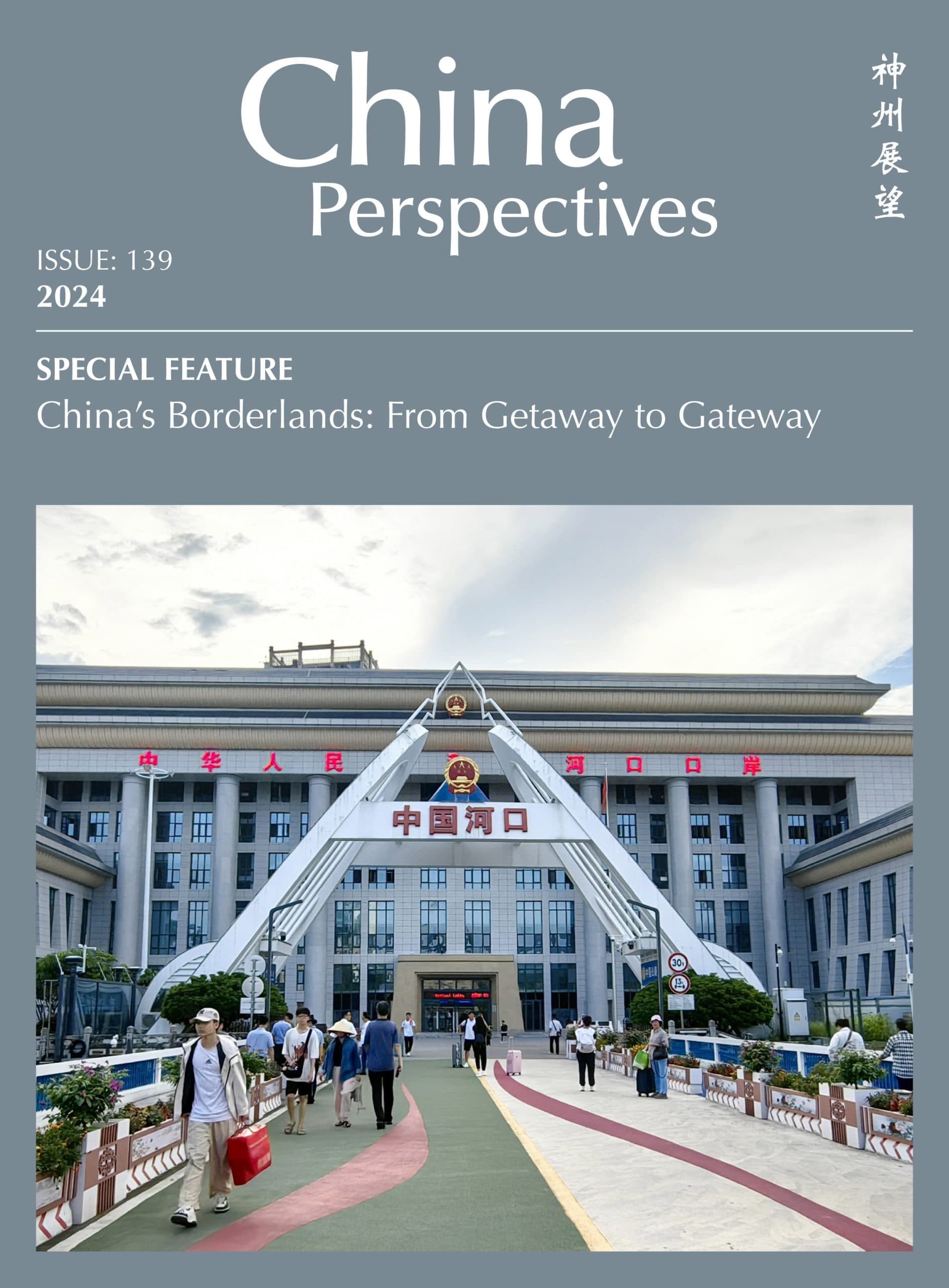
China Perspectives 139
Dossier
Les régions frontalières chinoises : de point de sortie à point d’entrée
- Dossier spécial
- Article
- Critiques de livres
Editorial - Repenser le cadre des études chinoises : les régions frontalières chinoises, entre marges et intersections globales
Consommation multi-sites dans la région de la Grande baie : interaction entre les politiques nationales, les comportements des consommateurs et la transformation des équipements urbains
Xiangyi Li est professeur associé à l’École de sociologie et d’anthropologie de l’Université Sun Yat-sen, n° 135 Xingang Xi Road, district de Haizhu, Canton, Chine (lixy26@mail.sysu.edu.cn).
Zeyu Gong est étudiant en master de sociologie au département de sociologie de l’Université de Pékin, n° 5 Yiheyuan Road, district de Haidian, Pékin, Chine (2401211880@stu.pku.edu.cn).
RÉSUMÉ : Cet article examine le phénomène de la consommation multi-sites ainsi que l’interaction entre les politiques nationales, les comportements des consommateurs et l’évolution du paysage urbain au sein de la région de la Grande baie Guangdong-Hong Kong-Macao à travers les concepts analytiques de consommation multi-sites et d’équipements des pôles urbains. En s’appuyant sur des entretiens qualitatifs et des données secondaires, cette recherche montre que les efforts déployés au niveau macro tels que l’intégration économique régionale, l’amélioration des infrastructures et la rationalisation des contrôles aux frontières renforcent les mobilités transfrontalières, ce qui facilite la consommation multi-sites. En outre, celle-ci est intensifiée par la recherche de rentabilité, de rareté et d’originalité de la part des résidents de la région de la Grande baie. Nous observons enfin que les interactions entre les stratégies au niveau macro et l’agrégation des comportements individuels des consommateurs au niveau micro produisent des transformations au niveau méso telles que la redistribution et la spécialisation des équipements des pôles urbains dans la région de la Grande baie. Ces résultats éclairent les changements récents et en cours des hiérarchies urbaines dans la région de la Grande baie ainsi que les implications plus larges de la consommation multi-sites pour l’intégration économique régionale.
MOTS-CLÉS : région de la Grande baie, consommation multi-sites, équipements des pôles urbains, mobilité transfrontalière, intégration régionale.
La création d’infrastructures frontalières : évolution et interaction avec la migration transfrontalière à la frontière sino-birmane
Tianlong You est professeur associé et directeur du département de sociologie de l’Université du Yunnan, n° 2 Cuihu North Road, district de Wuhua, Kunming, Chine (tyou0410@gmail.com).
Haijing Zhang est doctorant au département de sociologie de l’Université de Shanghai, n° 333 Nanchen Road, district de Baoshan, Shanghai, Chine (zhjcarbon@shu.edu.cn).
RÉSUMÉ : Cet article explore l’évolution des infrastructures frontalières le long de la frontière entre la Chine et le Myanmar, en se concentrant sur la ville de Ruili. Il retrace le développement historique de ces infrastructures, d’abord utilisées pour garantir une présence militaire minimale, puis tournées vers le marché, et, dernièrement, de plus en plus liées à des questions de sécurité. L’étude met en lumière l’interaction entre des logiques institutionnelles changeantes, la croissance économique, la sécurité nationale et la stratégie géopolitique, ainsi que la résilience continue des migrations transfrontalières. Malgré le renforcement des restrictions et des mesures de sécurité, les flux migratoires – motivés par des liens économiques, familiaux et culturels – persistent. En s’appuyant sur un vaste travail de terrain, des entretiens approfondis avec diverses parties prenantes et des données provenant d’archives, cet article examine comment les infrastructures ont façonné et ont été façonnées par les politiques publiques, les acteurs locaux et même les acteurs non étatiques. La recherche démontre que l’infrastructure frontalière n’est pas une entité statique mais un système dynamique influencé par une gouvernance à plusieurs niveaux et les intérêts concurrents de diverses parties prenantes. L’article soutient qu’en dépit de la transformation de la région frontalière impulsée par le virage sécuritaire du gouvernement en matière de gestion des infrastructures, la logique de marché et les réseaux de migration continuent d’exercer une influence significative. L’étude offre un aperçu de la future trajectoire de la gouvernance des frontières à une époque de tensions géopolitiques croissantes et examine comment les effets cumulatifs de ces infrastructures impactent la situation sociale, économique et politique dans les zones frontalières sino-birmanes.
MOTS CLÉS : infrastructure frontalière, logique institutionnelle, causalité cumulative, frontière Chine-Myanmar, Belt and Road Initiative.
Négocier la restructuration territoriale dans les marges frontalières chinoises : les points de vue des habitants de Nujiang dans le Yunnan
David Juilien est chargé d’enseignement en géographie à l’Université d’Angers, 10 bd. Victor Beaussier, 49000 Angers, France (djuilien@protonmail.com).
RÉSUMÉ : Cet article étudie les dynamiques territoriales produites par la relation entre les acteurs gouvernementaux et les résidents d’une marge frontalière du sud-ouest de la Chine. Alors que les politiques publiques cherchent à intégrer davantage les zones frontalières reculées au territoire national par le biais de projets de développement de modernisation ou de réduction de la pauvreté, les habitants sont confrontés à une restructuration territoriale rapide induisant des risques de conflits sociaux. L’article se penche sur les relations de pouvoir mises au jour par les politiques d’intégration afin d’explorer la construction des marges frontalières en tant que territoires. Il s’appuie sur une approche géopolitique centrée sur l’étude de protestations locales. À partir de l’étude de cas de la vallée de la rivière Nujiang (Yunnan), cette recherche montre que la capacité des résidents à protester peut conduire à l’adaptation de la construction territoriale menée par le gouvernement.
MOTS CLÉS : région frontalière, Chine, géopolitique, marges, protestations, résidents, restructuration territoriale, aménagement du territoire, territoire, Yunnan.
Le Dao du bonheur en Chine contemporaine : significations et affects pluriels de « Xingfu »
Gil Hizi est chargé de recherche au département d’anthropologie sociale et culturelle de l’Université Johann Wolfgang Goethe de Francfort-sur-le-Main, Campus Westend, salle IG 0552, Norbert-Wollheim-Platz 1, 60629 Francfort-sur-le-Main, Allemagne (hizi@em.uni-frankfurt.de).
RÉSUMÉ : Au cours des dernières décennies, la notion de bonheur est passée d’une simple forme de bien-être à un concept chargé de valeurs convoqué à la fois dans les campagnes politiques, les plans de développement, la publicité et la psychologie transnationale. En Chine, le terme xingfu a suivi cette tendance en s’articulant comme l’équivalent d’un « bonheur » profondément individualisé, mais comportant néanmoins des éléments liés aux conditions de vie et à la protection sociale. En s’appuyant sur des travaux de terrain menés dans des ateliers de psychologie et sur divers textes académiques et politiques, cet article conceptualise les attributs sémiotiques et communicatifs du xingfu dans la société chinoise contemporaine. Je définis le xingfu comme un dao contemporain, à savoir une priorité consensuelle qui évoque une humanité supposée universelle, pouvant servir à justifier des agendas politiques, tout en ouvrant la voie à des interactions et des imaginaires dépassant les priorités établies.
MOTS CLÉS : bonheur, xingfu, Chine, psychologie positive, Xi Jinping, Sara Ahmed, développement personnel.
Différences de privilèges, divergences de trajectoires : pertes de revenus des élites administratives et de marché en Chine pendant le Covid-19
Qingyi Zhao est doctorant au département de sociologie, École des sciences sociales de l’Université Tsinghua, salle 123, bâtiment Mingzhai, district de Haidian, Pékin 100084, Chine (lanyiqingyi1999@qq.com).
Haijun Shi (auteur correspondant) est doctorant au département de sociologie, École des sciences sociales de l’Université Tsinghua, bâtiment Xiong Zhixing, district de Haidian, Pékin 100084, Chine (shihaijun6324@gmail.com).
RÉSUMÉ : Le Covid-19 a certes touché l’ensemble de la population chinoise, mais pas de manière égale. Les études précédentes se sont principalement concentrées sur les pertes de revenus les plus graves subies par les groupes socio-économiques défavorisés pendant la pandémie, ignorant les disparités de revenus au sein des élites. En utilisant les données de l’Enquête sociale générale sur la Chine de 2021, cet article révèle que les élites administratives ont subi relativement moins de pertes de revenus pendant la pandémie, contrairement aux élites de marché, dont les pertes sont même supérieures à celles des groupes moins bien lotis. La disparité entre ces deux groupes d’élites pour ce qui est de la résilience au risque de revenu, représentée par le type de rémunération, constitue un mécanisme important de leur divergence en matière de perte de revenus. De plus, les pertes de revenus des élites administratives étaient plus limitées dans les régions où le système de redistribution était plus fort, tandis que celles des élites de marché étaient plus marquées dans les zones où les fermetures de marchés étaient plus strictes. Cette étude améliore notre compréhension de l’hétérogénéité des élites chinoises et de la tension entre le système de marché et le système de redistribution en Chine contemporaine.
MOTS-CLÉS : Covid-19, Chine, élites administratives, élites de marché, perte de revenus.
Les nouveaux exploitants agricoles et les politiques locales de transfert des terres en Chine
Ling Meng est chercheuse postdoctorale au China and Global Development Network, département des sciences sociales appliquées de l’Université polytechnique de Hong Kong, Hung Hom, Hong Kong (lingmeng@polyu.edu.hk).
Karita Kan (autrice correspondante) est professeure associée au département de sciences sociales appliquées de l’Université polytechnique de Hong Kong, Hung Hom, Hong Kong (karita.kan@polyu.edu.hk).
RÉSUMÉ : Plusieurs études ont montré comment, dans le cadre du programme politique de modernisation de l’agriculture, le gouvernement chinois a encouragé le transfert à grande échelle de terres rurales des petits exploitants vers de nouveaux opérateurs agricoles (NOA) tels que les entreprises agroalimentaires, les fermes familiales et les coopératives professionnelles. Malgré cette tendance nationale, l’ampleur et la dynamique des transferts de terres varient fortement en fonction des localités, un sujet largement sous-exploré par la littérature. En utilisant une méthodologie de cas multiples, cet article compare trois cas de transfert de terres dans un canton rural de la province du Shandong pour examiner comment et pourquoi les modèles de transfert et de gestion des terres diffèrent. En nous appuyant sur un travail de terrain et des entretiens approfondis, nous montrons comment les trajectoires de transfert de terres et la transition agraire sont façonnées par différents contextes et stratégies de NAO individuels, qui à leur tour structurent les arrangements fonciers et les conditions de travail et créent des dynamiques spécifiques d’interactions entre l’État, les NOA et les communautés locales. Nos résultats soulignent la nécessité d’aller au-delà des statistiques nationales pour explorer les politiques locales de transfert des terres ainsi que le rôle des NOA dans l’élaboration des diverses trajectoires de transition agraire.
MOTS CLÉS : transfert de terres, nouveaux opérateurs agricoles (NOA), politiques locales, transition agraire, modernisation agricole, province du Shandong, Chine rurale.
Définir le niveau de sinité dans les projets d’infrastructures chinois en Afrique : le cas du Ghana
Paola Pasquali est chercheuse indépendante associée à l’UMR 8504 Géographie-Cités, 5, cours des Humanités, 93322 Aubervilliers, France, et au centre d’études asiatiques de l’Université du Ghana, département de science politique, Ebenezer Laing Rd, Accra, Ghana (paola.pasquali@parisgeo.cnrs.fr).
Costanza Franceschini est chercheuse postdoctorale à l’Institut d’anthropologie culturelle et de sociologie du développement de l’Université de Leyde, faculté des sciences sociales et comportementales, bâtiment Pieter de la Court, Wassenaarseweg 52, 2333 AK, Leyde, Pays-Bas (c.franceschini@fsw.leidenuniv.nl).
RÉSUMÉ : Cet article examine et conceptualise la notion de sinité en relation avec les projets d’infrastructure au Ghana et en Afrique de manière générale. Menée à partir de travaux de terrain au Ghana et de la littérature secondaire, notre étude comporte deux volets. Nous entreprenons d’une part une analyse basée sur la nationalité et l’origine de l’ensemble des éléments constitutifs des projets d’infrastructures chinois au Ghana : propriété, financement, conception, conseil, normes de construction, matériaux et équipements, pratiques de travail. Nous étudions par ailleurs les aspects qui rendent la perception de ces projets comme étant spécifiquement chinois. Notre analyse identifie différents degrés de sinité dans les projets d’infrastructures du Ghana, ce que nous décrivons comme une « sinité diluée ». Nous constatons que même les projets perçus comme « entièrement chinois » sont investis par d’autres acteurs internationaux et locaux. Notre étude révèle également comment les représentations de tels projets d’infrastructure comme étant « entièrement chinois » sont utilisées par différents acteurs pour promouvoir leurs agendas – exprimant parfois des points de vue opposés sur la présence chinoise en Afrique.
MOTS-CLÉS : sinité, Ghana, Afrique, Chine, entreprises chinoises, projets d’infrastructure.
KUZUOĞLU, Uluğ. 2024. Codes of Modernity: Chinese Scripts in the Global Information Age. New York: Columbia University Press.
LO, Ming-Cheng M., Yu-Yueh TSAI, and Michael Shiyung LIU (eds.). 2024. Taiwan’s COVID-19 Experience: Governance, Governmentality, and the Global Pandemic. London: Routledge.
FU, Po-Shek. 2023. Hong Kong Media and Asia’s Cold War. Oxford: Oxford University Press.
Sabrina Y. Tao earned her PhD degree in East Asian Languages and Literatures at the University of Oregon, 20 Friendly Hall, Eugene, OR 97403-1248, United States (ytao@uoregon.edu).
The study of cultural Cold War in British colonial Hong Kong has gained increasing scholarly attention over the past decade, with historians and film, literary, and cultural scholars examining the circulation of cultural products, the history of cultural agencies, as well as the role of cultural workers in the transnational cultural makings. Po-Shek Fu’s book, Hong Kong Media and Asia’s Cold War, is an exemplary work within this trend, marked by meticulous archival research that draws from diverse contemporary sources. These sources range from newspapers and film studio releases to memoirs and previously unexplored materials from Hong Kong and the US. It offers a detailed analysis of Hong Kong media institutions and the influence of global Cold War dynamics on their cultural production.
As a sequel to Fu’s earlier renowned work, Between Shanghai and Hong Kong: The Politics of Chinese Cinemas (2003), in which he introduced the “Shanghai-Hong Kong nexus in the cultural and entertainment business of the two cities from 1935 to 1950” (p. xiii), Hong Kong Media and Asia’s Cold War extends the timeframe from the 1950s to the 1980s, with a particular focus on Hong Kong’s media landscape during the 1950s and 1960s. It explores Hong Kong’s strategic position in Asia’s Cold War, highlighting its role as a “crossroads where the global, regional, and local [influences] intersected” (p. x, xiii). To maintain colonial stability, the British colonial administration policed ideological advocacy to prevent potential political unrest, especially through film censorship aimed at preserving colonial authority by depoliticising and deescalating the Cold War rivalry between the Communists, the Nationalists, and the Americans – all vying for influence in East Asia. Fu argues that these powers exploited the colony’s political neutrality, or “Cold War gray zone,” to conduct propaganda and psychological warfare targeting Chinese diasporas in Southeast Asia and beyond (p. x-xi).
The book is structured with a preface, four main chapters, and an epilogue. Chapter One examines the cinematic warfare conducted by the three camps. It details the rise of leftist film companies and the evolution of pro-Communist cinematic propaganda in response to shifting colonial geopolitics in the 1950s. The Nationalist government’s propaganda efforts and the initial reluctance of local pro-Taiwan studios to engage in anti-Communist messaging until the emergence of the Motion Picture & General Investment Company Ltd. (MP & GI) film studio are also discussed. The role of the US is highlighted by its boosting of pro-“Free World” and anti-Communist media through key news agencies such as the United States Information Services (USIS), the American Consulate, and the CIA-funded Asia Foundation (TAF), which operated from Hong Kong to engage with Overseas Chinese.
Chapter Two delves into the realm of print media and discusses the role of the student magazine China Student Weekly – published in Hong Kong between 1952 and 1974 – in the battle between the People’s Republic of China and the US for ideological dominance in Sinophone communities. After 1949, the US covertly supported prominent liberal intellectuals and politicians who migrated from Mainland China to Hong Kong, seeking to sway young people embracing “Third-Force” ideologies. This movement advocates for a middle path between the Nationalists and Communists in building a united, “democratic China” (p. 43). To challenge the Chinese Communist Party’s media influence, the US established TAF in Hong Kong and secretly financed various émigré groups with cultural, educational, and media agendas. Notably, China Student Weekly served as a discreet platform for “Cold War enlightenment” by promoting democracy, respect for rights, and Chinese cultural nationalism, while deliberately avoiding local politics and student activism.
Chapters Three and Four shift attention from print media to cinema, as Fu claims that motion pictures were more potent in propaganda than other visual media for reaching Overseas Chinese (p. 87). Chapter Three details the unsuccessful attempts of the production company Asia Pictures, funded by the US and established by Chang Kuo-sin 張國興, to counter Communist influence. Chang aimed to use American capital to build a Hollywood-style film enterprise that would elevate Chinese cinema in exile to new standards of production and professionalism (p. 93). However, the costly and time-consuming production methods of Asia Pictures, coupled with Chang’s ambitious professionalisation of émigré cinema, led to suspicions and concerns from the US.
As Fu points out, Chang’s lack of filmmaking experience, business acumen, and influence within the émigré film industry hindered his efforts to establish a transnational Chinese film enterprise in Hong Kong (p. 107-8). In contrast, Run Run Shaw’s “border-straddling tactic of flexibility” and apolitical stance allowed him to navigate the complex divides of pro-Taiwan, pro-Beijing, and freedom-Communism (p. 110). Chapter Four examines how Run Run Shaw leveraged Asia’s Cold War media culture environment to build the Shaw Brothers’ film business empire, particularly his strategy of “deemphasizing the political” in film production to maximise profits (ibid.). The company’s films highlighted a romanticised, depoliticised “Chinese flavour” (Zhongguowei 中國味) celebrating a pan-Chinese cultural nationalism and a shared idealised past that attracted ethnic Chinese audiences for nostalgic comfort (ibid.).
The epilogue addresses the political unrest in Hong Kong starting in the late 1960s, the quest for “prosperity and stability” by both the colonial administration and the local population following the 1967 riots, the rise of local consciousness, and the ongoing student radicalisation and social activism throughout the 1970s and 1980s. In summary, this insightful book commendably reveals that all political parties had to neutralise their tone in colonial cultural production due to the colonial government’s balanced censorship. Building on existing scholarship on the cultural Cold War in Hong Kong, especially British colonial censorship and film companies, the book is distinguished by its masterful handling of historical materials, such as the nuanced exploration of TAF and Union Press’s internal dynamics and the strategic engagement of Third-Force intellectuals with the US, as detailed in Chapter Two. However, while Fu primarily covers pro-Nationalist and US-backed productions, he devotes less attention to pro-Communist works and their circulation – an area ripe for future research. As a historian, Fu’s expertise lies in the dynamics and agency of media corporations and individuals, rather than an in-depth dissection of primary film texts. Nonetheless, this book stands as a significant contribution to the study of the cultural Cold War in Hong Kong and East Asia. It is highly recommended for scholars and students researching the cultural Cold War, film, and media history of these regions.
Reference
FU, Po-Shek. 2003. Between Shanghai and Hong Kong: The Politics of Chinese Cinemas. Stanford: Stanford University Press.
CHIN, Angelina Y. 2023. Unsettling Exiles: Chinese Migrants in Hong Kong and the Southern Periphery during the Cold War. New York: Columbia University Press.
Yuqing Qiu is a PhD candidate at the Sciences Po Centre for History, 27 rue Saint-Guillaume, 75337 Paris Cedex, France (yuqing.qiu@sciencespo.fr).
Postwar Hong Kong was not merely a British colony, but was subject to influences exerted by regional politics and the Cold War. Situated at the threshold of the People’s Republic of China (PRC), Hong Kong became a transit station for those arriving from Mainland China under the political and economic uncertainties of the Cold War. Starting from 1949, the refugee crisis in Hong Kong prompted both the Hong Kong government and the PRC to establish immigration policies. Amid the backdrop of the Cold War, Chinese exiles who sought refuge in Hong Kong were deeply imbued with political significance.
Angelina Y. Chin’s captivating book, Unsettling Exiles, sets out to revisit this period through the analysis of escapees, migrants, squatters and deportees in Hong Kong from the 1950s to the 1970s – a population that later contributed to defining the Hong Kong identity. The book comes on the heels of exciting new scholarship exploring the interconnectedness of the Greater China region and putting Hong Kong in the centre of the discussion (Zhou 2021; Ho 2023). Drawing on large collections of untapped archival materials and oral sources, Unsettling Exiles is a first of its kind to explore broadly and in depth the story of different types of people in transit in Hong Kong, from political critics to intellectuals, victims of abduction, as well as people who were not welcome elsewhere. While some of them regarded Hong Kong as a temporary refuge, others saw it as a neutral ground for political alternatives.
Unsettling Exiles puts the concept of “Southern Periphery” to the forefront and uses it as a framework to examine Chinese exiles in Hong Kong. Geographically, the Southern Periphery roughly encompassed Hong Kong, Macao, and Taiwan, which shared the trait of existing outside the Central People’s Government’s (CPG) jurisdictional authority but were overshadowed by the CPG’s discourse of being part of China. For Chin, the gap between the Centre and the Periphery was not in terms of physical displacement, but rather related to the uncertainty that characterised the processes. People in transit constantly remained in a state of precarity after their initial displacement and continued to be marginalised by the PRC and the Republic of China (ROC). By using this framework, Chin criticises the romanticisation of Chinese emigrants’ relationship with the Chinese homeland, and therefore allows for studying the way in which Chinese national politics extended beyond its administrative border. Adopting this framework also allows for an examination of the often complex, intimate, and sometimes contradictory experiences of exile in the Southern Periphery. It challenges the dichotomous view of exiles as mere freedom fighters or “escaping to the Free World” (p. 133) by highlighting the networks and continuous uncertainties that shaped their trajectories. This framework also implies a continued state of precariousness, as Chin connects the exiles of the 1950s and 1970s to present-day exiles facing current uncertainties in the Southern Periphery.
The book is constructed as follows. Chapter One sets the background of the story and reveals definitional difficulties and international politicisation of refugees in Hong Kong. International debates equally indicate the precariousness of Chinese in exile in Hong Kong without refugee status. The vulnerability was first and foremost visible in the hierarchical classification of refugees and the deliberate selection of refugees with political value. Their uncertain status was further compounded by the unstable immigration policies of the Hong Kong government, the Cold War rivalry between the Chinese Communist Party (CCP) and the Kuomintang (KMT), and the United States’ intervention in the refugee crisis. Closely following Chapter One, the story unfolds with three distinct tempos, each carefully capturing different categories of people in exile over time. Evolving both thematically and chronologically, Unsettling Exiles investigates the development of the “Third Force” (a “political movement located in Hong Kong during the Cold War” – p. 18) among intellectual refugees to Hong Kong (Chapter Two), escapees by sea during the spillover of the Cultural Revolution in Hong Kong (Chapter Three), the “undesirable residents” of different regimes in the Southern Periphery (Chapter Four), and escapees during the 1962 refugee exodus (Chapter Five). The last chapter focuses on the interactions and confrontations between histories and memories in state and popular discourses. It scrutinises Hong Kong identity and diasporic consciousness in a contemporary context with the expansion of “Greater China” (Chapter Six).
Through the thorough examination of different types of refugees, Chin refutes the stereotyping of Chinese exiles in postwar Hong Kong. Stories of “freedom swimmers” during the Cultural Revolution were reported through pro-KMT publications that later formed the core anti-communist discourse in the Southern Periphery (p. 100). However, not all who arrived in Hong Kong escaped for political reasons. Some “did not particularly want to join the KMT at that time” (p. 187), and “Taiwan was not a familiar place where all had the courage to go” (p. 189). Examples in the book also reflect how some regarded their sojourn in Hong Kong as a temporary phase to escape economic shortages or political unrest before returning to the Mainland.
By retracing the politicisation of Chinese refugees in Hong Kong, the author further reiterates her initial argument against the popular perception of Hong Kong as a neutral place during the Cold War and provides a more nuanced narrative on the history of Chinese exiles in Hong Kong. Polemics on Chinese refugees in Hong Kong further indicate how different political visions circulated within Hong Kong society. While some political refugees at Rennie’s Mill envisaged the return of the KMT to the Mainland, certain intellectuals regarded as the “Third Force” discussed reuniting China with a constitutional government outside of the CCP and KMT (p. 58), and others remained politically indifferent (p. 188).
Unsettling Exiles vividly portrays the intimate experience of Chinese exiles in the Southern Periphery. In particular, Chapter Five retraces the journey of three men who fled to Hong Kong in 1962 but continued to be entangled in Chinese politics. Their personal accounts resonate with Meredith Oyen’s remark about “the politization of what is, essentially, a local problem” being “at the heart of refugee movements and refugee policy” (2014: 190). Their testimonies offer a graphic example of trajectories of exile in the Southern Periphery. Hong Kong therefore became a dwelling place for those whose sense of home and belonging was uncertain, an uncertainty penned by previous scholarship as a “citizenship contested,” where “identity was fluid, and the boundaries of political mobilization were blurred” (Zhou 2019: 4).
Ultimately, Unsettling Exiles paves the way for further dialogues and exploration concerning the Southern Periphery. For example, what was the particular role of Macao? How differently did the CCP’s national politics impact Macao, Hong Kong, and Taiwan? The field can also be greatly enriched by studies that compare displacements and refugee crises in different Asian countries during the same period. This book is a truly valuable read for scholars interested in Hong Kong studies and Chinese peripheries during the Cold War. It can also be a good fit for a university curriculum on contemporary China.
References
HO, Denise Y. 2023. “Oysterman and Refugee: Hong Kong and China Between the Tides, 1949-1997.” The American Historical Review 128(2): 561-87.
OYEN, Meredith. 2014. “‘Thunder without Rain’: ARCI, the Far East Refugee Program, and the U.S. Response to Hong Kong Refugees.” Journal of Cold War Studies 16(4): 189-221.
ZHOU, Taomo. 2019. Migration in the Time of Revolution: China, Indonesia, and the Cold War. Ithaca: Cornell University Press.
——. 2021. “Leveraging Liminality: The Border Town of Bao’an (Shenzhen) and the Origins of China’s Reform and Opening.” Asian Studies 80(2): 337-61.
BECKERSHOFF, André. 2023. Social Forces in the Re-making of Cross-strait Relations: Hegemony and Social Movements in Taiwan. London: Routledge.
CHEUNG, Sidney C. H. 2022. Hong Kong Foodways. Hong Kong: Hong Kong University Press.
Aël Théry is Researcher at the French National Research Institute for Agriculture, Food, and Environment (INRAE), and member of the Centre Maurice Halbwachs, École Normale Supérieure, 48 boulevard Jourdan, 75014 Paris, France (ael.thery@inrae.fr).
In this short book published by Hong Kong University Press, Sidney C. H. Cheung, an anthropologist at the Chinese University of Hong Kong, summarises his research’s main findings related to Hong Kong’s food culture in the last century. Over the last decade, Cheung has indeed focused on food in Hong Kong society as a lens to explore the shifts in local production dynamics, consumption patterns, and social identity that have marked the territory over the past century. His research therefore examines the factors that have shaped Hong Kong’s foodways and influenced not only the eating habits of Hong Kong people, but also the sociopolitical development of the city as global consumerism advanced. The book is divided into five thematic sections that follow classic themes in food studies, here adapted to the context of Hong Kong: locality, culinary migration and identities, the emergence of new cuisines, nostalgia and the sense of authenticity, and finally, intangible heritage. Given the quantity of examples provided in the book, I will just focus here on a few of them that I found particularly revealing.
As demonstrated in Chapter One, which focuses on local food production, Hong Kong’s location near the Pearl River estuary and the deep sea has made it a prime location for fishing and importing goods from both North and South. One example developed by the author concerns the oyster industry, which has a long history in the Pearl River Delta. In the nineteenth century, oysters were farmed in Lau Fau Shan (New Territories), but matured in the bay in Shenzhen, making them less salty. However, the introduction of strict border controls in the 1950s and concerns about agricultural contamination in the 1960s led to a change in practice. By the 1980s, floating barges had replaced traditional oyster farms, and mudflat cultivation techniques were introduced along the coast. Collaboration with government agencies also led to the installation of purification systems to control bacteria in the fresh oysters from Lau Fau Shan. This case showcases the still ongoing dilemma between food safety and heritage conservation, as also pointed out by Cheung in his 2019 article.
Chapter Two, titled “The Arrival of Migrants’ Food in the Post-war Era,” explores the contributions of migrant chefs. Cheung highlights the postwar rise of Hakka restaurants, which served simple yet popular dishes that defined the period. Hakka cuisine gained prominence in the 1950s, and was appreciated for its hearty, meat-based meals that sustained workers in Hong Kong’s expanding industrial sector (Cheung 2001). By the 1980s, however, these restaurants began to decline as shifting social values and tastes sparked a culinary transformation. In contrast, Shanghainese migrants who settled in North Point during the 1950s brought with them the culinary traditions of Jiangsu and Zhejiang Provinces, which were later promoted by organisations such as the Ning Po Residents Association (established in the late 1960s) and the Shanghai Fraternity Association (founded in 1977) in an effort to preserve regional food traditions, rooted in a nostalgic connection to their places of origin (Cheung 2020).
Chapter Three deals with the rise of nouvelle Cantonese and international cuisines. In the 1950s and 1960s, yumcha 飲茶 was primarily “a venue for men to socialize” (p. 43), but gradually became a gathering for the entire family, hence reinforcing the institution of the family. Yumcha also reflected a structural change in Hong Kong society, as the working class experienced upward mobility and moved into the middle class. Moreover, Hong Kong’s food scene has long incorporated Western and Japanese influences. Western restaurants have been operating since the 1930s and have evolved through various trends, including British and other influences. But the 1970s saw the emergence of nouvelle Cantonese cuisine that catered to Hong Kong’s increasingly cosmopolitan middle class. This cuisine, which featured both exotic ingredients and Western-style dining environments, remained popular into the 1980s. Finally, the rise of international cuisines in the 1980s reflected the emphasis on “freedom of choice,” with the introduction of American fast food, French haute cuisine, Italian pasta, Japanese sushi, etc.
In Chapter Four, “In Search of Nostalgic Foods,” Cheung explores “low everyday dishes” that have deep personal or cultural significance, such as basin food (puhn choi 盆菜). Puhn choi, a festive dish originally prepared for ancestor worship and weddings, was popular among the Punti, the indigenous people of the New Territories. Before the 1997 handover, puhn choi was widely promoted for its “taste of tradition”: its original function as a focus for lineage gathering in the New Territories then turned into a symbol of Hong Kong heritage that anyone could share. Cheung also draws the reader’s attention to another “low” cuisine: the private kitchens. Emerging in the early 1990s, private kitchens were unlicensed, exclusive eating places popular among the middle class, which offered “authentic” home-cooked food that represented (and still continues to represent) a contemporary conflation of everyday, home-cooked food with a commercialised rendition and image of the home (Cheung 2005).
In the last chapter, “The Awareness of Food Heritage,” Cheung highlights the challenges of preserving food heritage, such as the decline of freshwater fish farming, which has suffered from a lack of government support. Species such as grey mullet are no longer produced locally, and local authorities are pushing for the introduction of exotic species for monoculture to replace the traditional practice of polyculture. All these elements raise important questions about heritage conservation (as detailed in Cheung 2019).
As this book aims to bring together and introduce the results of twenty years of research on various aspects of food in Hong Kong, the reader may end up frustrated with access to only the research results without the ethnographic materials that would give more substance to the author’s arguments. In addition, the author occasionally blends together different time periods without clearly delimiting them, making it sometimes difficult for a non-Hong Kong specialist to follow the historical trajectory of foodways in Hong Kong. However, this monograph still provides the food researcher with a great basis for further discussion.
References
CHEUNG, Sidney C. H. 2001. “Hakka Restaurants: A Study of the Consumption of Food in Post-war Hong Kong Society.” In David Y. H. WU, and Chee Beng TAN (eds.), Changing Chinese Foodways in Asia. Hong Kong: The Chinese University of Hong Kong Press. 81-95.
——. 2005. “Consuming ‘Low’ Cuisine after Hong Kong’s Handover: Village Banquets and Private Kitchen.” Asia Studies Review 29(3): 259-73.
——. 2019. “Floating Mountain in Pearl River: A Study of Oyster Cultivation and Food Heritage in Hong Kong.” Asian Education and Development Studies 8(4): 433-42.
——. 2020. “Reflections on the Historical Construction of Huaiyang Cuisine: A Study on the Social Development of Shanghai Foodways in Hong Kong.” Global Food History 6(2): 128-42.